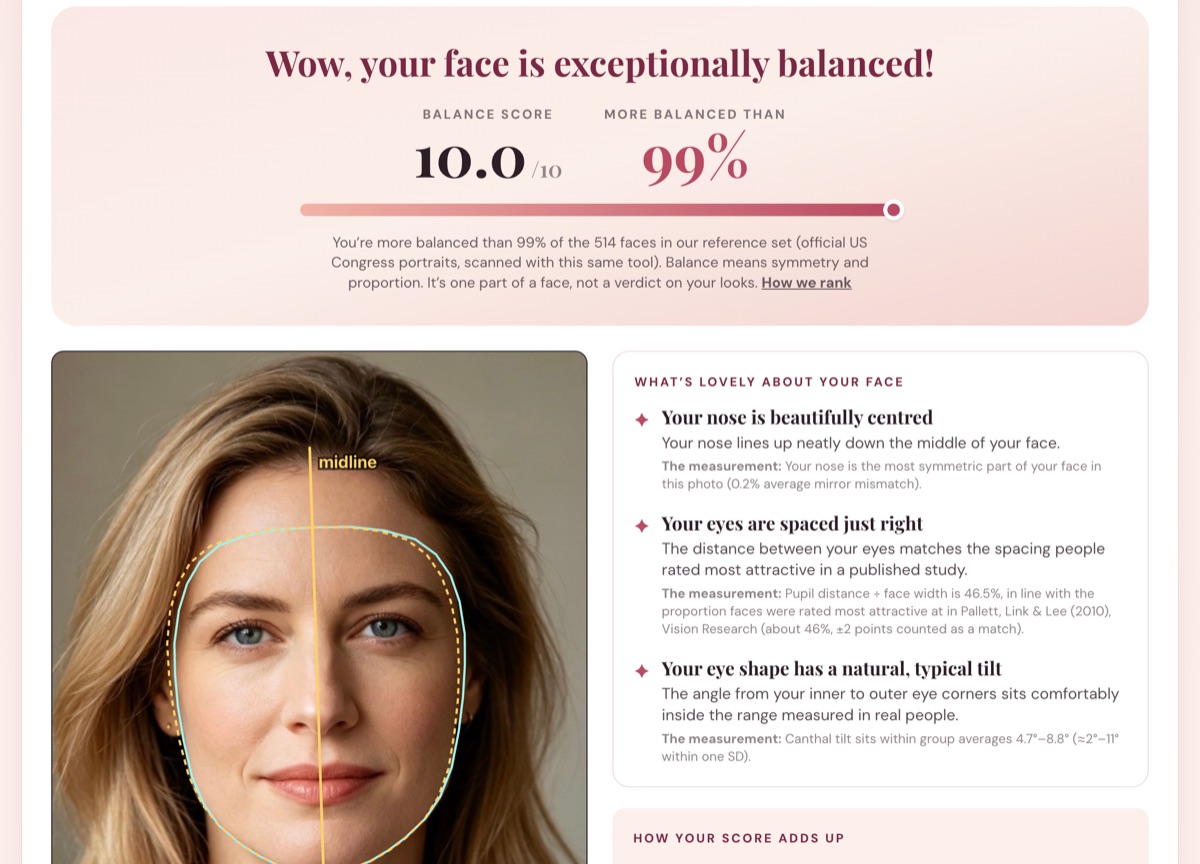
An attractiveness test should tell you what it measured, how sure it is, and what you can do with the result. Most don't. The top results for this search are app-store listings that need an install and an account first, and a video that can only score someone else's face. FaceCheckup does the opposite: your browser measures your photo, and every line it measured is drawn on your face so you can check it yourself.
The test is free, unlimited and needs no sign-up, and your photo never leaves your device. Results open with your three strongest measurements, then a few things you can do this week (haircut, brows, glasses, beard, makeup, photo technique), each labelled with where the advice comes from. No “ugly”, no tier ranking, no surgery talk.
How the attractiveness test works, step by step
Everything below happens in your browser tab, in this order. The first scan takes a few seconds while the model loads.
- Find the face. Google's open-source MediaPipe Face Landmarker places 478 points in 3D: 468 across the face and 10 on the irises, which locate your pupils. A second small model finds your hairline, which the face mesh doesn't reach.
- Check the photo. The quality check looks at head turn (a warning above 8°, a retake above 15°), chin angle, head tilt, resolution (at least 60 pixels between the pupils), close-up framing, a smile or open mouth, closed eyes, and dark or uneven light. A photo that fails a hard limit (head turned past 15°, chin tipped past 18°, eyes closed, a very dark or very low-resolution photo) gets “retake”, not a score; smaller problems are flagged as warnings.
- Correct the pose. A slightly turned head makes one half of the face look wider, which reads as asymmetry. The scanner uses the head-pose estimate to rotate the 3D landmarks back to a straight-on view before measuring anything.
- Measure. It takes more than 20 measurements, including canthal tilt per eye, eye spacing, pupil distance against face width, eyes-to-mouth against face length, facial thirds, fWHR, midface ratio, jaw and forehead width against cheekbone width, cheekbone height and overall asymmetry.
- Measure again, three more times. The photo is re-framed three times (slightly cropped and shifted) and measured again. The spread between the four results is the ± range shown next to every number, so you can see how much each one moves.
- Score and explain. The Balance Score combines symmetry and two published proportions (explained below). Your face shape, top three strengths and a short style plan come next. Every measurement is a layer you can switch on: Outline, Symmetry, Thirds, Fifths, Eye tilt, Brow map, Widths, Jaw, Ratios, and the landmark points.
What pose correction and the ± range did to one real photo
Here's why the extra steps matter, using one of our own test selfies from October 2026. The head was turned about 10° and the person was smiling, and the quality check flagged both. We kept the photo on purpose, because it's the kind most people actually upload.
Before pose correction, the scanner measured 4.70% asymmetry, as a share of face width. After rotating the landmarks back to straight-on, it measured 1.06%. Most of the apparent asymmetry was the head turn, not the face. We then mirrored the same photo and ran it again: 3.63% before correction, 1.51% after. The left and right half-widths went from a 72% match before correction to a 95% match after.
| Measurement | Before pose correction | After pose correction |
|---|---|---|
| Asymmetry, original photo | 4.70% of face width | 1.06% of face width |
| Asymmetry, mirrored copy | 3.63% of face width | 1.51% of face width |
| Left/right half-width match | 72% | 95% |
| Canthal tilt across 4 framings | 7.01°, 7.81°, 7.31°, 7.46° | Reported as about 7.4° ± 0.4° |
| Asymmetry across 4 framings (uncorrected) | 4.70%, 4.49%, 4.61%, 4.63% | Spread shown as the ± range |
The Balance Score in plain English
The Balance Score runs from 0 to 10. It starts at 10 and loses points in two places only: symmetry (up to 6 points) and proportions (up to 4 points). The full formula, with every constant, is on the How it works page.
Symmetry. The scanner mirrors 220 pairs of landmarks across a midline through your nose and chin, and averages how far each point lands from its partner, as a percentage of face width. The first 0.8% is free, because no real face is perfectly symmetric and the landmarks carry a little noise of their own. After that, every further 0.6% costs one point, up to 6. On our test photo above, the corrected 1.06% costs under half a point. The uncorrected 4.70% would have cost all six.
Proportions. Only two ratios count, because they are the two that Pallett, Link and Lee (2010) tested against how people rated faces: the distance between the pupils at about 46% of face width, and the eyes-to-mouth distance at about 36% of face length. Within 2 percentage points of either value costs nothing. Beyond that, each further 2 points costs one point, up to 2 per ratio. If your hairline isn't visible, face length can't be measured, so that ratio is scored as neutral rather than guessed.
Everything else, including thirds, fifths, fWHR, midface ratio and jaw width, is shown as a number with no judgement. Published norms for those were measured with calipers or differently placed landmarks, so comparing them with a photo would mislead you. Canthal tilt is shown with context (published group averages run from about 4.7° to 8.8°) but isn't scored.
What the science says about attractiveness, and what it doesn't
People's ratings of faces agree more than you might expect, but much less than a single score suggests. Both are true, and a fair test has to respect both.
Agreement is real at the group level. A meta-analysis by Langlois and colleagues (2000) found that the average of many raters is highly reliable: about r = .90 within a culture, .88 across ethnic groups and .94 across cultures. That describes a crowd's average, not whether two people agree. Hönekopp (2006) found that private taste is about as powerful as shared taste, so roughly half of what one person finds attractive is their own preference.
Symmetry matters, modestly. Rhodes (2006) concluded from a review and meta-analyses that symmetry, averageness and sex-typical features are all found attractive, in male and female faces and across cultures. The meta-analytic link between symmetry and attractiveness is about r = 0.25, as summarised by Jones and Jaeger (2019). In their own study of natural female faces, shape symmetry added little once other factors were counted. That's why symmetry carries most of our score's weight but the score still can't be read as a verdict.
Averageness is attractive. Langlois and Roggman (1990) found that composite faces, made by blending many photos, were judged more attractive than almost all the individual faces they were made from. That's why we compare only with published averages, never with a supposed ideal.
Why we don't score the golden ratio (or the rule of fifths)
Many face-rating sites still grade you against the golden ratio, 1.618. We don't, because the evidence keeps saying it doesn't describe attractive faces. Kiekens and colleagues (2008) tested 19 supposed golden proportions: only 4 related to attractiveness ratings, together explaining 16% of the variance. Holland (2008) found the famous Marquardt “phi mask” best fits masculinized white fashion models, not faces in general.
The newer studies agree. In Hong Kong Chinese faces, 42 of 77 measurements in the attractive female faces differed significantly from the supposed ideal (Zwahlen et al., 2022). In Miss Universe and Miss Universe Thailand winners, 12 of 16 facial golden ratios differed significantly from phi (Burusapat and Lekdaeng, 2019). A 2024 review by Naini concluded there is no convincing evidence linking the golden ratio to facial beauty.
The classical canons fare no better. The “one eye-width between the eyes” rule held for between 0% of a southern Chinese sample and about a third of North American white participants, depending on the study (Jayaratne et al., 2012; Farkas et al., as reported by Al-Sebaei, 2015). Equal facial thirds were found in 0% of that southern Chinese sample. A raw-data analysis of 27 studies found that no ethnic or gender group consistently matched the ideals of either the canons or phi (Khoshab et al., 2022).
So the Thirds and Fifths layers show your own proportions without marking you down. The golden ratio face page explains what a phi grid can't tell you, and measures the two research-tested ratios instead.
Why other attractiveness tests give “random” results
If three tests gave you three different numbers, they were mostly measuring the photo, the camera and their own scale, not your face.
The scales are inflated. Goshtasbi, Hakimi and Wong (2024) ran 40 frontal face images through five AI rating websites, including PrettyScale and attractivenesstest.com, and compared them with 24 human raters. The sites ranked the faces in a similar order to the humans (r = 0.84), but scored them higher: an average of 6.9 ± 0.9 against the humans' 5.0 ± 1.8. In 30 of 40 images (75%), the AI score was significantly higher. A test that tells everyone they're a 7 is a pleasant number, not information.
The camera distance changes the face. Ward and colleagues (2018) modelled a selfie taken about 12 inches (30 cm) away and found the nose base appears roughly 30% wider relative to the face than from 5 feet (1.5 m). Pressler and colleagues (2022) measured nasal length 6.4% longer in 12-inch selfies than in clinical photos. Distance changes judgements too: Bryan, Perona and Adolphs (2012) found the same faces were rated less trustworthy, competent and attractive when photographed from 45 cm than from 135 cm.
Pose and expression change the geometry. As our own test photo showed, a 10° head turn more than quadrupled the measured asymmetry. A smile widens the mouth, lifts the cheeks and narrows the eyes.
Every landmark model has error. Google's model card for the face mesh we use reports average landmark error of about 2.1% to 3.9% of the distance between the eyes, depending on the mode and face region. Human annotators placing the same points by hand differed by 2.56%. That is why every number here carries a ± range.
| What changed | Effect found | Source |
|---|---|---|
| Phone held about 30 cm from the face | Nose base appears roughly 30% wider relative to face width than at 1.5 m (modelled) | Ward et al. 2018 |
| 12-inch selfie vs clinical photo | Nasal length 6.4% longer (4.3% at 18 inches) | Pressler et al. 2022, 30 volunteers |
| 45 cm vs 135 cm portrait | Close faces rated less trustworthy, competent and attractive | Bryan, Perona & Adolphs 2012 |
How to take a photo that measures you fairly
Five minutes of setup does more for your result than anything else. Each step is labelled with where it comes from.
- Put the phone down. Prop it at eye level about 1 to 1.5 metres away and use the timer, instead of holding it at arm's length. Close-range photos make central features like the nose look bigger relative to face width (research-supported: Ward et al., 2018).
- Use the rear camera's 2x or 3x lens and step back, rather than the wide front camera close up. Distance, not the lens itself, keeps your proportions natural (photographer convention).
- Face a window. Soft daylight from the front, with no hard shadow across the cheeks or jaw, lets the scanner find the edges of your face (photographer convention). Avoid a single ceiling light, which throws shadows under the eyes and chin.
- Look straight into the camera with a neutral face, mouth closed and head level. Tilting your chin up or down changes how masculine, feminine and attractive the same face is judged, so keep it level for measuring (research-supported).
- Take your glasses off and pull your hair back from your forehead and jaw. Frames hide your eyes and brows, and hair hides the outline the face-shape comparison needs (optician and stylist convention).
- Add a second or third photo with “+ Add a photo to average”. Averaging photos usually narrows the ± range.
Your face shape, and what to do with it
The scan also finds your face shape: oval, round, square, oblong, heart, diamond or triangle. These are stylist and optician conventions, not anatomy, so the detector compares the same things they do. That means forehead, cheekbone and jaw width, face length against width, and how angular the jaw is. An oval face, for example, is usually described as about one and a half times as long as it is wide, widest at the cheekbones, with a softly rounded jaw.
You get the top two shapes with percentages, because many faces sit between two. A 55% / 40% split isn't an error. It means advice for either shape will work, and you can pick whichever you like better. The face shape detector shows the widths it compared, so you can see why it chose what it did.
Things you can do this week
Your result ends with up to eight practical tips picked for your measurements, never a verdict on your worth. Every rule behind them has at least two published sources and an honest label: stylist, optician, makeup-artist or photographer convention, or research-supported. Examples:
- Round face, haircut: keep length at or below the jaw, such as a lob or long layers, rather than a cut that ends at the cheeks. Length below the jaw makes a round face read longer (stylist convention).
- Oblong face, glasses: choose frames with deeper lenses, such as taller squares or rounds, to break up the face's length (optician convention).
- If you feel your forehead is tall (an optional tip you choose, because no published range lets a photo decide it): try side-swept or curtain bangs, or bring some hair forward onto the forehead (stylist convention).
- Brows, any face: map them from three points. Start in line with the side of the nose, peak above the outer edge of the iris, and end on a line from the nostril past the outer eye corner. Don't over-tweeze the gap between them (makeup-artist convention).
- Beard: set the neckline about two finger-widths above the Adam's apple, not at the jawbone, which keeps the shadow that outlines the jaw (stylist convention).
- Profile photos: have someone else take the picture from more than about a metre away instead of a close selfie. The same faces photographed from 45 cm were rated less attractive than from 135 cm (research-supported).
Free test or Full Face Report: what you get
The free test is the whole scan, not a teaser: no scan limit, no blurred results, no “unlock your score” and no trial that turns into a weekly charge, which is a recurring complaint in face-rating app reviews.
The Full Face Report is a one-time $12.99 payment, not a subscription. It averages 3 to 5 photos, ranks your photos for a profile picture, and gives your complete style plan and every measurement in one printable table. It runs on your device like the free scan, and the report page shows exactly what it contains before you buy. There are no refunds for change of mind. If the report fails to load, is missing anything promised, or you were charged twice, we fix it or refund you in full.
| Free test | Full Face Report ($12.99 once) | |
|---|---|---|
| Scans | Unlimited, no sign-up | Unlimited free scans continue |
| Photos | One at a time; add more to average | 3–5 photos averaged, quality check per photo |
| Balance Score | Score with ± range | Score with range across every frame of every photo |
| Measurements | All shown on screen | One table with each range, published typical range and source |
| Face shape | Top two shapes | Shape probabilities from every photo |
| Style plan | Up to 8 tips for this week | Every rule that applies to your face, with sources |
| Best photo | Not included | Your photos ranked for a profile picture |
| Share card | Yes, face hidden unless you add it | Yes, plus a printable report you can save as PDF |
Your photo stays on your device
Face geometry is sensitive, so we built the test so we never receive it. The model runs inside your browser tab. No photo, landmark or measurement is sent to our servers or anyone else's, and nothing is kept after you close the tab. Before your first scan you tick a consent box. The free scan stores only that tick, in your browser's session storage, which is deleted when you close the tab. If you buy the report, a purchase token is also kept in your browser so the report stays unlocked.
The share card is made on your device too, and includes your photo only if you choose to add it. The test is for adults scanning their own photos, so please don't use it to rate or embarrass anyone else. The privacy policy has the full details.
Who built FaceCheckup
FaceCheckup is built and edited by Sukie, the site's founder. She made it because none of the face tests she tried explained their numbers or said what to do with them. She isn't a doctor or a licensed stylist, and the site doesn't pretend otherwise. That's why every number on the site comes from a named, published source, and every styling tip is labelled as the convention it is. The full method is on the How it works page, and every study cited here is listed below.
Questions people ask
- How attractive am I?
- No photo test can answer that honestly, including this one. Roughly half of any one person's judgement is private taste (Hönekopp, 2006), and skin, expression, hair and the camera all change ratings. What this test can tell you is how symmetric your face measures, how close two research-tested proportions sit to published values, your face shape, your strongest measurements, and what styling suits you.
- Is this attractiveness test accurate?
- The measurements are as accurate as the photo allows, and the ± range shows how much each one moves when the same photo is re-framed. A straight-on, neutral photo from a metre or more away gives the most reliable result. The score is accurate about what it measures, symmetry and two ratios, but it isn't a measure of attractiveness.
- Is it really free? Is there a limit on scans?
- Yes: free, unlimited and no sign-up, with no locked score and no trial that rolls into a subscription. The optional Full Face Report is a one-time $12.99 payment, and the free test stays the same whether or not you buy it.
- Do you upload or store my photo?
- No. The face model runs inside your browser, so your photo, landmarks and measurements never reach our servers, and nothing is kept after you close the tab. The paid report runs on your device in the same way.
- What is a good Balance Score?
- The score itself has no curve. Next to it we show a percentile: the share of 514 public-domain portraits (official US Congress photos) that scored lower when run through the same tool, so you can see roughly where a number sits. A higher score means your photo measured as more symmetric and closer to the two published ratios, nothing more. Look at the parts: symmetry loses nothing up to 0.8% mismatch, and our pose-corrected test photo at 1.06% lost under half a point. If your score seems low, check the quality warnings first, because head turn and a close camera cost points that your face doesn't deserve.
- How should I take the photo for the test?
- Prop your phone at eye level about 1 to 1.5 metres away and use the timer. Face a window, keep your head level and your mouth closed, take your glasses off and pull your hair back. The quality check tells you if anything needs a retake.
- Why do different attractiveness tests give me different scores?
- They use different scales, models and photos. One study found AI rating sites averaged 6.9 where human raters gave 5.0 (Goshtasbi et al., 2024). Camera distance, head turn and expression change the measurements too: in our own test, a 10° head turn read as 4.70% asymmetry before correction and 1.06% after.
- Does the test work the same for men and women?
- The scan and the symmetry part of the score are the same for everyone, and the review evidence on symmetry and averageness covers male and female faces. The two proportions in the score come from a study of female faces (Pallett, Link and Lee, 2010), so they're a weaker guide for men. The style tips differ where the sources do, for example beard advice.
- Is the Balance Score the same as a PSL rating?
- No. PSL is a scale that grew out of online forums, and press coverage describes it as pseudoscientific. It has no peer-reviewed validation that we could find. FaceCheckup doesn't assign PSL ranks. The PSL scale guide explains what the scale is and why its tiers mislead.
- Can I improve my score?
- Your photo can: a level head, a neutral face and a camera a metre or more away all remove false asymmetry. Your underlying geometry doesn't change with styling, but a haircut, brows or glasses change how your face reads, which is why the result ends with styling tips. We give no medical advice; for any procedure, speak to a licensed professional.
- Is this an AI attractiveness test?
- It uses a machine-learning model, Google's MediaPipe Face Landmarker, to find 478 points on your face. It doesn't use an AI trained to judge beauty, and no chatbot gives an opinion of you. Every number comes from geometry drawn on your photo, using a published formula.
- What's the difference between a face rating and this test?
- Most face rating apps give a number out of 10 with no explanation. This test gives a number with its range, its formula and every measurement drawn on your photo, followed by what suits your face. The face rating page covers how rating scales work and how to compare them.
Sources & further reading
- Langlois JH et al. (2000), Psychological Bulletin: Maxims or myths of beauty? A meta-analytic and theoretical review
- Hönekopp J (2006), J Exp Psychol Hum Percept Perform: Once more: is beauty in the eye of the beholder?
- Rhodes G (2006), Annual Review of Psychology: The evolutionary psychology of facial beauty
- Jones AL, Jaeger B (2019), Symmetry: Biological Bases of Beauty Revisited
- Langlois JH, Roggman LA (1990), Psychological Science: Attractive faces are only average
- Pallett PM, Link S, Lee K (2010), Vision Research: New “golden” ratios for facial beauty
- Kiekens RM et al. (2008), Am J Orthod Dentofacial Orthop: Putative golden proportions as predictors of facial esthetics in adolescents
- Holland E (2008), Aesthetic Plastic Surgery: Marquardt's Phi mask: pitfalls of relying on fashion models and the golden ratio
- Naini FB (2024), Maxillofac Plast Reconstr Surg: The golden ratio, dispelling the myth
- Zwahlen RA et al. (2022), Maxillofac Plast Reconstr Surg: Does 3-dimensional facial attractiveness relate to golden ratio, neoclassical canons, 'ideal' ratios and 'ideal' angles?
- Burusapat C, Lekdaeng P (2019), Plast Reconstr Surg Glob Open: What is the most beautiful facial proportion in the 21st century?
- Khoshab N et al. (2022), Aesthetic Surgery Journal: Historical tools of anthropometric facial assessment
- Jayaratne YS et al. (2012), PLoS One: Are neoclassical canons valid for southern Chinese faces?
- Al-Sebaei MO (2015), Head & Face Medicine: The validity of three neo-classical facial canons (quoting Farkas et al.)
- Goshtasbi K, Hakimi AA, Wong BJF (2024), Facial Plast Surg Aesthet Med: Artificial intelligence versus human focus group rating of facial attractiveness
- Ward B, Ward M, Fried O, Paskhover B (2018), JAMA Facial Plast Surg: Nasal distortion in short-distance photographs: the selfie effect
- Rutgers University News (2018): Selfies distort your nose (summary of Ward et al. 2018)
- Pressler MP et al. (2022), Plast Reconstr Surg: Size and perception of facial features with selfie photographs
- Bryan R, Perona P, Adolphs R (2012), PLoS One: Perspective distortion from interpersonal distance is an implicit visual cue for social judgments of faces
- Google (2022): Model Card, MediaPipe Face Mesh V2
- Google AI Edge: MediaPipe Face Landmarker guide
- Packiriswamy V, Kumar P, Rao KG (2012), N Am J Med Sci: Photogrammetric analysis of palpebral fissure dimensions (canthal tilt 4.71° men)
- Choi SS, Park DH (2002), J Korean Cleft Palate-Craniofac Assoc: Slant of palpebral fissure in Koreans (8.5° men, 8.8° women)
- Ware G (2026), The Conversation: The pseudoscientific attractiveness scale that grew out of incel forums
- Seraj SS et al. (2025), Aesthet Surg J Open Forum: Efficacy of conservative techniques for mechanical facial rejuvenation, a systematic review
- TODAY (NBC), quoting stylist Paul Labrecque: How to get the best haircut for your face shape (oval ≈ 1.5× as long as wide)
- Matrix (L'Oréal Professional Products): How to choose the best hairstyle for your face shape
- TODAY (NBC): The most flattering bangs according to your face shape
- All About Vision, reviewed by an ABOC optician: Glasses for your face shape and skin tone
- Reliant Medical Group: How to choose eyeglasses that suit your face
- HELLO! Magazine, quoting Benefit's brow expert: Eyebrow shaping rules
- jane iredale Makeup Blog: How to shape and define your eyebrows
- Braun: How to trim and shape a beard neckline
- Adobe Express Learn (2026): How to take portrait photos with your phone
- Digital Photography School: How focal length changes the shape of the face in portraiture
- Digital Photography School: 7 tips for gorgeous window-light portraits
- PsyPost (2020), reporting Marshall, Bartolacci & Burke, Evolutionary Psychology: Head tilt changes judgments of attractiveness
- NBC News (2016): New passport rule, glasses off
- Felix Gray (2026): What is my face shape for glasses?
Sukie · Founder and editor
Sukie built FaceCheckup because she always wanted a face tool that explains its numbers and tells you what to do with them, and nothing on the market did both. She checks every measurement on the site against published research and labels every tip for what it is: research, or stylist convention.
About this site · How pages are checked · Last updated October 24, 2026