An oblong face shape combines the length of an oval with the even widths of a square: long, with a straight cheek line from temple to jaw. If you have read conflicting descriptions online, with high cheekbones on one site and none on another, or a forehead that is wider on one site and equal on the next, the reason is that few of them measure anything. This page sticks to the definitions professionals agree on, shows exactly where oval ends and oblong begins on our scale, and then turns to what suits a long face, with every styling rule labelled and sourced.
Check your own face: oblong face shape
Tick the box to scan your own photo, or try the example first.
- 100% free
- No sign-up
- Photo never leaves your device
- Unlimited scans
Best results: face the camera at eye level, neutral expression, lips together, hair off the forehead, soft light from the front, phone at arm’s length.
Oblong in one line: long, with straight sides
Four professional sources agree on the core. Matrix, L'Oréal's professional salon brand: “An oblong shape face is longer than it is wide.” Revlon Professional: “The length is longer than the width of the face.” All About Vision, reviewed by a certified optician: “longer than it is wide, with a long, straight cheek line.” The Art of Manliness, written with barber Thad Forrester, gives the most useful version, quoted below.
That makes two checks. Is your face clearly long? And are your forehead, cheekbones and jaw close to the same width, so the outline doesn't taper much above or below the cheekbones? A face that is long but tapers to a rounded chin is oval. A face that is long and straight-sided is oblong. If the jaw corner is also sharp and square, many stylists call it rectangle; TODAY's panel of stylists defines it as a square jaw on “a face that's longer than it is wide.”
What the definitions do not say is just as useful. None of them requires high or low cheekbones, and none requires a wide forehead. Cheekbone height is a separate measurement; our high cheekbones guide covers it. The oblong question is only about length and how evenly the three widths line up.
Your face length is long (like an oval), but your forehead, cheekbones, and jawline are similar in size (like a square).
— The Art of Manliness, with barber Thad Forrester
Where oval ends and oblong begins
This is the question most people with a long face are really asking, and the honest answer is that no professional source draws the line with a number. Hairstylist Paul Labrecque's rule that an oval face is about one and a half times as long as it is wide is the only figure in print, and it is a rule of thumb for oval, not a cut-off for oblong. Any website that gives an exact oval-to-oblong threshold made it up or took it from its own app.
So we publish ours. FaceCheckup's face shape detector compares your face with a reference point for each shape. On our scale, length divided by cheekbone width is 1.17 for the oval reference and 1.31 for the oblong reference. If the rest of your face is typical, a ratio around 1.24 sits halfway, and the detector will show oval and oblong with similar percentages. Our length runs from the top of the face mesh on the upper forehead to the chin, not from the hairline, so these numbers are smaller than tape-measure ratios and can't be compared with them directly.
Width matters as well as length. The oblong reference also has a wider jaw relative to the cheekbones (0.80 against 0.77 for oval), which is the straight-sides trait in number form. So two faces of the same length can land differently: the one whose jaw stays wide is more oblong, the one whose jaw tapers is more oval.
If you are between the two, you are in good company. One of the questions behind this page came from a Quora user who described a mix of oval and oblong and felt that only a high ponytail and a side braid suited them. That is a common experience on the boundary: advice written for one shape doesn't quite fit. The practical answer is to start with the advice both shapes share, which is below.
Haircuts for an oblong face
All the hair advice for a long face follows one principle: add width, not height. Every item below is a stylist convention with at least two professional sources in our rulebook, from Matrix, Revlon Professional, Huda Beauty, Cosmopolitan, The Seattle Times' Aveda educator and The Art of Manliness.
If you want to keep long hair, you don't have to cut it to suit an oblong face shape. The rules above work on any length: ask for face-framing layers that begin around the cheekbones so the hair widens there, add a fringe to brow level, and wear a side part instead of a sleek centre part. Waves or curls, whether natural or styled, do the widening for you. What stylists warn against is the combination of very long, flat, one-length hair and an exposed forehead, because together they draw one long vertical line.
When you book, describe the effect you want rather than the face shape: width at the cheekbones and jaw, less height on top, and a fringe that reaches your brows. A stylist can deliver that in many cuts, from a textured bob to long layers.
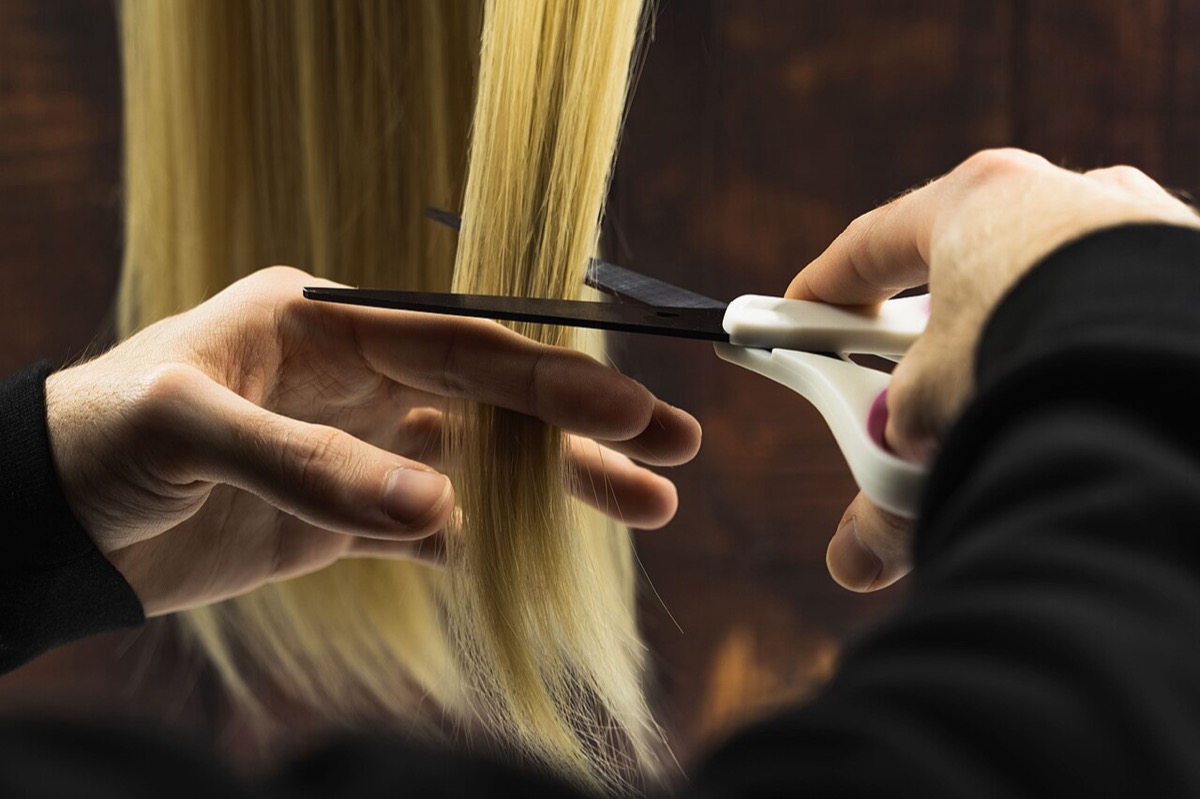
- Add width at the sides around the cheekbones and jaw: waves, curls or face-framing layers. Side volume balances length so the face reads less long.
- Try a chin- to shoulder-length cut, such as a textured bob, instead of very long, flat, one-length hair, which extends the vertical line.
- Add a fringe that falls to about eyebrow level. It shortens the visible forehead and so the visible length of the face. Skip very short micro bangs, which expose the forehead again.
- Avoid lots of volume or height on top. Height adds to length the face already has; tall pompadours are the classic example.
- Avoid scraping hair straight back or wearing a sleek centre part on long hair, which shows the full length and draws the eye downward.
- Men: avoid very short sides with a tall top and keep the top moderate. Barbers disagree on the rest: Matty Conrad in GQ Middle East suggests going very short, while The Art of Manliness recommends medium length with a fringe, and a Seattle Times stylist warns that very short cuts can make an oblong face look longer. If you are unsure, start with medium length and a fringe; it is easier to go shorter than to grow back.
Glasses, brows, makeup, beard and photos
The same width-not-height idea runs through every other choice. The table collects the rules from our rulebook, each with the trade it comes from. Opticians at All About Vision and Reliant Medical Group agree on frames, makeup artists from Fox News' brow panel to HighBrow Beauty agree on brows, and photographers at SLR Lounge, The Lens Lounge and StudioBinder agree on light.
The photo rule is worth knowing even if you never change your hair. Broad lighting means turning the lit side of your face toward the camera, so the wider, brighter part of the face is what the lens sees. Short lighting, where the shadowed side faces the camera, makes faces look narrower and longer, which is the opposite of what a long face wants.
| Area | Try | Skip | Label |
|---|---|---|---|
| Glasses | Frames with deeper lenses, more depth than width, such as taller squares or rounds | Narrow, shallow rectangles and small lenses | Optician convention |
| Glasses detail | Decorative or contrasting-colour temples (arms) that add width at the sides | Plain, thin temples on a narrow frame | Optician convention |
| Brows | Fuller, straighter brows with only a slight arch; tails extend slightly outward and stay level | High, peaked arches and long tails that drop down | Makeup-artist convention |
| Contour | Along the top of the forehead at the hairline and just under the chin; keep cheek contour horizontal | Long diagonal contour running down toward the mouth | Makeup-artist convention |
| Blush | A straight horizontal line or soft semicircle across the cheeks | Steep upward sweeps toward the temples | Makeup-artist convention |
| Beard | Short to medium, fuller on the cheeks and sides, chin no longer than the sides | Long, pointed beards, long goatees, chinstraps | Stylist convention |
| Photos | Face toward the window and turn the lit side of your face to the camera (broad lighting) | Short lighting, which makes faces look longer | Photographer convention |
Measure it, then pick one change
Because the oval and oblong boundary is a matter of degree, measure before you restyle. Prop your phone about 1 to 1.5 m away at eye level, use the timer, pull your hair back, take your glasses off and keep your mouth closed. Distance matters more than people expect for length: a camera very close to the face exaggerates whatever is nearest the lens, and photographers advise keeping the camera at or slightly above eye level, never below the chin. Ward and colleagues (2018) modelled that a camera about 30 cm away makes the base of the nose look roughly 30% wider relative to face width than at 1.5 m, and the same perspective effect changes every ratio a shape tool measures.
Run the face shape detector and switch on the Outline and Widths layers. Look at whether the jaw line is nearly as long as the cheekbone line. (The Face length ÷ width number in your results runs from the hairline, so it is larger than the 1.17 and 1.31 references, which use the top of the face mesh; don't compare them directly.) Read the two closest shapes. Oblong with a clear lead: the table above is your list. Oblong and oval close together: start with the advice the two shapes share, a fringe to brow level and soft side volume. Oblong and square close together: you have the rectangle variant, so add the square-face habit of keeping hair soft below the jaw. If the quality check asks for a retake because your chin is tipped up or down, take it seriously, because chin angle changes measured length directly.
Then pick one change for this week, not five. If you have long, straight hair, ask for face-framing layers that start at the cheekbones and a fringe that grazes the brows. If you wear glasses, try a deeper frame at your next fitting. If you mostly care about photos, turn toward the window. Each one works on its own, and each is easy to undo. For a side-by-side of cuts across all shapes, see hairstyle for face shape; men can find barber and beard advice by shape in male face shapes.
Questions people ask
- Is an oblong face the same as a long face?
- Yes. Oblong, long and rectangle describe the same family: a face clearly longer than wide with similar forehead, cheekbone and jaw widths. Rectangle usually means the jaw is also square.
- How do I know if my face is oval or oblong?
- Check two things: length and the sides. An oblong face is longer and its sides run straighter, with the jaw nearly as wide as the cheekbones. An oval face tapers gently into a rounder chin. The detector shows both shapes with percentages if you sit between them.
- Do bangs suit an oblong face?
- Yes. Stylists recommend a fringe that falls to about eyebrow level because it shortens the visible forehead. Very short micro bangs work against it.
Sources & further reading
- Matrix, Jackie Summers: How To Choose The Best Hairstyle For Your Face Shape
- Revlon Professional: What Hairstyle Suits Me?
- All About Vision, Erinn Morgan (reviewed by Chloe Tauaefa, ABOC): The Best Glasses for Your Face Shape and Skin Tone
- The Art of Manliness, with barber Thad Forrester: The Best Haircut for Your Face Shape
- TODAY (NBC), Chrissy Callahan: What is my face shape? How to determine your face shape once and for all
- TODAY (NBC), Anna De Souza quoting hairstylist Paul Labrecque: Need a haircut? Here's how to get the best style for your face shape
- The Seattle Times (Star-Tribune), Allie Shah: Look to the stars' face shapes for haircut do's and don'ts
- Huda Beauty: How To Cut Your Bangs To Flatter Your Face Shape
- Cosmopolitan via AOL (2025), Lia Mappoura: The Best Haircuts and Styles for Every Face Shape
- GQ Middle East, Adam Hurly quoting barber Matty Conrad: What's the best haircut for your face shape?
- Reliant Medical Group, Dan Delisle, Registered Optician: How to Choose Eyeglasses that Suit Your Face
- Glasses Direct: Face Shapes
- Fox News, quoting Anastasia Soare and Joey Healy: Get the perfect eyebrow shape for your face
- HighBrow Beauty, Beverly Harris: Eyebrow shapes to flatter your face
- Refinery29, Erika Stalder: The Pro's Guide To Finding Your Perfect Eyebrow Shape
- e.l.f. Cosmetics, Emma Izquierdo: How to Properly Contour Your Face Based on Your Face Shape
- AARP Sisters, Anissa Gabbara: Easy Contouring Tips to Balance Your Face Shape
- L'Oréal Paris USA, Roberto Rodriguez: How to Apply Blush for Your Face Shape
- Pall Mall Barbers: 2026 best beard styles for different shapes
- FashionBeans, Al Hardacre: Beard Styles For Face Shapes
- SLR Lounge, Pye Jirsa (2019): Broad vs. Short Lighting
- The Lens Lounge, Jane Allan (2019): Short lighting and broad lighting for portrait photography
- StudioBinder, Kyle DeGuzman (2021): What is Broad Lighting Photography
- Ward B et al. (2018), JAMA Facial Plastic Surgery: Nasal Distortion in Short-Distance Photographs: The Selfie Effect
Read next
- Face shapes
Face shapes explained: oval, round, square, oblong, heart, diamond and triangle, how stylists define each, and a free detector with no sign-up.
- Face shape detector
Face shape detector that's free with no sign-up and runs on your device: it measures forehead, cheekbones, jaw and length, then gives your top two shapes.
- Oval face shape
Oval face shape: longer than wide, widest at the cheekbones, softly rounded jaw. How to tell oval from oblong or round, and the cuts and frames that suit it.
- Male face shapes
Male face shapes, explained: the 7 outlines barbers use, what research says differs in men's faces, and a sourced haircut, beard and frame plan per shape.
- Haircut finder
Haircut depending on face shape: scan one photo free, no sign-up, to find your shape, then see sourced cuts to try and to avoid, for women and men.
- High cheekbones
High cheekbones or low? Free test, no sign-up: find where your face is widest, drawn on your photo, plus blush, contour and glasses tips that fit.
Part of Face shapes. Take the full free attractiveness test on the FaceCheckup home page.
Sukie · Founder and editor
Sukie built FaceCheckup because she always wanted a face tool that explains its numbers and tells you what to do with them, and nothing on the market did both. She checks every measurement on the site against published research and labels every tip for what it is: research, or stylist convention.
About this site · How pages are checked · Last updated October 23, 2026
FaceCheckup is for information and entertainment. It measures proportions in one photo; it is not a medical, psychological or cosmetic-surgery assessment, and it cannot tell you your worth.