A facial symmetry test should do two things most online checkers skip: show you where the two halves of your face differ, and stop a tilted or turned photo from pretending to be asymmetry. FaceCheckup does both, on your device, with no upload.
This page is also the hub for everything about proportions and symmetry on the site. Below you'll find exactly how the mirror method works, what a result of 1% or 4% actually means, what research says about symmetry and looks, why photos make most people look more lopsided than the mirror does, and practical things you can do about it this week.
One thing first, because it matters: a perfectly symmetric face does not exist in any study we have read, and symmetry explains only a small part of why people find a face attractive. Treat the number as a measurement of a photo, not a verdict on you.
How the mirror method works
Google's MediaPipe Face Landmarker places 478 points on your face. Of those, 220 come in left-right pairs: the outer corner of your right eye has a partner at the outer corner of your left eye, each mouth corner has a partner, and so on around the jaw, brows, nose and cheeks. We took those pairs directly from MediaPipe's own canonical face model, where each point on one side has an exact mirror on the other.
Next the scan finds your midline. Instead of trusting one point such as the nose tip, it fits a straight line through 28 landmarks that sit on the centre of the face, from the forehead through the bridge and tip of the nose to the lips and chin. A crooked nose tip or a lip that pulls to one side can't drag the whole midline with it.
Then each landmark is reflected across that line and compared with its real partner. If your face were perfectly symmetric, every reflected point would land exactly on its partner. The distance between them is the mismatch. We divide it by your face width (the widest outline points at cheekbone level) so the number doesn't depend on how big your face is in the photo, and average it over all 220 pairs. That average, as a percentage, is your overall asymmetry. Lower means more symmetric.
The scan also reports a second, simpler number: left/right half-width match. It measures each half of the face from the midline out to the outline at cheekbone level and gives the narrower half as a percentage of the wider one. 100% would be two identical halves.
Why head pose matters more than your face
A head turned even a few degrees toward one shoulder makes the near half of your face look wider and the far half narrower. A mirror-based test that measures the photo as it is will read that as asymmetry. So before measuring, FaceCheckup uses the 3D landmark positions and the head-pose estimate from MediaPipe to rotate your face back to a frontal view. Only then does it mirror the pairs.
We tested how much this matters on one of our own selfies, taken with the head turned about 10 degrees and smiling. The photo-quality check flagged both problems. The numbers below are from that single photo, so they show the size of the effect, not a population average.
| Measurement | Before pose correction | After pose correction |
|---|---|---|
| Overall asymmetry, original photo | 4.70% | 1.06% |
| Overall asymmetry, mirrored copy | 3.63% | 1.51% |
| Left/right half-width match | 72% | 95% |
| Symmetry points in the Balance Score (out of 6) | 0 (penalty capped) | 5.57 |
What a normal result looks like
Some asymmetry is universal. In a UK study of 270 healthy 15-year-olds scanned in 3D, Djordjevic and colleagues (2014) mirrored each face and measured how much of the surface matched its mirror image within half a millimetre. On average only 53.49% of the face matched in boys and 58.50% in girls, while the average left-right differences in individual distances stayed under 1 mm. Most of the face was slightly off, by very small amounts.
A 2026 study of 120 consecutive cosmetic-practice patients photographed in 3D found measurable cheekbone-width asymmetry in 98.3% of them, with the left side wider in 118 cases (Divaris, 2026). That is an aesthetic-clinic population, not a random sample, but it points the same way: some difference between the halves is the rule, not the exception. A study that followed a birth cohort with 3D imaging (70 children analysed) found asymmetry already detectable in early childhood, tending to reduce with age (Launonen and colleagues, 2023).
Here's the honest part about our number. None of these studies used our index (220 MediaPipe pairs, measured as a share of face width on a 2D photo), so we can't tell you that your percentage is “normal” or “above average” against them. What we can tell you is what we see on our own test photos: a straight-on, neutral, well-lit photo typically measures around 1%, and the re-framing jitter alone moves it by roughly 0.1 to 0.3 points. That is why the Balance Score ignores the first 0.8% entirely.
There is also a hard floor on precision. Google's model card for the landmark model reports an average landmark error of about 2% to 3.3% of the distance between the eyes in tracking mode, and slightly more on single images. Tiny asymmetries are the same size as that error. A difference that doesn't survive a retake isn't a feature of your face.
We ran the Mona Lisa through the symmetry test
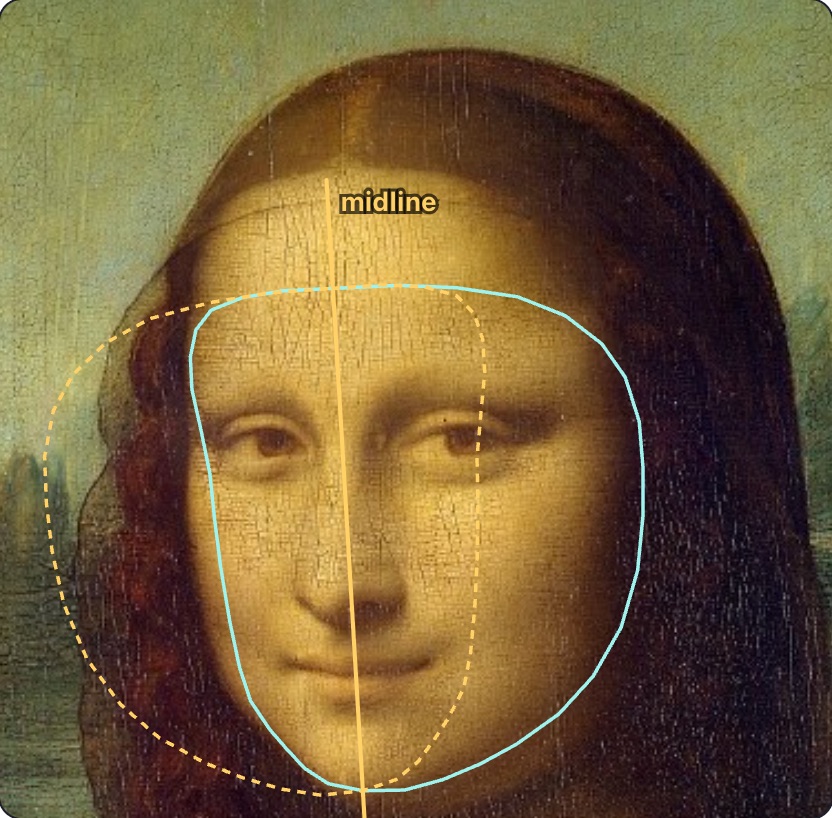
To show what the Symmetry layer looks like on a real image, we scanned a public-domain painting rather than a stranger's face: Leonardo da Vinci's Mona Lisa. The yellow line is the fitted midline. The dashed outline is the left half of the face mirrored onto the right.
The result is a lesson in photo quality, not in her symmetry. Our quality check measured her head as turned 17° and her chin as down 19°, both past the retake limits (15° and 18°), so the scan withheld the Balance Score and asked for a new photo. The mirrored outline sits far off the real one because a turned head makes one half of any face look wider. For your own scan, face the lens squarely and keep your chin level, and the two outlines should nearly overlap.
Does a symmetrical face look more attractive?
A little, on average, and much less than social media suggests. Gillian Rhodes's 2006 review in the Annual Review of Psychology concluded that symmetry, averageness and sexual dimorphism are each found attractive in male and female faces and across cultures. But when Jones and Jaeger (2019) summarised the meta-analytic evidence, they noted that symmetry has a mean effect size of r = 0.25 and contributes the least variance of the three, and in their own study of natural female faces shape symmetry did not help predict attractiveness ratings at all.
Averageness seems to matter at least as much. In the classic experiment by Langlois and Roggman (1990), digital composites made by averaging many faces were judged more attractive than almost all of the individual faces that went into them. Averaging also makes a face more symmetric, which is one reason the two effects are hard to separate.
And taste is personal. Hönekopp (2006) found that private taste, the part of a rating that is specific to each rater, is about as powerful as the taste raters share. That is why FaceCheckup's Balance Score is described as a measure of symmetry and two published proportions, never a prediction of how attractive anyone will find you.
Symmetry … contributes the least amount of variance to facial attractiveness, with a mean effect size r of 0.25.
— Jones & Jaeger (2019), Symmetry, summarising Rhodes (2006)
Why photos make your face look lopsided
If your face looks fine in the mirror and strangely uneven in photos, you are not imagining it, and it usually isn't your face changing. There are four ordinary causes.
First, familiarity. In a 1977 experiment by Mita, Dermer and Knight, people preferred the mirror image of their own face, while their friends preferred the true, unreversed photo. You have seen the mirror version of yourself thousands of times; a camera shows the flipped version, so every small asymmetry suddenly sits on the “wrong” side. In the 2026 cosmetic-practice study above, 40% of patients said they noticed differences between their mirror image and photographs.
Second, camera distance. A phone held close to the face enlarges whatever is nearest the lens. Ward and colleagues (2018) modelled that at about 30 cm the base of the nose appears roughly 30% wider relative to face width than at 1.5 m. Any small turn of the head then enlarges one side more than the other.
Third, head turn and tilt, which we covered above. Fourth, light: a lamp or window on one side throws one cheek into shadow, which hides the face edge and makes that half look narrower. The quality check warns when one side of your face is noticeably darker than the other.
How to take a fair photo for the symmetry test
These steps come from our sourced rulebook. Each one removes a cause of false asymmetry in any facial symmetry test, so your result reflects your face rather than the camera.
- Prop the phone at eye level about 1 to 1.5 m away and use the timer, instead of holding it at arm's length (research-supported: Ward et al. 2018; Bryan, Perona & Adolphs 2012).
- If you can, switch to the rear camera's 2x or 3x lens and step back, so distance keeps the face in natural proportion (photographer convention).
- Look straight into the lens with your head level; both ears should look equally visible. The scan corrects small turns, but it warns above 8° and asks for a retake above 15°.
- Use a relaxed, neutral face with lips together. A smile moves the mouth corners and cheeks, and any unevenness in it shows up as asymmetry.
- Face a window or soft daylight so both cheeks are evenly lit, not a single ceiling light (photographer convention).
- Take off glasses and pull hair back from the forehead and jaw so the outline is visible (optician and stylist conventions).
- Take two or three photos and compare. If a difference appears in one and vanishes in the others, it came from the photo.
How to read your result on FaceCheckup
Switch on the Symmetry layer. It draws your fitted midline in yellow and lays a dashed, mirrored copy of your face outline over the real one. Where the dashed line and the real outline separate, the halves differ. Usually you'll see the gap at the jaw or cheek on one side, which is also where head turn shows up first, so check the quality notes before deciding it's real.
In the results, the Symmetry group shows two numbers. Overall asymmetry is the average mirror mismatch of all 220 pairs, as % of face width. Left/right half-width match compares the two halves at cheekbone level. Each comes with a ± range from the four framings; if two results' ranges overlap, treat them as the same.
The symmetry part of the Balance Score is worth up to 6 of its 10 points. The first 0.8% of asymmetry costs nothing; after that, each further 0.6% costs one point, down to zero. On our test photo, 1.06% cost 0.43 points. Your strengths list may also name the most symmetric part of your face in that photo (eyes, brows, nose, mouth or jaw), measured the same way region by region. The full formula is on our How it works page.
The proportion measurements in this hub
Symmetry compares your left half with your right. The other pages in this hub compare parts of your face with each other, top to bottom and across. Each has its own tool view and its own honest note on what research does and doesn't support.
The golden ratio face page explains why 1.618 doesn't hold up as a beauty formula, and what the two research-tested ratios (Pallett, Link and Lee, 2010) actually are. The facial thirds page measures hairline-to-brows, brows-to-nose and nose-to-chin, using a hair-segmentation model to find your hairline. Is my forehead big measures your upper third and forehead width and gives haircut, bang and glasses options. The midface ratio page covers the pupil-distance-to-upper-lip ratio that looksmaxxing forums discuss, and is clear that no published population norm exists for it.
Outside this hub, canthal tilt measures the angle of your eyes, and the face shape detector compares forehead, cheekbone and jaw widths.
Styling choices for a slightly asymmetric face
Nothing here is a fix, and you don't need one. These are the choices professionals make when they want a face to photograph evenly, each labelled with where it comes from.
Find your camera side (photographer convention). Take one three-quarter photo turned left and one turned right, and keep whichever you prefer. Portrait photographers do this routinely because most faces are slightly asymmetric. It costs nothing and it is the single most effective change for profile photos.
Map your brows to the same three points on each side (makeup-artist convention). Start each brow on a vertical line up from the side of the nose, arch it above the outer edge of the iris, and end it on a line from the nostril to the outer eye corner. Because each brow is placed against its own eye and nostril, uneven brows end up drawn to matching landmarks. Don't over-tweeze the gap between them; it grows back slowly.
Light both sides (photographer convention). Stand facing a window or in open shade. Hard side light deepens whichever side is already narrower.
Try your parting both ways. Our rulebook doesn't contain a stylist rule specifically for asymmetric faces. What it does contain is that stylists use a side part to put a diagonal line across the face and break up symmetry on round faces. Whether a parting makes your own asymmetry more or less noticeable is something you can test in two photos, so do that rather than trusting a rule.
When asymmetry is a medical question
This site doesn't give medical advice, and the scan is not a diagnostic tool; Google's own model card says the landmark model is not intended for life-critical decisions. Long-standing, gradual asymmetry is almost always normal variation.
Sudden change is different. The US Centers for Disease Control and Prevention lists sudden numbness or weakness in the face, especially on one side, as a sign of stroke, and its F.A.S.T. check asks: smile, and does one side of the face droop? If that happens to you or someone near you, call 911 right away. The US National Library of Medicine's MedlinePlus notes that Bell's palsy, the most common cause of facial paralysis, usually affects one side of the face and comes on suddenly. Any new droop, weakness or change you didn't have before belongs with a doctor, not a face scanner.
Every guide in Facial symmetry test
- Is my forehead big?
Big forehead or just a photo angle? Free test, no sign-up: measure your forehead on your own photo, then see haircuts, bangs and frames that help.
- Facial thirds
Facial thirds measured free on your photo, no sign-up: hairline, brows, nose base and chin drawn for you, plus how rarely thirds are equal in studies.
- Golden ratio face
Golden ratio face claims tested against research: why 1.618 fails as a beauty formula, and two ratios studies support, measured free with no sign-up.
- Midface ratio
Midface ratio measured free on your photo, no sign-up: pupil distance ÷ pupils-to-lip height with a ± range, the three definitions and the research.
Questions people ask
- How do I know if my face is symmetrical?
- Take a straight-on, neutral photo from about 1 to 1.5 m away in even light and run it through the scan. Look at the Symmetry layer: if the dashed mirrored outline sits close to your real outline all the way round, your face is very symmetric in that photo. Repeat with a second photo to confirm, because head turn and light can create differences that aren't really there.
- Is a perfectly symmetrical face possible?
- Not in any study we have read. 3D scans of healthy teenagers found that on average only about half of the face surface matched its mirror image within half a millimetre, and a 3D study of cosmetic-practice patients found measurable cheekbone asymmetry in 98.3% of them. Slight asymmetry is the normal human face.
- Why does my face look different in photos than in the mirror?
- Mostly because the mirror flips you. People prefer the mirror image of their own face, which is the version they see daily, while friends prefer the true photo (Mita, Dermer and Knight, 1977). Close camera distance, a slight head turn and side lighting then exaggerate small differences.
- What is a good facial symmetry score?
- On FaceCheckup, lower overall asymmetry is more symmetric, and on our own straight, neutral test photos results sit around 1%. We don't label a number “good” or “normal” against studies, because no published study uses the same measurement. Compare your own photos with each other rather than with other people.
- Are online facial symmetry tests accurate?
- Only as accurate as the photo and the method. Landmark models have an average error of about 2 to 3.3% of the distance between the eyes, and a turned head can multiply apparent asymmetry several times; on our test photo, correcting a 10° turn took the result from 4.70% to 1.06%. A facial symmetry test that doesn't correct pose or show a range can mislead you.
- Does facial symmetry make you more attractive?
- Slightly, on average. Reviews find symmetry is preferred across cultures, but its meta-analytic effect size is about r = 0.25, the weakest of the classic factors, and individual taste matters about as much as shared taste. A measurement of symmetry is not a rating of your looks.
- Which side of the face is more attractive?
- There is no general answer in the sources we use. In the 2026 cosmetic-practice study, patients' preferred sides were split almost evenly between left and right and didn't match their anatomically wider side. Take a three-quarter photo of each side and keep the one you like.
- Is my photo uploaded for the symmetry test?
- No. The landmark model runs in your browser, so the photo stays on your device. The share card leaves your face out unless you choose to add it.
Sources & further reading
- Djordjevic J, Toma AM, Zhurov AI, Richmond S (2014), European Journal of Orthodontics: Three-dimensional quantification of facial symmetry in adolescents using laser surface scanning
- Divaris M (2026), Plastic and Reconstructive Surgery Global Open: Facial asymmetry as a universal signature
- Launonen AM et al. (2023), European Journal of Orthodontics: A longitudinal study of facial asymmetry in a normal birth cohort up to 6 years of age
- Rhodes G (2006), Annual Review of Psychology: The evolutionary psychology of facial beauty
- Jones AL, Jaeger B (2019), Symmetry: Biological bases of beauty revisited
- Langlois JH, Roggman LA (1990), Psychological Science: Attractive faces are only average
- Hönekopp J (2006), J Exp Psychol: Human Perception and Performance: Once more: is beauty in the eye of the beholder?
- Mita TH, Dermer M, Knight J (1977), Journal of Personality and Social Psychology: Reversed facial images and the mere-exposure hypothesis
- Amestoy A, Bouvard MP, Cazalets JR (2010), Frontiers in Psychology: Left-right facial orientation of familiar faces (summarises Mita et al. 1977)
- Ward B, Ward M, Fried O, Paskhover B (2018), JAMA Facial Plastic Surgery: Nasal distortion in short-distance photographs: the selfie effect
- Bryan R, Perona P, Adolphs R (2012), PLOS ONE: Perspective distortion from interpersonal distance is an implicit visual cue for social judgments of faces
- Pallett PM, Link S, Lee K (2010), Vision Research: New “golden” ratios for facial beauty
- Yan G, Grishchenko I (Google, 2022): Model Card, MediaPipe Face Mesh V2
- Google AI Edge: MediaPipe canonical face model (canonical_face_model.obj)
- Lois Joy Johnson, quoting photographer Eric Wolfe, AARP (2024): Looking better in pictures
- Adobe Express Learn (2026): How to take portrait photos with your phone
- Chelsea Simmons, jane iredale Makeup Blog: How to shape and define eyebrows
- Centers for Disease Control and Prevention: Signs and symptoms of stroke
- MedlinePlus, US National Library of Medicine: Bell's palsy
- Leonardo da Vinci, Mona Lisa (public domain), Wikimedia Commons file
Read next
- Golden ratio face
Golden ratio face claims tested against research: why 1.618 fails as a beauty formula, and two ratios studies support, measured free with no sign-up.
- Facial thirds
Facial thirds measured free on your photo, no sign-up: hairline, brows, nose base and chin drawn for you, plus how rarely thirds are equal in studies.
- Is my forehead big?
Big forehead or just a photo angle? Free test, no sign-up: measure your forehead on your own photo, then see haircuts, bangs and frames that help.
- Midface ratio
Midface ratio measured free on your photo, no sign-up: pupil distance ÷ pupils-to-lip height with a ± range, the three definitions and the research.
- Canthal tilt
Canthal tilt is the angle from your inner to outer eye corner. Measure each eye free, no sign-up, with head-roll correction and published averages.
- Face shape detector
Face shape detector that's free with no sign-up and runs on your device: it measures forehead, cheekbones, jaw and length, then gives your top two shapes.
Take the full free attractiveness test on the FaceCheckup home page.

Sukie · Founder and editor
Sukie built FaceCheckup because she always wanted a face tool that explains its numbers and tells you what to do with them, and nothing on the market did both. She checks every measurement on the site against published research and labels every tip for what it is: research, or stylist convention.
About this site · How pages are checked · Last updated October 23, 2026
FaceCheckup is for information and entertainment. It measures proportions in one photo; it is not a medical, psychological or cosmetic-surgery assessment, and it cannot tell you your worth.