High cheekbones are usually explained with a mirror test: find the fullest part of your cheek and see whether it lines up with your eyes or sits lower, near your nostrils or mouth. People on Quora describe exactly this 'eye-line' check, and it works, but judging your own cheek in a mirror is hard because light, expression and the angle you look from all move the answer. The tool above does the same test with landmarks, draws the face outline and width lines it used, and tells you how sure it is. Below you will learn what the number means, why no one can tell you what is 'normal' for it, and how to use the result for blush, contour, glasses and photos.
The eye-line test, done with landmarks instead of a mirror
The scanner traces the outline of your face with Google's MediaPipe Face Landmarker and straightens it so your pupils sit level. It then walks down the outline on both sides, from a little above the pupil line to the corners of the mouth, and finds where the face is widest measured from its centre line. That height becomes your cheekbone height: where the widest point sits between the pupils (0%) and the mouth corners (100%).
A low number, such as 15%, means the face reaches its full width close to eye level, which is what people mean by high cheekbones. A higher number means the widest point sits further down the face, which reads as lower or fuller cheeks. Because the search window starts slightly above the pupils, a very high widest point can even show as a small negative number.
Open the Jaw group in your results and switch on the Widths layer. You will see the cheekbone width line drawn between the outline landmarks at cheekbone level; the height result itself is reported as a number, not drawn as a separate line. If the outline lands in the wrong place, for example because hair covers the side of your face, you can see that straight away and retake the photo.
- Take a straight-on photo with a neutral face and closed mouth, hair tucked behind your ears, glasses off.
- Run the scan and open the Jaw group of results.
- Read cheekbone height and its ± range. The range comes from measuring your photo and three re-framed copies of it.
- Switch on the Widths layer and check the cheekbone line sits on the outer edge of your cheeks, not on hair or shadow.
- Compare two or three photos taken the same way. If the results agree within their ± ranges, you can trust the reading.
What nobody can tell you yet: a 'normal' cheekbone height
We looked for a published population range for cheekbone height measured this way and did not find one. The large anthropometric surveys measure cheekbone width, not the vertical level of the widest point, and the clinical literature describes cheekbone position with bone landmarks you can't see on a photo. So the tool shows your number on its own, with no 'average' beside it. Any site that tells you your cheekbones are 'in the top 10%' is making that figure up.
Cheekbone width is well documented. In the US Army's ANSUR II survey of 6,068 adults, bizygomatic breadth (the distance between the cheekbones) averaged 142.6 mm in men and 133.8 mm in women, calculated by us from the public data. Caton and Dixson (2022) found it highly sexually dimorphic in that sample, with an equivalent effect size of d = 1.39. Width and height are separate questions, though: a face can be wide at the cheekbones and still be widest low down.
Users on looksmaxxing forums point out that 'high' and 'low' get unreliable on long faces, and they are right. If your face is long from eyes to mouth, the same bone sits at a lower percentage than on a shorter face. That's one reason we report a share of the eye-to-mouth distance rather than a pixel height, and why the face-shape result, which accounts for length, is worth reading alongside this one.
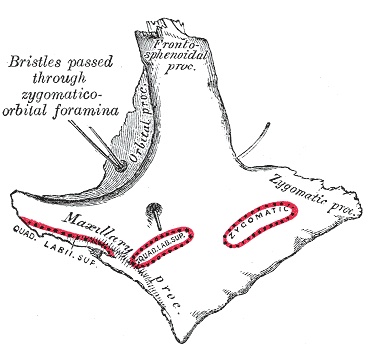
High, wide or prominent? Three measurements people confuse
'High cheekbones' gets used for three different things. One is height: how close to the eyes the face is widest. Another is prominence, meaning the cheekbones are clearly wider than the forehead and jaw, which is what makes a diamond face shape. The last is overall face width against the height of the midface, the facial width-to-height ratio (fWHR) used in research. FaceCheckup reports all three separately, so you can see which one your friends mean when they comment on your cheekbones.
| What people say | Measurement in the scan | Layer | Comparable published norm? |
|---|---|---|---|
| High vs low cheekbones | Cheekbone height (% between pupils and mouth) | Widths | None found |
| Prominent cheekbones | Jaw width ÷ cheekbone width and forehead width ÷ cheekbone width | Widths | None that uses these landmarks |
| A wide face | Width-to-height ratio (fWHR) | Ratios | Published means differ by method (1.80–1.86 manual, 2.18 automatic), so none applies |
Blush, contour and highlight: where to put them
Makeup artists place colour by face shape rather than by cheekbone height alone, so start from your face-shape result. These are makeup-artist conventions, each backed by at least two brand or editorial sources (L'Oréal Paris, Charlotte Tilbury, Trinny London, Patrick Ta, e.l.f., Maybelline and AARP).
Round face: put blush high on the cheekbones and blend it up toward the temple instead of on the centre of the apples, and place contour in the hollows under the cheekbones, at the temples and along the jaw, with highlight down the centre. Lifted, angled colour is the classic way to suggest higher cheekbones.
Diamond face, where the cheekbones are already the widest point: contour lightly on the outer cheekbones and along the temples, keep highlight in the centre of the forehead and chin, and put blush on the tops of the cheekbones blended out toward the ears.
Heart face: sweep blush in a 'C' from the top of the cheekbone up toward the end of the brow, add a little contour under the cheekbones and at the temples, and keep it off the jaw. Oblong face: keep cheek contour and blush horizontal rather than in steep diagonals, because a horizontal line adds width to a long face. Square face: blush on the apples, blended outward, softens the corners.
Glasses, haircuts and photos: things to try this week
If your cheekbones are the widest part of your face, opticians and stylists give consistent advice, and the camera changes how cheekbones look more than anything else. Pick the items that match your result, then rescan with the same setup to compare. If you also want a read on the rest of the lower face, the jawline rating page covers jaw width and the jaw corner, and the face shape detector puts all three widths together.
- Glasses: oval or cat-eye frames soften wide cheekbones, and cat-eyes lift the eye line (optician convention, All About Vision, Reliant Medical Group, Glasses Direct, Vision Express).
- Glasses: frames with a defined brow line add width above narrow temples to balance wide cheekbones; rimless or semi-rimless frames frame the eyes without adding width at the cheekbones (optician convention).
- Haircut: avoid short layers that end right at the cheekbones, which add volume at the widest point; keep some fullness at the temples (stylist convention, Cosmopolitan, InStyle, The Art of Manliness).
- Haircut: a chin-length bob, or a side-parted lob, adds width at the jaw to balance cheekbones that are the widest point (stylist convention, TODAY, InStyle, Revlon Professional).
- Photo: stand in soft window light. Light from directly above casts deep shadows under the cheekbones and can hide their outline (photographer convention).
- Photo: take pictures from about 1.5 m away with the zoom rather than at arm's length. Close selfies exaggerate central features relative to face width (research-supported, Ward et al. 2018; Bryan et al. 2012).
- Measurement: keep a neutral face for the scan, then smile for the photos you share. A smile lifts the cheeks, so it belongs in your pictures, not in your measurement.
Questions people ask
- How do I know if I have high cheekbones?
- Look at where your face is widest. If the outer edge of your cheeks reaches its widest point near the level of your eyes, your cheekbones are high; if the widest point sits nearer your nostrils or mouth, they are lower. The tool measures this on your photo and draws the outline it used.
- What is the difference between high and low cheekbones?
- Only where the widest point sits. High cheekbones peak close to the eye line, low ones closer to the mouth. Neither is a flaw, and makeup artists have placement rules for both.
- Are high cheekbones attractive?
- We found no study that isolates cheekbone height and measures its effect on attractiveness ratings. Broader research shows that people's private taste matters about as much as shared taste (Hönekopp 2006), so a single feature rarely decides how a face is judged.
- Can you get higher cheekbones?
- The bone doesn't change, and this site gives no advice on fillers or surgery; for those, talk to a licensed medical professional. Blush placed high and blended toward the temple, and contour in the hollow underneath, create the look with makeup.
- Why do my cheekbones look higher when I smile?
- Smiling lifts and widens the soft tissue over the cheekbones. That's why the scan asks for a neutral face and flags smiles in its quality check.
- Why does the tool show a negative cheekbone height?
- The search for the widest point starts a little above the pupil line. If your face is widest there, the value is slightly below 0%, which simply means very high cheekbones.
- Do men and women have different cheekbones?
- Width differs a lot: in the ANSUR II data men's cheekbone breadth averaged 142.6 mm and women's 133.8 mm. We found no published data on whether the height of the widest point differs by sex.
- Is cheekbone height the same as fWHR?
- No. fWHR divides face width by the height from brows to upper lip. Cheekbone height is where the face is widest. The scan reports both, on different layers.
- How accurate is the cheekbone height measurement?
- It's best for comparing your own photos. Google reports landmark errors of about 2% to 3.9% of the distance between the eyes, and hair or shadow on the face edge can move the result. Check the ± range and the drawn line.
Sources & further reading
- Gordon CC et al. (2015), ANSUR II 2012 Anthropometric Survey of U.S. Army Personnel, public data (Penn State OPEN Design Lab)
- Caton N, Dixson B (2022), Biology Letters: Beyond facial width-to-height ratios: bizygomatic width is highly sexually dimorphic when adjusting for allometry
- Carré JM, McCormick CM (2008), Proc R Soc B: In your face: facial metrics predict aggressive behaviour
- Summersby S et al. (2022), Royal Society Open Science: Tracking sexual dimorphism of facial width-to-height ratio across the lifespan
- Hönekopp J (2006), J Exp Psychol Hum Percept Perform: Once more: is beauty in the eye of the beholder?
- Ward B, Ward M, Fried O, Paskhover B (2018), JAMA Facial Plastic Surgery: Nasal Distortion in Short-Distance Photographs: The Selfie Effect
- Bryan R, Perona P, Adolphs R (2012), PLoS One: Perspective Distortion from Interpersonal Distance Is an Implicit Visual Cue for Social Judgments of Faces
- Google (2022), Model Card: MediaPipe Face Mesh V2
- L'Oréal Paris USA: Blush by face shape
- Charlotte Tilbury: How to apply blush to suit your face shape
- Trinny London: Where to apply blush
- Patrick Ta Beauty: How to contour and highlight based on your face shape
- e.l.f. Cosmetics: How to contour based on your face shape
- Maybelline: How to contour by face shape
- AARP Sisters: Easy contouring tips to balance your face shape
- All About Vision: Glasses frames for diamond-shaped faces
- Reliant Medical Group: How to choose eyeglasses that suit your face
- Glasses Direct: Face shapes
- Vision Express: Face shape style finder
- InStyle (via AOL, 2024): Celebrity hairstylists explain the best haircuts for every face shape
- Cosmopolitan (via AOL, 2025): The best haircuts and styles for every face shape
- TODAY (NBC): Hairstyles for round, oval, heart-shaped faces and more
- Adobe Express Learn: How to take portrait photos with your phone
Read next
- Jawline rating
Jawline rating from a front photo, free with no sign-up: jaw-to-cheekbone width and jaw angle drawn on your face, plus beard, hair and photo tips.
- Face shapes
Face shapes explained: oval, round, square, oblong, heart, diamond and triangle, how stylists define each, and a free detector with no sign-up.
- Face shape detector
Face shape detector that's free with no sign-up and runs on your device: it measures forehead, cheekbones, jaw and length, then gives your top two shapes.
- Midface ratio
Midface ratio measured free on your photo, no sign-up: pupil distance ÷ pupils-to-lip height with a ± range, the three definitions and the research.
- Eyebrow shapes
Eyebrow shapes explained: soft arch, high arch, straight, rounded and S-curve, matched to your face in a free scan with no sign-up and a three-point map.
Part of Jawline rating. Take the full free attractiveness test on the FaceCheckup home page.

Sukie · Founder and editor
Sukie built FaceCheckup because she always wanted a face tool that explains its numbers and tells you what to do with them, and nothing on the market did both. She checks every measurement on the site against published research and labels every tip for what it is: research, or stylist convention.
About this site · How pages are checked · Last updated October 23, 2026
FaceCheckup is for information and entertainment. It measures proportions in one photo; it is not a medical, psychological or cosmetic-surgery assessment, and it cannot tell you your worth.