If you typed 'pretty scale' or 'am I pretty' into a search bar, you probably already have a number, and it may be bothering you. Questions like 'I got 62% on the pretty scale, am I ugly?' get asked on Quora. This page explains, with sources, what those tests actually calculate, how far you can trust them, and what is worth doing with your face and your photos instead.
The scan above is a different kind of tool. It runs on your device, never uploads the photo, draws every line it measures on your face, and shows a ± range with each number. It won't call you pretty or ugly, because no measurement can.
How PrettyScale-style tests work
PrettyScale.com is the best-known pretty scale and the brand behind most searches for this phrase. Its own help page explains that it 'measures the face beauty by studying and testing the placement and sizes of different face features', that results are 'based on the face shape, distance between eyes and lips, mouth size and face symmetry', and that 'sometimes golden ratio is also used'. You place lines and dots on your photo following its instructions, and the help page adds that 'results can be different based on how you place lines and dots on your face'.
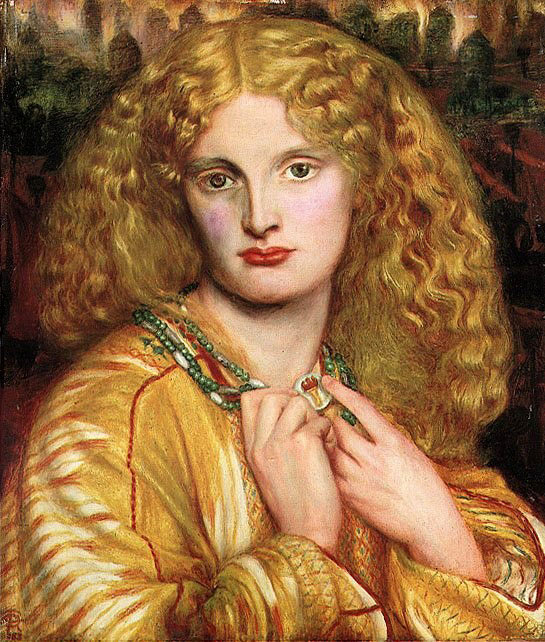
The score is a percentage. PrettyScale describes it with a joke unit, the 'micro Helen', after Helen of Troy, 'the face that launched a thousand ships': a score of 80% means 80 micro Helens. Its home page also carries two warnings worth taking seriously: 'Please do not start if you have low self-esteem or confidence issues', and results 'could be incorrect'.
Whatever the app, a score of this kind comes down to the same steps: locate a handful of points, measure the distances between them, compare each distance with a target ratio, and turn the gaps into a percentage. The targets are the weak point, because they come from art traditions and the golden ratio, not from measurements of real people.
What happened when researchers compared AI raters with people
Goshtasbi, Hakimi and Wong (2024) tested five face-rating websites, prettyscale.com among them, against a panel of 24 human raters. Everyone rated the same 40 frontal photos. The sites' average scores rose and fell with the human averages, a correlation of r = 0.84, so they ranked faces in a broadly similar order. But they were consistently generous: the sites averaged 6.9 out of 10 against 5.0 from the people, and 30 of the 40 faces (75.0%) were scored significantly higher by the sites than by humans.
Two limits matter. The 40 faces were AI-generated images of white women, a narrow set, and the paper's abstract doesn't report PrettyScale's results separately from the other four sites. So the study can't tell you how accurate PrettyScale is on your face. What it does show is that a confident number from a rating site can sit two points away from what people actually think, and in either direction you would have no way to tell from the screen.
| Measure | AI rating sites | Human raters |
|---|---|---|
| Mean score (out of 10) | 6.9 ± 0.9 | 5.0 ± 1.8 |
| Faces scored significantly higher by AI | 30 of 40 (75.0%) | — |
| Correlation between AI and human averages, per photo | r = 0.84 (p < 0.01) | — |
Why the golden ratio and the 'rule of fifths' make poor targets
The classical canons say a face should be five eye-widths across, with the gap between the eyes equal to one eye width and the nose as wide as that gap. Measured faces rarely fit. The orbital canon, eye gap equal to eye width within a millimetre or so, held in 0% of 103 southern Chinese adults (Jayaratne et al. 2012), 29% of Saudi men and 25% of Saudi women (Al-Sebaei 2015), and 33% of Kenyan men and 27% of Kenyan women (Virdi et al. 2019). A pooled analysis of raw data from 27 studies found that no ethnic or gender group consistently matched the canons or the golden ratio (Khoshab et al. 2022).
The golden ratio fares no better as a beauty formula. Burusapat and Lekdaeng (2019) measured Miss Universe and Miss Universe Thailand winners and found 12 of 16 facial golden ratios differed significantly from phi in both groups. Naini (2024) concluded there is 'no convincing evidence' that the golden ratio is linked to facial beauty. A pretty scale built on these targets can mark a face down for being an ordinary, healthy human face.
'Am I pretty?' deserves a better answer than a percentage
Research on attractiveness gives a more nuanced picture than any score. When many people rate the same faces, their averages agree closely, even across cultures (Langlois et al. 2000). But each person's own taste is large: Hönekopp (2006) found that private taste is about as powerful as shared taste. That means a face one person rates as average, another person may find striking, and both are being honest.
Things a pretty scale never measures make a big difference too. Bryan, Perona and Adolphs (2012) found that the same faces photographed at 45 cm were rated less attractive than at 135 cm. Close selfies also stretch central features: Ward and colleagues (2018) modelled the base of the nose appearing about 30% wider relative to face width at 12 inches than at 5 feet. Expression, lighting, skin, hair and the way you look at the camera all shift ratings, and none of them is in the formula.
So if a rating site gave you a low number, it has told you how your hand-placed dots compare with an old art formula, in one photo, on one day. It has not told you how pretty you are. If checking your looks has started to take up a lot of your time or make you feel low, the PSL scale page has a short note on getting support.
What the FaceCheckup scan shows you instead
The scan finds 478 landmarks with Google's MediaPipe Face Landmarker, checks the photo first (head turn, chin angle, tilt, smile, closed eyes, resolution, lighting) and asks for a retake rather than scoring a bad picture. It then rotates your head pose back to frontal before measuring. On one of our own test selfies, with the head turned about 10° and a smile, the mirror mismatch fell from 4.70% of face width before correction to 1.06% after, which shows how much a slight turn can distort a symmetry reading.
Results open with your top three strengths, then the measurements, each drawn as a layer you can switch on: Outline, Symmetry, Thirds, Fifths, Eye tilt, Brow map, Widths, Jaw and Ratios. If you want to see your own rule-of-fifths spacing, switch on Fifths; you will see the numbers, not a pass or fail. Only three measurements are shown with a published reference beside them: pupil distance ÷ face width and eyes-to-mouth ÷ face length, compared with Pallett, Link and Lee's (2010) ratios of about 46% and 36%, and canthal tilt, shown with group averages for context.
The Balance Score sums those up from 0 to 10: up to 6 points for symmetry and up to 4 for how close the two Pallett ratios sit to the published values. It measures geometry. It is not a prettiness score, and we say that on the result screen. The golden ratio face page and the facial symmetry test page explain each part in more depth.
Photo and style tips that make a real difference
These come from FaceCheckup's sourced rulebook, each labelled with where the advice comes from. They change how you look in pictures, which is where most pretty scale scores start.
- Prop your phone about 1 to 1.5 m away at eye level and use the timer, or ask a friend, instead of holding it at arm's length (research-supported, Ward et al. 2018; Bryan et al. 2012).
- Switch to the rear camera's 2x or 3x lens and step back; cropping a close wide-angle shot doesn't undo the distortion, only distance does (photographer convention).
- Face a window in daylight, or stand in open shade outdoors; avoid a single ceiling light (photographer convention).
- Angle your shoulders slightly away from the camera while your face stays toward it (photographer convention).
- Take one three-quarter shot to each side and keep the one you like better; most faces are slightly asymmetric and photographers routinely choose a side (photographer convention).
- Map your brows: start above the side of the nose, peak above the outer edge of the iris, end on the line from the nostril to the outer eye corner, and don't over-tweeze the middle (makeup-artist convention).
- For blush, follow your face shape: higher and angled toward the temple for a round face, on the apples for a square face, in a soft C toward the brow for a heart face (makeup-artist convention).
- For the measurement photo only, look straight at the camera with a neutral face, hair off your forehead and glasses off. Save the smile for the photos you share.
Questions people ask
- I got 62% on the pretty scale. Am I ugly?
- No. A pretty scale percentage compares a few distances on one photo with fixed ratios that most real faces don't match. Research shows camera distance, lighting and each viewer's personal taste change how attractive a face looks, and none of that is in the score.
- How accurate is PrettyScale?
- There is no published accuracy figure for PrettyScale on its own. A 2024 study that included it alongside four other rating sites found the sites ranked faces in a similar order to people (r = 0.84) but scored them higher on average (6.9 vs 5.0 out of 10). PrettyScale's own site says its results could be incorrect.
- Why do I get a different score every time?
- PrettyScale says results change with how you place the lines and dots. Small differences in head angle, expression, distance and light also move the measurements. That is why FaceCheckup measures several re-framed copies of your photo and shows the spread as a ± range.
- How do I get 100% on the pretty scale?
- Chasing a perfect score means matching an art formula, not becoming prettier. If you want better photos, take them from farther away, in soft window light, with the camera at eye level.
- What is a micro Helen?
- PrettyScale's joke unit: one Helen is a face that could launch a thousand ships, after Helen of Troy, so 80% on its scale means 80 micro Helens. It isn't a scientific unit.
- Is there a scientific pretty scale?
- No validated one. Researchers measure agreement between raters and the effects of symmetry, averageness and other features, but those explain only part of how faces are judged, and private taste counts for about as much as shared taste.
- Am I pretty if my face isn't symmetrical?
- Every face is somewhat asymmetric. A meta-analytic estimate puts symmetry's effect on attractiveness at about r = 0.25, the smallest of the factors studied. Small left-right differences on a photo are often head pose or lighting.
- Does FaceCheckup upload or save my photo?
- No. The scan runs on your device in the browser, and the photo is never uploaded. The share card leaves your face out unless you choose to add it.
Sources & further reading
- PrettyScale.com, Help and FAQs (method, 'micro Helen' unit), read 2026-10-23
- PrettyScale.com home page (warnings), read 2026-10-23
- Goshtasbi K, Hakimi AA, Wong BJF (2024), Facial Plast Surg Aesthet Med: Artificial Intelligence Versus Human Focus Group Rating of Facial Attractiveness
- Jayaratne YS et al. (2012), PLoS One: canons in southern Chinese young adults
- Al-Sebaei MO (2015), Head & Face Medicine: neoclassical canons in Saudi young adults
- Virdi SS, Wertheim D, Naini FB (2019), Maxillofacial Plastic and Reconstructive Surgery: Normative anthropometry and proportions of the Kenyan-African face
- Khoshab N et al. (2022), Aesthetic Surgery Journal: Historical Tools of Anthropometric Facial Assessment
- Burusapat C, Lekdaeng P (2019), PRS Global Open: What Is the Most Beautiful Facial Proportion in the 21st Century?
- Naini FB (2024), Maxillofac Plast Reconstr Surg: The golden ratio, dispelling the myth
- Langlois JH et al. (2000), Psychological Bulletin: Maxims or myths of beauty? A meta-analytic and theoretical review
- Hönekopp J (2006), J Exp Psychol Hum Percept Perform: Once more: is beauty in the eye of the beholder?
- Jones AL, Jaeger B (2019), Symmetry: Biological Bases of Beauty Revisited
- Bryan R, Perona P, Adolphs R (2012), PLoS One: Perspective Distortion from Interpersonal Distance Is an Implicit Visual Cue for Social Judgments of Faces
- Ward B, Ward M, Fried O, Paskhover B (2018), JAMA Facial Plastic Surgery: Nasal Distortion in Short-Distance Photographs: The Selfie Effect
- Pallett PM, Link S, Lee K (2010), Vision Research: New 'golden' ratios for facial beauty
- Adobe Express Learn: How to take portrait photos with your phone
- AARP: Tips for looking better in pictures
- Bustle: Eyebrow mapping
- L'Oréal Paris USA: Blush by face shape
Read next
- PSL scale
PSL scale explained: its forum origin, how the tiers are laid out, why no percentile backs them, and a free face test with no sign-up.
- Golden ratio face
Golden ratio face claims tested against research: why 1.618 fails as a beauty formula, and two ratios studies support, measured free with no sign-up.
- Facial symmetry test
Facial symmetry test that mirrors 220 landmark pairs on your own photo, corrects head turn, and shows a ± range. Free, private, no sign-up.
- Facial thirds
Facial thirds measured free on your photo, no sign-up: hairline, brows, nose base and chin drawn for you, plus how rarely thirds are equal in studies.
- Face shape detector
Face shape detector that's free with no sign-up and runs on your device: it measures forehead, cheekbones, jaw and length, then gives your top two shapes.
- Eyebrow shapes
Eyebrow shapes explained: soft arch, high arch, straight, rounded and S-curve, matched to your face in a free scan with no sign-up and a three-point map.
Part of PSL scale. Take the full free attractiveness test on the FaceCheckup home page.

Sukie · Founder and editor
Sukie built FaceCheckup because she always wanted a face tool that explains its numbers and tells you what to do with them, and nothing on the market did both. She checks every measurement on the site against published research and labels every tip for what it is: research, or stylist convention.
About this site · How pages are checked · Last updated October 23, 2026
FaceCheckup is for information and entertainment. It measures proportions in one photo; it is not a medical, psychological or cosmetic-surgery assessment, and it cannot tell you your worth.