The midface ratio comes from looksmaxxing forums, where it's often presented as a key to a “compact” or “long” face. This page measures it on your photo with a stated definition, shows how to convert between the three definitions you'll find online, and is straight with you about the part forums skip: there's no published research that says what a normal or ideal midface ratio is.
Our definition, and why we chose it
The scan finds the centre of each pupil (MediaPipe's iris landmarks) and the top edge of the upper lip on the midline. It levels the image so the pupils sit on a horizontal line and turns the head back to frontal. Then it divides two distances: the straight-line distance between the pupils, and the vertical height from the pupil line down to the top of the upper lip.
Midface ratio = pupil distance ÷ pupils-to-upper-lip height. A value of 1.00 means the two distances are equal. A value of 1.10 means your pupils are 10% farther apart than the height below them; 0.90 means the height is the larger of the two.
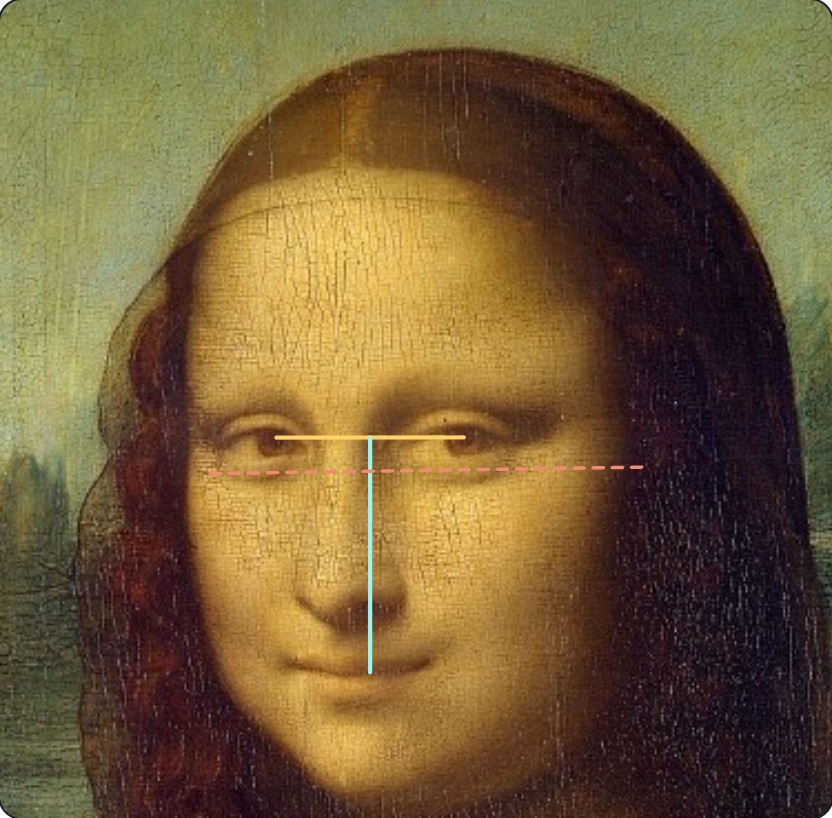
We use this direction because it's the one used in the forum threads where most people first meet the term, so your number can be compared with what you've read there. Higher numbers mean a wider, shorter midface; lower numbers mean a taller, narrower one. Switch on the Ratios layer to see the pupil line and a vertical line running down from it toward your mouth; the height used in the ratio stops at the top edge of your upper lip.
Three definitions, one name
Search results don't agree on what the midface ratio is, which is why two sites can give you numbers that look contradictory. Here's how they differ and whether you can convert.
| Definition | Where you'll see it | Converting to ours |
|---|---|---|
| Pupil distance ÷ pupils-to-upper-lip height | FaceCheckup; looksmaxxing forum threads | Same measurement |
| Midface height ÷ pupil distance | Some brand and beauty-tech blogs | Divide 1 by their number, if both use the pupils and the top of the upper lip |
| Middle third (brows to nose base) as a share of face length | Some multi-ratio face tools | Not convertible: it measures a different region. See our facial thirds page |
Is there a normal midface ratio?
Not one that's been published. We looked for peer-reviewed studies that measure pupil distance ÷ pupils-to-upper-lip height in a population, or test it against attractiveness ratings, and found none. Forum threads describe an “ideal” near 1.0, with titles like “ideal midface ratio is 0.95–1”, but we couldn't trace that figure to a study. A 2026 commentary in Plastic and Reconstructive Surgery Global Open by Maini and Janis lists the formulaic ratios circulating in looksmaxxing culture and warns that they're often understood partially and misapplied.
Half of the ratio is well documented. Adult pupil distance has been measured many times; for example, it averaged 68.09 mm in men and 63.6 mm in women in a photographic study of 300 Malaysian South Indian adults (Packiriswamy and colleagues, 2012). But we found no matching large-sample norm for the pupils-to-upper-lip height, so a population ratio can't be built from published data.
A close cousin shows why definitions matter so much. The facial width-to-height ratio (fWHR) is also width divided by a mid-face height. With manually placed landmarks, Carré and McCormick (2008) found averages of 1.80 in women and 1.86 in men; with automatic landmarks on 17,607 passport photos, Summersby and colleagues (2022) found 2.18. Same idea, different points, a gap of more than 0.3. A meta-analysis also found the difference between men and women in fWHR is very small (d = .11; Geniole and colleagues, 2015). Any midface “ideal” quoted without its landmarks and sample deserves the same caution.
So FaceCheckup shows it as a plain number with a ± range. We don't call it good, bad, compact or long, because no source we trust supports those labels.
The Ratios layer on a real image
The Ratios layer draws the lines this page is about. The yellow line runs between the pupils. The teal line drops from the pupil line to the mouth. The dashed red line is face width. We tested it on a public-domain painting, Leonardo's Mona Lisa, rather than on a real person.
On that image the scan measured a midface ratio of 0.90 ± 0.02. Pupil distance came out at 43.4% of face width, and the eyes-to-mouth distance at 39.8% of face length. Because the photo check also found a 17° head turn and a 19° chin tilt, the scan treated the photo as a retake. A turned head shortens the pupil line on camera, which lowers this ratio. Re-scan straight on before comparing your own ratio with anything.
What moves the number in a photo
Because the midface ratio divides a horizontal distance by a vertical one, anything that stretches the face vertically in a photo changes it. Four things matter most.
Chin tilt: tipping your head up or down foreshortens the height in a flat photo. The quality check warns beyond 10° and asks for a retake beyond 18°. Camera distance: close selfies distort the centre of the face; Pressler and colleagues (2022) measured nasal length 6.4% longer in 12-inch selfies than in clinical photos taken from 5 feet, and the nose sits right inside this measurement. Expression: a smile moves the upper lip, which is one end of the height. Resolution: below about 60 pixels between the pupils, landmark placement gets coarse, so the scan warns you.
On top of that, the landmark model's own average error is about 2% to 3.3% of the distance between the eyes, per Google's model card. That's why the scan reports a ± range from four framings and never shows the ratio to more than two decimals. If two of your photos differ by less than their ranges, they're the same result.
A worked example: reading your result
Here's how to read the result card, using made-up numbers rather than anyone's real face. Say the scan shows Midface ratio 1.06 ± 0.02. That means across your photo and its three re-framed copies, the ratio ran from about 1.04 to 1.08: your pupils are a little farther apart than the height from the pupil line to the top of your upper lip.
Now say a second photo, taken the next day in the same spot, shows 1.03 ± 0.02. The ranges (1.04–1.08 and 1.01–1.05) overlap, so the honest conclusion is that both photos measured the same thing. If a third photo came back at 0.97 ± 0.02, check its quality notes before believing it; a tucked chin or a slight smile is the usual reason one photo stands apart.
It also helps to read it next to the two ratios it shares distances with. Pupil distance ÷ face width uses the same top line, and eyes-to-mouth ÷ face length uses almost the same height, measured down to the mouth line instead of the top of the lip. If your pupil-distance share is on the high side and your eyes-to-mouth share on the low side, this ratio will come out high, and the reverse. Those two are the ratios with a published reference (Pallett, Link and Lee, 2010), which is why the Balance Score uses them and not this one.
How to measure your midface ratio
Use one good photo rather than many quick ones. These steps follow our rulebook's measurement rules.
- Prop the phone at eye level about 1 to 1.5 m away and use the timer, or use the rear camera's 2x lens and step back.
- Look straight into the lens with your head level and your lips gently closed.
- Take off glasses; frames and glare can hide the pupils.
- Face a window for soft, even light.
- Run the scan and check the quality notes. If it flags head turn, chin tilt, smiling or low resolution, retake.
- Open the Proportions group and find Midface ratio. Turn on the Ratios layer to check that the pupil line sits across the centres of your pupils and the vertical line runs down the middle of your face.
- Repeat with a second photo and compare the two ± ranges.
What to do with your number
Honestly, not much, and that's a relief. Without a population norm or an attractiveness study behind it, the ratio is a description of one photo, not a score. The two proportions that were tested on raters, pupil distance ≈ 46% of face width and eyes-to-mouth ≈ 36% of face length (Pallett, Link and Lee, 2010), are already in your Balance Score, and they overlap with what the midface ratio tries to capture.
You'll see claims online that mewing, “bonesmashing” or exercises can shorten the midface. A 2025 systematic review found the evidence for mewing sparse and mostly anecdotal (Seraj and colleagues), and a 2026 study flagged bonesmashing as a dangerous trend spreading on social media (Grillo and colleagues). This site doesn't give medical advice; if you're concerned about your facial structure, talk to a licensed dentist or doctor.
What does change how your midface looks in photos is the camera. Our rulebook's research-supported tip is to shoot from about 1.5 m with the zoom instead of at arm's length; in experiments, the same faces photographed at 45 cm were rated less attractive, trustworthy and competent than at 135 cm (Bryan, Perona and Adolphs, 2012). Photographers also suggest holding the camera at eye level or slightly above, never below the chin.
If you're exploring the eye area, our canthal tilt page measures eye angle the same careful way, high cheekbones covers where the widest point of your face sits, and the PSL scale page explains the ranking culture these ratios come from.
Questions people ask
- What is a good midface ratio?
- No study we could find defines one. Forums describe an “ideal” near 1.0, but we couldn't trace that to research, so FaceCheckup shows your ratio as a number without a grade.
- Is a long midface bad?
- There's no published evidence that a lower midface ratio makes a face less attractive. The vertical proportion that was tested on raters, eyes-to-mouth at about 36% of face length (Pallett et al., 2010), is scored separately in the Balance Score, and even that study used only female Caucasian faces.
- Can mewing fix a long midface?
- A 2025 systematic review found little evidence that mewing produces significant changes, with most support anecdotal. This site gives no medical advice; ask a licensed dentist or doctor about any concern with your facial structure.
- How do I calculate my midface ratio by hand?
- On a straight, level photo, measure the distance between the centres of your pupils, then the vertical distance from the line joining your pupils down to the top edge of your upper lip. Divide the first by the second. The scan does the same, with pose correction and a ± range.
- Why is my midface ratio different on another app?
- Usually because the app uses a different definition (height ÷ pupil distance, or a share of face length) or different points, such as the eye corners or the mouth line instead of the pupils and the top of the upper lip. Camera distance and head tilt then add their own differences. Compare like with like, or convert using the table above.
- Is the midface ratio the same as fWHR?
- No. fWHR divides face width at the cheekbones by the height from the brows to the upper lip; the midface ratio divides pupil distance by the height from the pupils to the upper lip. FaceCheckup shows both as separate numbers, and neither is compared with a published norm, because published fWHR averages change with how the landmarks are placed.
- Does camera distance change my midface ratio?
- It can. Close selfies distort the centre of the face, and one study measured the nose 6.4% longer in 12-inch selfies than in photos taken from 5 feet. Shoot from about 1 to 1.5 m at eye level to keep the measurement fair.
- Do men and women have different midface ratios?
- We couldn't find a peer-reviewed study that measured this ratio by sex, so we can't say. Pupil distance alone is a little larger in men in published samples, but without matching data for the height below the pupils, no ratio can be inferred.
Sources & further reading
- Maini RS, Janis JE (2026), Plastic and Reconstructive Surgery Global Open: Looksmaxxing and the digital evolution of male beauty standards
- Packiriswamy V, Kumar P, Rao KG (2012), North American Journal of Medical Sciences: Photogrammetric analysis of palpebral fissure dimensions
- Carré JM, McCormick CM (2008), Proceedings of the Royal Society B: In your face: facial metrics predict aggressive behaviour
- Summersby S, Harris B, Denson TF, White D (2022), Royal Society Open Science: Tracking sexual dimorphism of facial width-to-height ratio across the lifespan
- Geniole SN et al. (2015), PLOS ONE: Evidence from meta-analyses of the facial width-to-height ratio as an evolved cue of threat
- Pressler MP et al. (2022), Plastic and Reconstructive Surgery: Size and perception of facial features with selfie photographs
- Yan G, Grishchenko I (Google, 2022): Model Card, MediaPipe Face Mesh V2
- Pallett PM, Link S, Lee K (2010), Vision Research: New “golden” ratios for facial beauty
- Seraj SS et al. (2025), Aesthetic Surgery Journal Open Forum: Efficacy of conservative techniques for mechanical facial rejuvenation: a systematic review
- Grillo R et al. (2026), J Stomatol Oral Maxillofac Surg: Dangerous trends on social media related to facial esthetics
- Bryan R, Perona P, Adolphs R (2012), PLOS ONE: Perspective distortion from interpersonal distance
- looksmax.org thread: “Ideal midface ratio is 0.95–1” (forum claim, quoted as a claim only)
- Leonardo da Vinci, Mona Lisa (public domain), Wikimedia Commons file
Read next
- Canthal tilt
Canthal tilt is the angle from your inner to outer eye corner. Measure each eye free, no sign-up, with head-roll correction and published averages.
- Facial thirds
Facial thirds measured free on your photo, no sign-up: hairline, brows, nose base and chin drawn for you, plus how rarely thirds are equal in studies.
- PSL scale
PSL scale explained: its forum origin, how the tiers are laid out, why no percentile backs them, and a free face test with no sign-up.
- High cheekbones
High cheekbones or low? Free test, no sign-up: find where your face is widest, drawn on your photo, plus blush, contour and glasses tips that fit.
- Facial symmetry test
Facial symmetry test that mirrors 220 landmark pairs on your own photo, corrects head turn, and shows a ± range. Free, private, no sign-up.
- Golden ratio face
Golden ratio face claims tested against research: why 1.618 fails as a beauty formula, and two ratios studies support, measured free with no sign-up.
Part of Facial symmetry test. Take the full free attractiveness test on the FaceCheckup home page.

Sukie · Founder and editor
Sukie built FaceCheckup because she always wanted a face tool that explains its numbers and tells you what to do with them, and nothing on the market did both. She checks every measurement on the site against published research and labels every tip for what it is: research, or stylist convention.
About this site · How pages are checked · Last updated October 23, 2026
FaceCheckup is for information and entertainment. It measures proportions in one photo; it is not a medical, psychological or cosmetic-surgery assessment, and it cannot tell you your worth.