Facial thirds are the oldest proportion rule there is, and the easiest to measure badly. The hairline has no fixed landmark, a slight chin tilt shifts every line, and the textbook “equal thirds” is something researchers have looked for in hundreds of real faces and seldom found. This page shows you how our scan finds each line, what the measurement data actually says, and how to get a reading you can trust.
Where the rule of facial thirds comes from
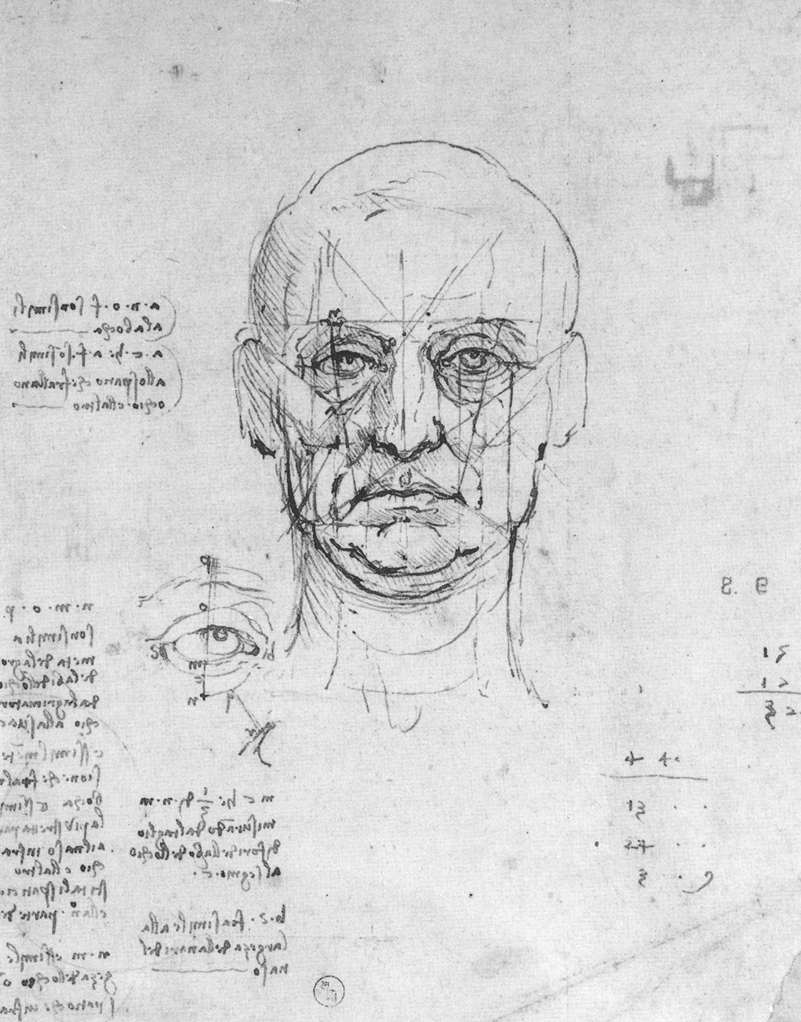
The rule is about two thousand years old. The Roman architect Vitruvius, writing about proportion in temples and in the human body, described the face as three equal parts, and Renaissance artists such as Leonardo da Vinci ruled lines across their face studies in the same spirit. It was a tool for drawing a convincing head, not a description of measured people.
Modern anthropometry inherited the rule as one of the “neoclassical canons” and then tested it. The short version of what it found: real faces vary a lot, the middle third is usually the shortest, and the canon is a poor yardstick for anyone.
When orthodontic textbooks and looksmaxxing forums talk about facial thirds today, they usually mean the same three bands Vitruvius described, measured between slightly different points. That small difference in landmarks turns out to matter, as section 5 explains.
The distance from the bottom of the chin to the under side of the nostrils is one third of it; the nose from the under side of the nostrils to a line between the eyebrows is the same; from there to the lowest roots of the hair is also a third, comprising the forehead.
— Vitruvius, The Ten Books on Architecture, Book III, Chapter I (trans. M. H. Morgan, 1914)
1. How the scan places your four lines
Switch on the Thirds layer and you'll see up to four horizontal lines on your photo, labelled hairline, brows, nose base and chin.
The brow line is taken at the point between your eyebrows on the midline, not at the top of the arches. The nose base is the point where the nose meets the upper lip. The chin line is the lowest point of the chin on the face outline. All three come from Google's MediaPipe face landmarks, after the image has been rotated so your pupils sit level and your head has been turned back to frontal.
The hairline is the hard one, because there's no landmark for it. We run a second Google model, a hair-segmentation model that marks which pixels are hair. Starting at the top of the face mesh, the scan walks straight up the midline and stops at the first row where most of a small strip of pixels is hair. If it never finds one within a sensible distance, it reports the hairline as not found and skips every measurement that needs it, rather than guessing.
Your upper, middle and lower thirds are then shown as percentages of the hairline-to-chin length, each with a ± range from the photo plus three re-framed copies.
3. How often are facial thirds actually equal?
Researchers have tested the thirds canon directly, by measuring faces with calipers or 3D cameras and counting how many fit within a small tolerance. Here is what they found.
| Population (study) | Upper = middle | Middle = lower | Upper = lower |
|---|---|---|---|
| Saudi young adults, n = 168 (Al-Sebaei 2015) | 9.7% men, 9.3% women | 5.4% men, 10.7% women | 21.5% men, 14.7% women |
| Kenyan-African adults, n = 72 (Virdi et al. 2019) | 0% men, 0% women | not reported | not reported |
| Southern Chinese, n = 103, 3D photos (Jayaratne et al. 2012) | All three equal: 0% |
5. Why your percentages won't match a textbook
Even a perfectly measured photo won't reproduce those millimetre figures, for three reasons. First, the landmarks differ: the studies above start the middle third at the nasal root (the deepest point between the eyes), while our brow line sits at the point between the eyebrows, a little higher. Second, they used calipers or 3D cameras on the real face, while a phone photo is a 2D projection; close range enlarges the centre of the face, and Pressler and colleagues (2022) measured nasal length 6.4% longer in 12-inch selfies than in clinical photos. Third, the landmark model has its own error, about 2% to 3.3% of the distance between the eyes on average, per Google's model card.
That's why FaceCheckup shows your thirds as plain numbers, without a “normal range” beside them. The published norms use different landmark definitions, so telling you that your 36% upper third is normal or abnormal against them would be making something up. Compare your own photos with each other instead: if two good photos agree within their ± ranges, that's your measurement.
6. How to measure your facial thirds accurately
Vertical proportions are the most sensitive to how you hold your head. Tipping your chin up or down foreshortens parts of the face in a flat photo and moves every line. The quality check warns at 10° of chin tilt and asks for a retake beyond 18°.
Get these steps right and your facial thirds should repeat closely from one photo to the next; get them wrong and the lines can move by more than the differences you're trying to see.
- Prop the phone at eye level, about 1 to 1.5 m away, and use the timer (research-supported: close photos distort central features).
- Keep your head level, chin neither raised nor tucked.
- Pull all hair, including bangs, off your forehead, and take off glasses.
- Close your lips gently and keep your face relaxed; an open mouth or a smile lengthens the lower third.
- Use even, frontal light so the forehead and chin edges are visible.
- Scan, read the quality notes, and repeat with a second photo. Trust the numbers only where both photos agree.
7. Reading middle ÷ lower third
This ratio is the most robust part of the thirds measurement, because it doesn't depend on hair. A value of 1.00 means your brows-to-nose-base and nose-base-to-chin distances are equal. A value of 0.85 means the middle third is 85% as long as the lower third.
In the published averages above, the middle third is shorter than the lower one. Dividing the published means ourselves gives about 0.75 for Farkas's North American white men and 0.79 for women, and about 0.83 and 0.88 for Al-Sebaei's Saudi men and women. Because those studies measure from the nasal root, not from between the brows, those figures describe the populations, not a target for your scan. No study we found identifies an attractive or ideal value for this ratio.
Expression matters here too. A smile pulls the mouth corners up and back and can change the lower third by more than the ± range, which is why the quality check flags smiling and an open mouth.
If you want to track it over time, for example while trying a new beard shape or fringe for photos, keep the camera in the same place and note the ± range each time. A change smaller than the range is noise, not a change in your face.
8. What you can do with your result
Proportions aren't problems, but they do guide styling choices, and that's where measuring is genuinely useful. Every suggestion below comes from our sourced rulebook, with its label.
- If your upper third is the longest of the three and that bothers you: side-swept or curtain bangs, or some hair brought forward onto the forehead, and no strict centre part or slicked-back style that exposes the whole forehead (stylist convention). Thin, light or bottom-weighted frames rather than heavy top bars (optician convention). Our big-forehead page covers these in detail.
- If your whole face reads as long: avoid styles that add height on top, keep length moderate and add width at the sides; a fringe that falls to about eyebrow level shortens the visible length (stylist convention).
- If your upper third is short: our rulebook has no well-sourced rule for that case, so we won't invent one. Most face-shape advice still applies; run the face shape detector for those suggestions.
- For photos: hold the camera at eye level or slightly above, never below the chin. Photographers find a slightly high angle defines the jaw, while a low angle is unflattering for most people (photographer convention).
Sources & further reading
- Vitruvius, The Ten Books on Architecture, Book III, Chapter I, trans. Morris Hicky Morgan (1914), Project Gutenberg
- Al-Sebaei MO (2015), Head & Face Medicine: The validity of three neo-classical facial canons in young adults originating from the Arabian Peninsula
- Virdi SS, Wertheim D, Naini FB (2019), Maxillofacial Plastic and Reconstructive Surgery: Normative anthropometry and proportions of the Kenyan-African face (with Farkas comparison data)
- Jayaratne YS, Deutsch CK, McGrath CP, Zwahlen RA (2012), PLOS ONE: Are neoclassical canons valid for southern Chinese faces?
- Khoshab N et al. (2022), Aesthetic Surgery Journal: Historical tools of anthropometric facial assessment
- Winiarska N et al. (2025), Aesthetic Plastic Surgery: The concept of ideal lips of Caucasian female
- Pressler MP et al. (2022), Plastic and Reconstructive Surgery: Size and perception of facial features with selfie photographs
- Ward B et al. (2018), JAMA Facial Plastic Surgery: Nasal distortion in short-distance photographs
- Yan G, Grishchenko I (Google, 2022): Model Card, MediaPipe Face Mesh V2
- Tkachenka A et al. (Google, 2019): Model Card, Hair Segmentation
- Jackie Summers, Matrix blog: How to choose the best hairstyle for your face shape
- Erinn Morgan, All About Vision: Glasses shape and color analysis
- Lois Joy Johnson, quoting photographer Eric Wolfe, AARP (2024): Looking better in pictures
- Felix Gray (2026): What is my face shape for glasses? (hair back for the scan)
- Wikimedia Commons: Leonardo da Vinci, Study on the proportions of head and eyes, public domain
Read next
- Is my forehead big?
Big forehead or just a photo angle? Free test, no sign-up: measure your forehead on your own photo, then see haircuts, bangs and frames that help.
- Golden ratio face
Golden ratio face claims tested against research: why 1.618 fails as a beauty formula, and two ratios studies support, measured free with no sign-up.
- Facial symmetry test
Facial symmetry test that mirrors 220 landmark pairs on your own photo, corrects head turn, and shows a ± range. Free, private, no sign-up.
- Midface ratio
Midface ratio measured free on your photo, no sign-up: pupil distance ÷ pupils-to-lip height with a ± range, the three definitions and the research.
- Face shapes
Face shapes explained: oval, round, square, oblong, heart, diamond and triangle, how stylists define each, and a free detector with no sign-up.
Part of Facial symmetry test. Take the full free attractiveness test on the FaceCheckup home page.

Sukie · Founder and editor
Sukie built FaceCheckup because she always wanted a face tool that explains its numbers and tells you what to do with them, and nothing on the market did both. She checks every measurement on the site against published research and labels every tip for what it is: research, or stylist convention.
About this site · How pages are checked · Last updated October 23, 2026
FaceCheckup is for information and entertainment. It measures proportions in one photo; it is not a medical, psychological or cosmetic-surgery assessment, and it cannot tell you your worth.