A jawline rating is only useful if you can see what was measured, so this one draws every line on your own photo instead of handing you a bare score out of ten. Most pages that rank for this search list jaw 'types' or sell exercises. None of them measures the face you upload.
This hub covers the lower face as a whole: jaw width, the jaw corner, the chin, and the cheekbones the jaw is compared against. You will see how the numbers are calculated, why a front photo can never give you the true bone angle, how men's and women's faces differ according to large measured samples, and which beard, haircut, contour and camera choices change how a jaw reads in real life.
What a jawline rating can measure from the front
FaceCheckup finds 478 landmarks on your face with Google's MediaPipe Face Landmarker, running on your device so the photo never leaves it. Three of the outputs describe the lower face. Jaw width ÷ cheekbone width compares the distance between the two jaw corners with the distance between the widest points of the cheekbones. Forehead width ÷ cheekbone width does the same at the temples. Jaw angle (front view) is the angle at each jaw corner between the line running up to the cheekbone and the line running down to the chin, averaged across both sides.
A smaller front-view angle means the outline turns more sharply at the corner, which is what people usually mean by a 'sharp' or 'square' jaw. A larger angle means the outline flows more gradually from cheek to chin, which reads as softer or rounder. A wider jaw relative to the cheekbones makes the lower face look broader; a narrower one makes it taper toward the chin.
Those two numbers, width and corner, are what a camera can honestly capture. Definition under the jaw and chin depth need a profile view or a 3D scan, so we leave them out rather than guess.
Why no photo can give you your true gonial angle
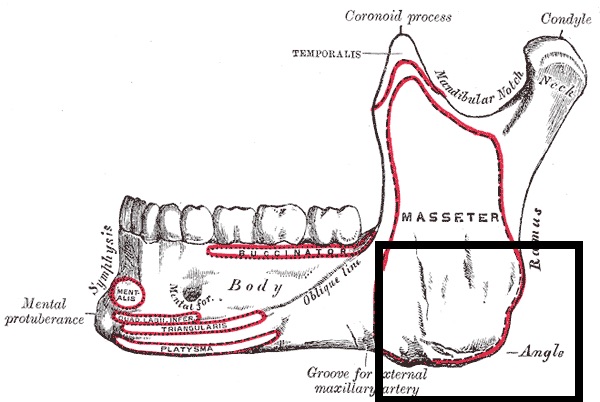
Forum threads often ask for a 'gonial angle' rating. The gonial angle is a bone angle: it sits between the back edge of the lower jaw (the ramus) and its lower border, and it is measured from the side on X-rays or CT scans. Bakan and colleagues (2022) measured it on cone-beam CT images of 235 people in Turkey aged 7 to 77. The right-side gonial angle averaged 125.25° ± 6.61° in women (124 people) and 121.64° ± 6.88° in men (111 people).
Those figures are useful context, but they cannot be compared with anything a selfie shows. A front photo flattens the jaw into a 2D outline, and soft tissue sits over the bone. The angle you see from the front is a different angle in a different plane. That is why our measurement is labelled 'jaw angle (front view)' and why we never convert it into a gonial estimate. Any site that gives you a gonial angle from a front-facing selfie is inventing a number.
How to read your jaw result on FaceCheckup
Run the scan above, then open the Jaw group of results. Switch on the Jaw layer to see the angle drawn at both corners, and the Widths layer to see the forehead, cheekbone and jaw lines laid across your face. If a line lands somewhere odd, such as inside a beard or below the jaw because of a shadow, you will see it immediately, which a bare score would hide.
Every number comes with a ± range. The scanner measures your photo plus three re-framed copies of it, and the ± is half the spread between them. In our own test on one selfie, canthal tilt read 7.01°, 7.81°, 7.31° and 7.46° across the four copies, a spread of about ±0.4°. Jaw numbers wobble the same way. Treat a difference smaller than the ± as no difference at all.
These numbers are shown without a 'normal range' next to them. The published jaw studies used calipers or CT scans on bone points that MediaPipe does not locate in the same place, so lining your number up against them would be comparing different things. The jaw measures also don't feed the Balance Score, which uses only symmetry and Pallett, Link and Lee's (2010) two eye ratios.
Is there a 'good' jaw width? What research does and doesn't show
There is no large, multi-population norm for jaw width relative to cheekbone width. The best published numbers we found come from Virdi, Wertheim and Naini (2019), who measured 72 Kenyan-African adults aged 18 to 30 with calipers. Dividing their published means gives about 0.80 for men and 0.74 for women. That arithmetic is ours, the sample is small, and caliper points sit on bone landmarks rather than the photo outline, so the ratio cannot be laid over your result.
Face width itself is better documented. In the US Army's ANSUR II survey of 6,068 adults, cheekbone (bizygomatic) breadth averaged 142.6 mm in men and 133.8 mm in women, calculated by us from the public data. Your phone cannot give you millimetres at all: a photo has no absolute scale, and the landmark model's own error is about 2% to 3.9% of the distance between the eyes, according to Google's model card. That is why every jaw figure we show is a ratio.
| Measure | Men | Women | Who was measured |
|---|---|---|---|
| Jaw corner width (bigonial) | 106.6 mm (SD 5.9) | 96.8 mm (SD 2.9) | 72 Kenyan-African adults, calipers |
| Cheekbone width (bizygomatic) | 133.8 mm (SD 4.6) | 130.1 mm (SD 3.5) | Same Kenyan-African sample |
| Cheekbone width (bizygomatic) | 142.6 mm (SD 6.2) | 133.8 mm (SD 5.6) | 6,068 US Army personnel, calculated from ANSUR II data |
| Gonial angle, right side | 121.64° (SD 6.88) | 125.25° (SD 6.61) | 235 people in Turkey, cone-beam CT |
Men's and women's jaws: what actually differs
Looksmaxxing forums lean heavily on the facial width-to-height ratio (fWHR) as a 'masculinity' number. The research is far less dramatic. A meta-analysis by Geniole and colleagues (2015) found that fWHR was larger in men than in women by d = .11 across 10,853 people, which is a very small difference. Summersby and colleagues (2022) measured 17,607 Australian passport photos and found men's fWHR larger only in young adulthood, with women's larger after age 48.
Raw width tells a clearer story. Caton and Dixson (2022), working with the same 6,068 ANSUR II adults, found bizygomatic (cheekbone) width highly sexually dimorphic, with an equivalent effect size of d = 1.39. They also showed that ratio measures like fWHR can produce misleading results, because the sign of the sex difference flips depending on which height you divide by. The CT data above show men's gonial angles slightly smaller than women's on average, with wide overlap.
So when someone says a jaw looks 'masculine', they are mostly reacting to overall size and width, which a ratio from a selfie cannot capture. A ratio describes shape, not sex, testosterone or personality.
Jaw, chin and cheekbones work as one outline
Stylists judge face shape by comparing three widths, forehead, cheekbones and jaw, plus face length and how sharp the jaw corner is. FaceCheckup's face-shape detector uses exactly those inputs, which is why your jaw result feeds into the shape you get. Round and square faces have about the same length and width in every stylist definition we collected; the one thing that separates them is the jaw corner. Heart and diamond faces both narrow toward the chin, and diamond adds a narrow forehead so the cheekbones stand out as the widest point.
If your jaw ratio is high and the corner is sharp, expect a square or triangle (pear) result; if the jaw is narrow, expect heart or diamond. The detector shows the top two shapes with percentages instead of forcing one. The high cheekbones, face shapes and male face shapes pages go deeper into each part of this outline.
Mewing, bone smashing and fillers: where this site stands
Many jawline searches end in advice to mew, chew hard gum, or worse. A 2025 systematic review by Seraj and colleagues found a paucity of studies on mewing, with claims resting on anecdotal or low-level evidence. A 2026 study by Grillo and colleagues tracked 'bonesmashing' (hitting the face to provoke bone growth) on social media and described it as a dangerous trend being normalised with pseudoscientific language.
We don't give advice on exercises that claim to reshape bone, on fillers, on surgery or on any medical procedure. If you are thinking about a procedure, talk to a licensed medical professional. Our measurements are not medical: Google's model card for the landmark model states it is not intended for life-critical decisions. What we can offer instead are choices that are free, reversible and sourced: facial hair, haircuts, frames, makeup and the way a photo is taken.
Beard choices that change how a jaw reads
A beard is the most direct way to change the outline of the lower face, and barbers agree on a few rules. Each one below is a stylist convention, sourced from at least two grooming publications (FashionBeans, The Art of Manliness, Philips, Pall Mall Barbers, Harry's and Braun).
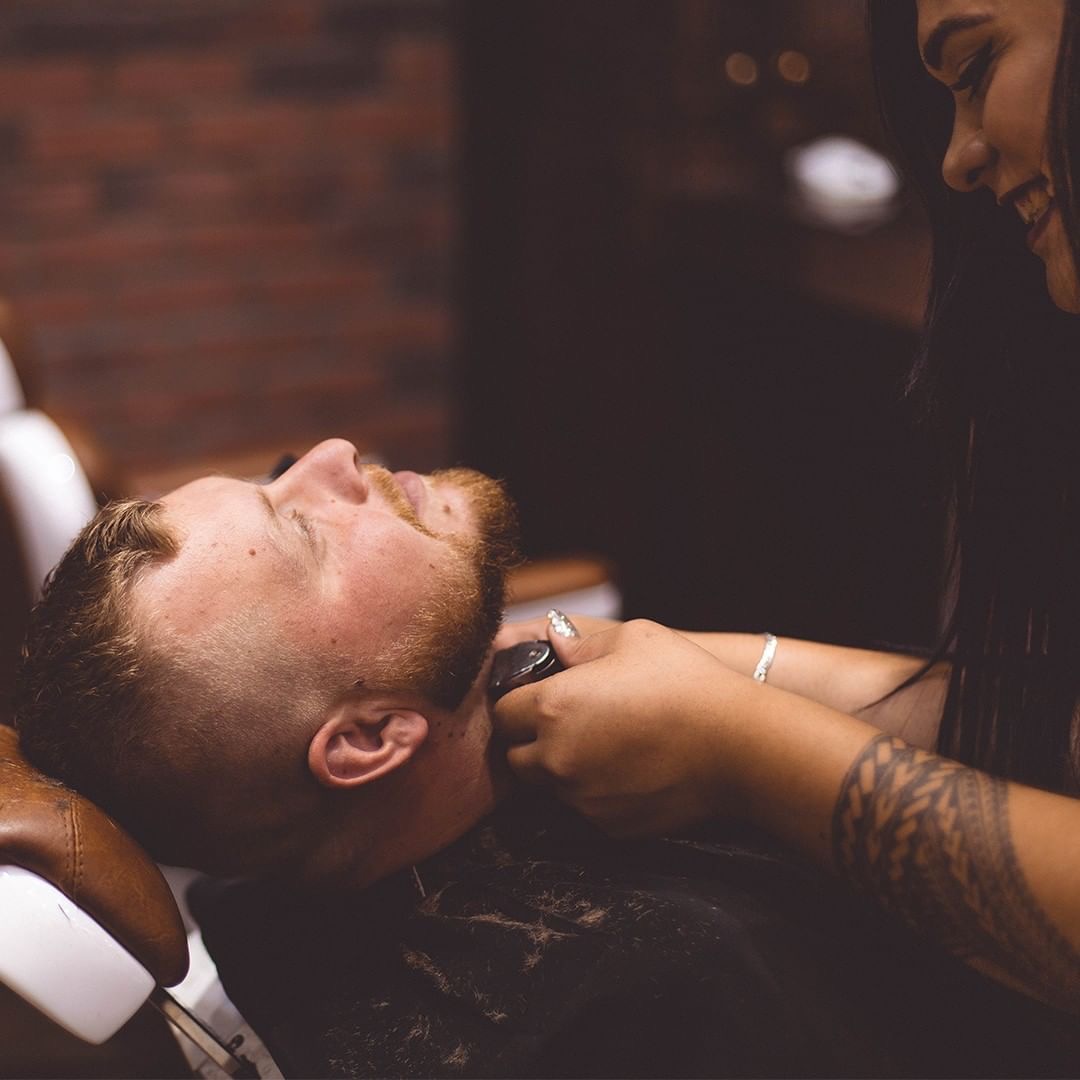
- Soft or low-definition jaw: grow a short full beard that covers the whole jaw and is a little longer at the chin. A beard can draw the jaw and chin outline that the bone structure doesn't show (stylist convention).
- Any jaw: set the neckline about two finger-widths above the Adam's apple. Shaving right up to the jawbone removes the shadow that outlines the jaw and makes it look weaker (stylist convention).
- Narrow jaw: keep fuller sides along the lower jaw and a rounded or squared chin rather than a point; pointed goatees narrow it further (stylist convention).
- Wide, angular jaw you like: keep it short, such as close stubble or a goatee, so the jawline stays visible (stylist convention).
- Wide, angular jaw you want softer: choose a beard rounded or slightly tapered at the chin, and tell the barber not to square it off with hard corners (stylist convention).
- Patchy cheeks: a goatee, anchor or Van Dyke puts hair where it grows thickest. The scanner doesn't measure beard growth, so this one is your call (stylist convention).
Haircuts, glasses and contour around the jaw
Where hair ends matters more than the cut's name. Stylists at Revlon Professional, Matrix and InStyle agree that a wide jaw looks best when the hem or layers end below the jaw, not exactly on it, because a blunt line at the jaw angle draws attention to its width. A narrow jaw is the opposite case: fullness at chin level, such as a wavy chin-to-collarbone bob or a lob, fills out the lower face. For men with a square face, barbers suggest height and texture on top with neat sides (all stylist conventions).
Opticians use frames to move attention up or down. If your jaw is wide, WebMD, All About Vision and Vision Express suggest putting the frame's visual weight on top, such as a browline or a bold top rim. For a square face, curved oval or round frames contrast with the jaw's angles, while boxy, sharply angular frames echo them (optician conventions).
If you wear makeup, contour follows the same logic. For a square face, makeup artists at e.l.f., Maybelline and AARP shade the outer corners of the forehead and the jaw corners, with only a light touch under the cheekbones. For a round face, Patrick Ta, e.l.f. and AARP place contour along the jaw and in the hollows under the cheekbones, with highlight down the centre. For a heart face, keep contour off the jaw, which would narrow the lower face further, and shade only the tip of the chin (makeup-artist conventions).
Photo angles: the fastest change to how your jaw looks
Camera distance changes faces more than most people expect. Ward and colleagues (2018) modelled a selfie taken about 12 inches away and found the nose base appears about 30% wider relative to face width than in a photo from 5 feet. Bryan, Perona and Adolphs (2012) photographed the same faces at 45 cm and 135 cm; the close photos were rated less attractive, trustworthy and competent. Both effects change how the lower face reads, so measure and share photos taken from farther away.
- Prop the phone about 1 to 1.5 m away at eye level and use the timer, instead of holding it at arm's length (research-supported).
- Keep the camera at eye level or slightly above, never below the chin; a low angle hides the jaw under the chin (photographer convention).
- Push your forehead slightly toward the camera and let the chin tip a little forward and down to sharpen the jaw line in straight-on shots (photographer convention).
- Use soft window light from the front or side. Hard overhead light throws shadow under the chin and can hide the jaw edge the scanner needs (photographer convention).
- For profile pictures, take one three-quarter shot to each side and keep the one you prefer, without turning so far that the nose crosses the far cheek line (photographer convention).
Your jawline plan for this week
Start with the measurement, then pick one change. Take a straight-on photo with the phone propped at eye level, hair pulled back, glasses off, mouth closed and a neutral face. Run the scan and switch on the Jaw and Widths layers. Note the jaw ratio, the front-view angle and their ± ranges, and check whether the face-shape result lands on square, round, heart or somewhere between two shapes.
If you have facial hair, try the neckline rule first: it costs nothing and changes the jaw outline within one trim. Booking a haircut? Tell your stylist where the hem should land relative to the jaw. Then retake the photo the same way and compare. The numbers will barely move, because bone doesn't change, but you will see how much of what people notice is outline, shadow and angle.
Every guide in Jawline rating
- High cheekbones
High cheekbones or low? Free test, no sign-up: find where your face is widest, drawn on your photo, plus blush, contour and glasses tips that fit.
Questions people ask
- How do I know if my jawline is weak?
- There is no published cut-off for a 'weak' jaw from a front photo. What you can check is whether your jaw is narrow relative to your cheekbones and whether the jaw corner turns gradually or sharply. Both are shapes, not flaws. A short full beard, a higher neckline or a slightly forward head position in photos changes how defined the jaw looks.
- Can you rate a jawline from a side photo?
- Not on FaceCheckup. The landmark model and quality check are built for front-facing photos, and a side view needs different landmarks. The side-view gonial angle is measured clinically on X-rays or CT scans, where Bakan et al. (2022) found averages of about 125° in women and 122° in men.
- Why does my jaw look different in every photo?
- Pose, distance and light. Lifting or tucking the chin changes the front-view jaw angle, a close selfie widens central features relative to the face edge, and overhead light hides the jaw edge in shadow. That's why the scanner checks pose and light first and shows a ± range.
- Does mewing give you a better jawline?
- The evidence isn't there. A 2025 systematic review found few studies on mewing and only anecdotal or low-level evidence. We don't recommend exercises that claim to change bone.
- Is a wide jaw more masculine?
- Men's faces are wider on average, mainly across the cheekbones (Caton and Dixson 2022). Ratios such as fWHR show only a very small sex difference (d = .11), and it reverses in older adults. A ratio from a photo says little about masculinity.
- How accurate is a jawline rating from a selfie?
- Good enough to compare your own photos, not precise to the millimetre. Google reports landmark errors of about 2% to 3.9% of the distance between the eyes. Use the ± range: differences smaller than it aren't meaningful.
Sources & further reading
- Bakan A, Kervancioglu P, Bahsi I, Yalcin ED (2022), Cureus: Comparison of the Gonial Angle With Age and Gender Using Cone-Beam Computed Tomography Images
- Virdi SS, Wertheim D, Naini FB (2019), Maxillofacial Plastic and Reconstructive Surgery: Normative anthropometry and proportions of the Kenyan-African face
- Gordon CC et al. (2015), ANSUR II 2012 Anthropometric Survey of U.S. Army Personnel, public data (Penn State OPEN Design Lab)
- Caton N, Dixson B (2022), Biology Letters: Beyond facial width-to-height ratios: bizygomatic width is highly sexually dimorphic when adjusting for allometry
- Geniole SN et al. (2015), PLoS One: Evidence from Meta-Analyses of the Facial Width-to-Height Ratio as an Evolved Cue of Threat
- Summersby S, Harris B, Denson TF, White D (2022), Royal Society Open Science: Tracking sexual dimorphism of facial width-to-height ratio across the lifespan
- Pallett PM, Link S, Lee K (2010), Vision Research: New 'golden' ratios for facial beauty
- Seraj SS et al. (2025), Aesthetic Surgery Journal Open Forum: Efficacy of Conservative Techniques for Mechanical Facial Rejuvenation: A Systematic Review
- Grillo R, Fernandes LA et al. (2026), J Stomatol Oral Maxillofac Surg: Dangerous trends on social media related to facial esthetics
- Ward B, Ward M, Fried O, Paskhover B (2018), JAMA Facial Plastic Surgery: Nasal Distortion in Short-Distance Photographs: The Selfie Effect
- Bryan R, Perona P, Adolphs R (2012), PLoS One: Perspective Distortion from Interpersonal Distance Is an Implicit Visual Cue for Social Judgments of Faces
- Hönekopp J (2006), J Exp Psychol Hum Percept Perform: Once more: is beauty in the eye of the beholder?
- Google (2022), Model Card: MediaPipe Face Mesh V2
- FashionBeans: The right beard for your face shape
- The Art of Manliness: Your no-nonsense guide to choosing the right beard style
- Philips UK men's grooming: The best beards for face shapes
- Pall Mall Barbers: Best beard styles for different face shapes
- Braun: How to trim and shape a beard neckline
- Revlon Professional: What hairstyle suits me?
- Matrix: How to choose the best hairstyle for your face shape
- WebMD: How to pick the right glasses for your face shape
- All About Vision: The best glasses for your face shape and skin tone
- e.l.f. Cosmetics: How to contour based on your face shape
- Maybelline: How to contour by face shape
- AARP: Tips for looking better in pictures
- Adobe Express Learn: How to take portrait photos with your phone
Read next
- High cheekbones
High cheekbones or low? Free test, no sign-up: find where your face is widest, drawn on your photo, plus blush, contour and glasses tips that fit.
- Face shapes
Face shapes explained: oval, round, square, oblong, heart, diamond and triangle, how stylists define each, and a free detector with no sign-up.
- Male face shapes
Male face shapes, explained: the 7 outlines barbers use, what research says differs in men's faces, and a sourced haircut, beard and frame plan per shape.
- Facial symmetry test
Facial symmetry test that mirrors 220 landmark pairs on your own photo, corrects head turn, and shows a ± range. Free, private, no sign-up.
- Haircut finder
Haircut depending on face shape: scan one photo free, no sign-up, to find your shape, then see sourced cuts to try and to avoid, for women and men.
- Midface ratio
Midface ratio measured free on your photo, no sign-up: pupil distance ÷ pupils-to-lip height with a ± range, the three definitions and the research.
Take the full free attractiveness test on the FaceCheckup home page.

Sukie · Founder and editor
Sukie built FaceCheckup because she always wanted a face tool that explains its numbers and tells you what to do with them, and nothing on the market did both. She checks every measurement on the site against published research and labels every tip for what it is: research, or stylist convention.
About this site · How pages are checked · Last updated October 23, 2026
FaceCheckup is for information and entertainment. It measures proportions in one photo; it is not a medical, psychological or cosmetic-surgery assessment, and it cannot tell you your worth.