The diamond face shape is defined by one feature: cheekbones that are noticeably wider than both the forehead and the jaw. Above and below them the face narrows, so the outline comes to a soft point at the top and the bottom.
Because the cheekbones are also the widest point on an oval face, diamond is easy to confuse with oval, and because the chin is narrow, it is easy to confuse with heart. This guide shows how to tell them apart on your own photo, then covers diamond face shape hairstyles, glasses, brows, makeup and beards, each with the professional source behind it.
Check your own face: diamond face shape
Tick the box to scan your own photo, or try the example first.
- 100% free
- No sign-up
- Photo never leaves your device
- Unlimited scans
Best results: face the camera at eye level, neutral expression, lips together, hair off the forehead, soft light from the front, phone at arm’s length.
What is a diamond face shape?
Every source we read describes the same pattern. Celebrity hairstylist Paul Labrecque, quoted by TODAY: “You have wider cheeks with a narrow forehead and jawline.” Barber Matty Conrad, in GQ Middle East: “Widest at the cheekbones, and slightly more narrow at the forehead and chin.” Optometrist Dr. Catherine Ong, for Zenni: “A diamond face shape features a narrow forehead, high cheekbones, and a small, defined chin.” Opticians at All About Vision say “narrow at the forehead and chin,” and the optical trade journal Eyecare Business puts it as “narrow at the eyeline and jawline.”
So there are three checks. The cheekbones are the widest point. The forehead is clearly narrower than the cheekbones. And the jaw is clearly narrower too, usually ending in a narrow chin. Diamond faces are often moderately long, but length is not what defines them.
Why does my diamond face look oval?
This is one of the most common diamond questions, and the answer is that the two shapes share their widest point. On both, the cheekbones are wider than the forehead and the jaw. The difference is how much. On an oval face the forehead and jaw are only a little narrower and the outline curves smoothly; on a diamond face both are clearly narrower, so the cheekbones stand out as a corner on each side.
Several everyday things blur that difference. Hair worn loose over the temples fills in a narrow forehead and makes the outline look oval. A fringe does the same. Fuller cheeks soften the cheekbone corner. And a photo taken close to the face, or from below, changes the widths you see. If someone who knows you says oval and an app says diamond, both may be describing the same face in different conditions.
On FaceCheckup the forehead-to-cheekbone ratio decides it. Our reference value is 0.92 for oval and 0.86 for diamond, and 0.77 against 0.73 for jaw-to-cheekbone. These are our own model values, built on Google's canonical face model, because no stylist source gives a numeric cut-off. If your result shows diamond and oval close together, you are on the boundary, and the advice that suits both (soft fringes, length past the cheekbones) is the safe choice.
Diamond or heart: which end is narrow?
Heart and diamond both have a narrow, often pointed chin, so they get mixed up from the bottom. Look at the top instead. On a heart face the forehead is the widest part, or about as wide as the cheekbones; L'Oréal Paris's quick test is that “if your brows are noticeably wider than your jaw, you have a heart-shaped face.” On a diamond face the forehead is clearly narrower than the cheekbones.
On a photo, compare the top and middle lines on the Widths layer. If the top line is close to or longer than the middle line, read the heart-shaped face guide. If it is clearly shorter, diamond is the better description. The styling advice differs mainly at the forehead: heart faces are told to soften a wide forehead with side-swept or long curtain bangs and to avoid heavy blunt ones, while diamond faces are told to add width there.
Diamond face shape hairstyles that work
Stylists approach a diamond face with one goal: add visual width at the forehead and the jaw so the cheekbones no longer stand out alone. Every cut below is a stylist convention from our rulebook, each backed by at least two professional sources (TODAY, InStyle, Cosmopolitan, Revlon Professional, Huda Beauty and The Art of Manliness among them).
For short hair, the chin-length bob is the classic recommendation, because it ends where the face is narrow and adds fullness there. For medium hair, a side-parted lob or shoulder-length cut is the safest single choice: the off-centre part softens the symmetry of the cheekbone corners, and length past the cheekbones carries weight down to the jaw. For long hair, keep it, but add a fringe or face-framing pieces that start below the cheekbones.
How to ask for it at the salon: rather than naming a face shape, describe where you want the weight. Say you want the cut to sit fuller around the jaw or chin, softer and fuller at the temples, and with no short layers ending at the cheekbones. If you want a fringe, ask for one that is longer at the outer edges so it widens the forehead instead of covering it as a narrow block. Bringing a screenshot of your Widths layer helps here: a stylist can see at a glance that your middle line is the longest, which is the whole reason for the advice.
Hair texture changes how much help you need. Curly and wavy hair adds width on its own, so a shoulder-length curly cut often balances a diamond face with no further changes, as long as the volume starts below the cheekbones rather than at them. Very fine, straight hair falls flat at the temples, so a fringe or a side part does more of the work. These are applications of the same stylist convention, not separate rules: put width where the face is narrow.
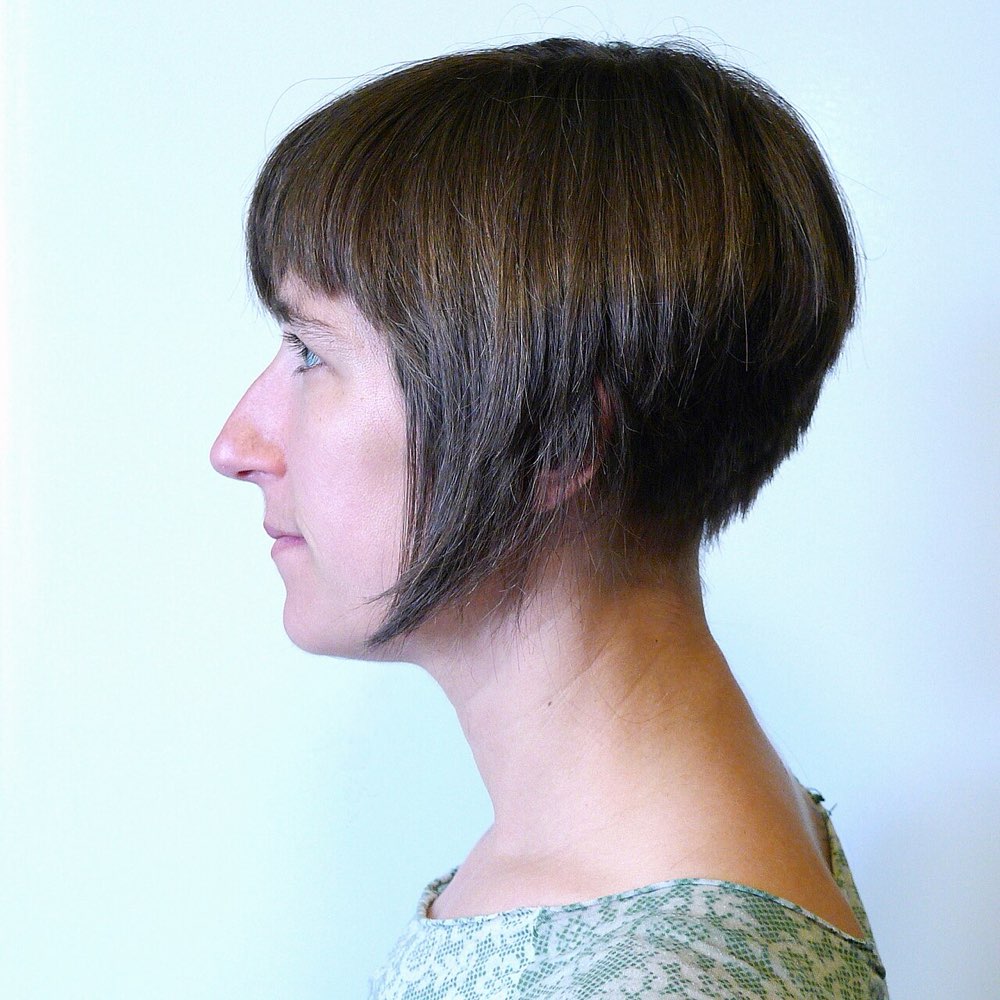
- Chin-length bob, or a shoulder-length cut with fullness at the jaw (stylist convention). Width at the jaw balances cheekbones that are the widest point.
- A fringe: curtain, side-swept or long layered (stylist convention). Hair across the forehead adds width at the top to match the cheekbones.
- Side-parted lob or shoulder-length cut (stylist convention). An off-centre part and length past the cheekbones soften the angles.
- Some fullness at the temples (stylist convention). Flat temples make the forehead look narrower next to wide cheekbones.
- For men: keep some length and texture at the sides and top rather than a skin-tight fade at the temples, and consider a fringe (stylist convention, The Art of Manliness and Cosmopolitan). The same logic applies: fill in the narrow forehead.
What should a diamond face avoid?
Two habits work against the shape. The first is short layers that end right at the cheekbones; Cosmopolitan's stylists and barber Matty Conrad both warn against them, because they put volume exactly where the face is already widest. The second is flat hair or tight sides at the temples, which makes the narrow forehead look narrower still.
Brow and beard choices have similar traps: sharp, peaked arches make the cheekbone width more angular, and a pointed chin beard narrows an already narrow jaw. Neither is wrong if you like the look; they just pull in the opposite direction from the balancing advice.
Updos follow the same logic. Hair scraped tightly back from the temples shows the full cheekbone width against a narrow forehead; leaving a few face-framing pieces loose in front of the ears, or pulling the hair back softly rather than flat, keeps some width at the top.
Which glasses suit a diamond face?
Opticians agree on curves and on detail at the top. The table gives the three frame conventions from our rulebook with the reason and the sources behind each. Whatever the shape, the frame should not be much wider than your cheekbones, or it adds width where you have the most.
| Try | Why | Sources |
|---|---|---|
| Oval or cat-eye frames | Curves soften high, wide cheekbones and cat-eyes lift the eye line | All About Vision, Reliant Medical Group optician, Glasses Direct, Vision Express |
| A defined brow line or top-heavy detail, such as browline or Clubmaster styles | Detail on top adds width to the narrow forehead | All About Vision, Reliant Medical Group optician, Vision Express |
| Rimless or semi-rimless frames | They frame the eyes without adding width at the cheekbones | All About Vision, Reliant Medical Group optician, Glasses Direct |
What about brows, makeup and a beard?
Brows (makeup-artist convention): use a rounded or gently curved brow rather than a sharp peak; curves soften the widest point at the cheekbones. HighBrow Beauty and Maybelline both recommend it.
Contour (makeup-artist convention): contour lightly on the outer cheekbones and along the temples and hairline, and keep highlight in the centre of the forehead and chin. Patrick Ta, e.l.f. and Maybelline give the same pattern, which shades the widest point and brightens the narrow ends.
Blush (makeup-artist convention): apply it on the tops of the cheekbones and blend outward toward the ears. This rule has only one strong source so far, L'Oréal Paris's Roberto Rodriguez, with Trinny London's makeup artist describing the same placement, so treat it as a starting point.
Beard (stylist convention): grow fullness at the chin and lower jaw while keeping the cheeks lighter, and avoid a pointed chin beard. The Art of Manliness, Pall Mall Barbers and FashionBeans agree. Philips suggests a shorter Van Dyke or Balbo instead, which keeps the same idea of weight at the chin with less bulk.
How do you confirm a diamond face shape on FaceCheckup?
Take a straight-on photo with the phone propped about 1 to 1.5 m away at eye level, hair pulled back off the temples and jaw, glasses off, mouth closed. Hair over the temples is the biggest single reason a diamond face reads oval, so tie it back fully for the measurement.
Run the face shape detector and switch on the Widths layer. You are looking for a middle line (cheekbones) that is clearly longer than both the top line (forehead) and the bottom line (jaw). Then read the two closest shapes and their percentages. Diamond with a clear lead confirms it. Diamond and oval close together means a softer diamond: use the fringe and below-cheekbone length advice, which suits both. Diamond and heart close together means your forehead is wider than a typical diamond; compare the heart-shaped face guide and choose the cuts both pages share, such as a chin-length bob or long side-swept bangs.
Take three photos and check the ± range beside each ratio. If the top shape holds across all three, you can take the result to your stylist with confidence. The main scan on the homepage also measures cheekbone height, which tells you whether your widest point sits high or low.
Questions people ask
- Is the diamond face shape rare?
- Many sites call it the rarest shape, but we could not find any study that measured how common face shapes are, so we don't repeat that claim.
- Should a diamond face have long or short hair?
- Either works. What matters is where the volume sits: short cuts should end around the chin, and long hair looks best with a fringe or face-framing layers that start below the cheekbones.
- Do bangs suit a diamond face?
- Yes. Stylists recommend curtain, side-swept or long layered bangs for diamond faces because they add width across the narrow forehead.
- What is the difference between diamond and oval face shapes?
- Both are widest at the cheekbones. On a diamond face the forehead and jaw are clearly narrower, so the cheekbones form a visible corner; on an oval face the outline curves smoothly from forehead to chin.
- How do I tell a diamond face from a heart-shaped face?
- Compare the forehead with the cheekbones. On a heart face the forehead is the widest part or about as wide as the cheekbones; on a diamond face it is clearly narrower. Both usually have a narrow chin, so the chin alone won't tell you.
Sources & further reading
- TODAY (NBC), Anna De Souza quoting hairstylist Paul Labrecque: Need a haircut? Here's how to get the best style for your face shape
- GQ Middle East, Adam Hurly quoting barber Matty Conrad: What's the best haircut for your face shape?
- Zenni Optical, Dr. Catherine Ong, OD: What Is My Face Shape?
- All About Vision, Erinn Morgan (reviewed by Chloe Tauaefa, ABOC): The Best Glasses for Your Face Shape and Skin Tone
- All About Vision, Laura Evans: The best glasses for diamond face shapes
- Eyecare Business, Susan P. Tarrant (2001): The Last Word: All Shapes and Sizes
- L'Oréal Paris USA: The Best Haircuts for Your Face Shape
- InStyle via AOL (2024), Nicole Catanese and Krista Carter: Celebrity Hair Stylists Explain the Best Haircuts for Every Face Shape
- Cosmopolitan via AOL (2025), Lia Mappoura: The Best Haircuts and Styles for Every Face Shape
- Revlon Professional: What Hairstyle Suits Me?
- Huda Beauty: How To Cut Your Bangs To Flatter Your Face Shape
- The Art of Manliness, with barber Thad Forrester: The Best Haircut for Your Face Shape
- Reliant Medical Group, Dan Delisle, Registered Optician: How to Choose Eyeglasses that Suit Your Face
- Glasses Direct: Face Shapes
- Vision Express: Face shape style finder
- HighBrow Beauty, Beverly Harris: Eyebrow shapes to flatter your face
- Maybelline India: 7 Eyebrow Shapes For Different Face Types
- Patrick Ta Beauty: How To Contour & Highlight Based On Your Face Shape
- e.l.f. Cosmetics, Emma Izquierdo: How to Properly Contour Your Face Based on Your Face Shape
- Maybelline: How to contour by face shape
- L'Oréal Paris USA, Roberto Rodriguez: How to Apply Blush for Your Face Shape
- Trinny London, Katie Levy: Where to apply blush
- The Art of Manliness, quoting barber Thad Forrester: Your No-Nonsense Guide to Choosing the Right Beard Style
- Pall Mall Barbers: 2026 best beard styles for different shapes
- FashionBeans, Al Hardacre: Beard Styles For Face Shapes
- Philips UK: The best beards for face shapes
Read next
- Face shapes
Face shapes explained: oval, round, square, oblong, heart, diamond and triangle, how stylists define each, and a free detector with no sign-up.
- Face shape detector
Face shape detector that's free with no sign-up and runs on your device: it measures forehead, cheekbones, jaw and length, then gives your top two shapes.
- Heart shaped face
Heart shaped face: widest at the forehead, narrow at the jaw, often a pointed chin. Check yours from a photo, then get sourced cut, brow and glasses tips.
- Oval face shape
Oval face shape: longer than wide, widest at the cheekbones, softly rounded jaw. How to tell oval from oblong or round, and the cuts and frames that suit it.
- High cheekbones
High cheekbones or low? Free test, no sign-up: find where your face is widest, drawn on your photo, plus blush, contour and glasses tips that fit.
- Haircut finder
Haircut depending on face shape: scan one photo free, no sign-up, to find your shape, then see sourced cuts to try and to avoid, for women and men.
Part of Face shapes. Take the full free attractiveness test on the FaceCheckup home page.

Sukie · Founder and editor
Sukie built FaceCheckup because she always wanted a face tool that explains its numbers and tells you what to do with them, and nothing on the market did both. She checks every measurement on the site against published research and labels every tip for what it is: research, or stylist convention.
About this site · How pages are checked · Last updated October 23, 2026
FaceCheckup is for information and entertainment. It measures proportions in one photo; it is not a medical, psychological or cosmetic-surgery assessment, and it cannot tell you your worth.