Male face shapes are the same seven outlines stylists use for everyone. What changes for men is the toolkit: a haircut is usually shorter at the sides, and a beard can redraw the jaw and chin in a way no haircut can. This guide gives the plan for each shape (cut, beard and frames) from barbers' and opticians' published advice, flags where they disagree, and shows how to measure your own shape from one photo instead of guessing in a mirror.
A word on the numbers you'll see elsewhere. Men's style guides list five, six, seven or nine shapes and rank which is rarest. We found no published, measured study of how common each shape is in men, so we don't rank them.
Check your own face: male face shapes
Tick the box to scan your own photo, or try the example first.
- 100% free
- No sign-up
- Photo never leaves your device
- Unlimited scans
Best results: face the camera at eye level, neutral expression, lips together, hair off the forehead, soft light from the front, phone at arm’s length.
Seven male face shapes, measured the same way
Every shape comes from four measurements: how wide the forehead is, how wide the cheekbones are, how wide the jaw is, and how long the face is relative to its width, plus how angular the jaw corners look. Barber Thad Forrester's descriptions in the Art of Manliness are typical. Round: the cheekbone measurement is larger than the forehead and jawline, which are about the same. Square: the angle of the jaw is sharp rather than rounded. Oblong: your face length is long, like an oval, but your forehead, cheekbones and jawline are similar in size, like a square.
Two naming traps are worth knowing before you read any other guide. 'Oblong', 'long' and 'rectangle' describe the same long shape; rectangle is the version with a square jaw. And 'triangle' means opposite things: barber Matty Conrad, quoted by GQ Middle East, lists a triangle with a wide forehead and a separate 'pear' with a wide jaw, while opticians use triangle for the wide-jaw shape. We use triangle (pear) for a jaw wider than the forehead and call the wide-forehead shape heart.
What research says is different about men's faces
Men's faces are larger on average, but the proportions that define a shape overlap heavily between sexes. That is the plain reading of the anthropometric data, and it matters, because it means a man and a woman with the same shape get advice built on the same balancing logic.
The clearest sex difference is cheekbone width itself. Caton and Dixson (2022), working with 6,068 people, found bizygomatic width highly sexually dimorphic, with an effect size of d = 1.39. Face shape, though, is a ratio. When we calculated the facial index (face length divided by cheekbone width) from the U.S. Army's ANSUR II public data, the averages for men and women were close. The jaw is where men's faces lean squarer in the small studies available: wider relative to the cheekbones in one Kenyan sample, and a slightly sharper jaw-corner angle on CT scans in a Turkish sample. Neither is large enough, or broad enough, to say any shape is 'the male shape'.
| Measure | Men | Women | Sample and source |
|---|---|---|---|
| Facial index (sellion to chin ÷ cheekbone width × 100) | 86.1 ± 5.4 | 84.7 ± 5.1 | US Army, 4,082 men and 1,986 women, 2010 to 2012; calculated from ANSUR II public data |
| Cheekbone width | 142.6 ± 6.2 mm | 133.8 ± 5.6 mm | Same ANSUR II data |
| Jaw width ÷ cheekbone width (ratio of means) | 0.80 | 0.74 | 72 Kenyan adults; Virdi, Wertheim and Naini (2019) |
| Gonial (jaw-corner) angle on CT | 121.6° ± 6.9° | 125.3° ± 6.6° | 235 Turkish adults and children aged 7 to 77; Bakan et al. (2022) |
A plan for each of the male face shapes
This table condenses the beard and haircut rules from our rulebook, each backed by at least two sources. Haircut and beard columns are stylist convention; glasses are optician convention. Where barbers split, both options are shown and the next section explains the choice.
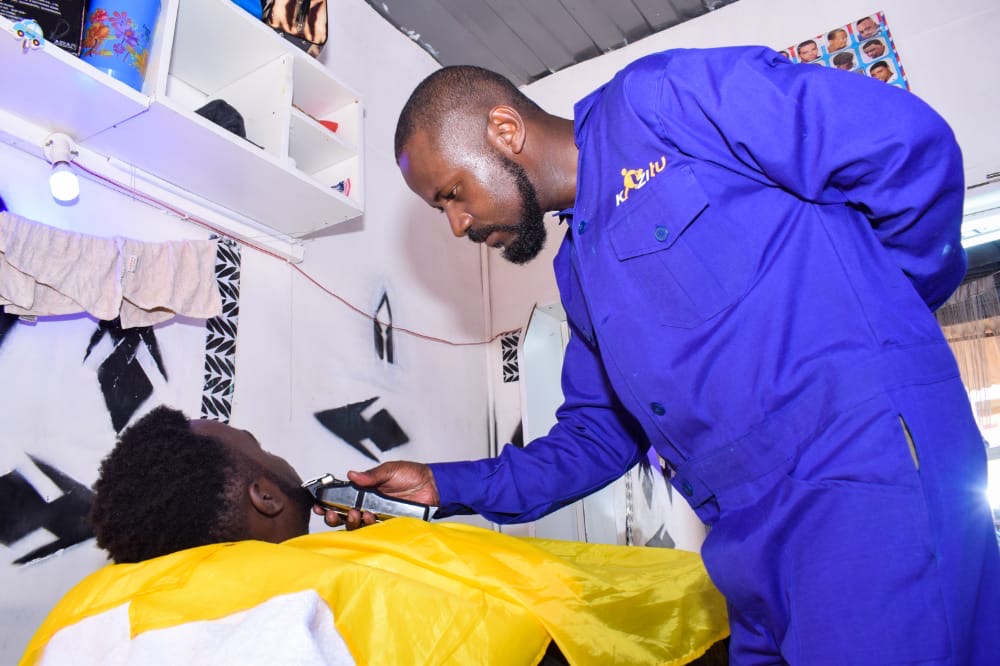
| Shape | Haircut | Beard | Glasses |
|---|---|---|---|
| Oval | Most classic cuts work: short sides, top swept back or side-parted, pompadour, crop with fade, undercut. Skip a heavy forward fringe. | Any length you can grow evenly; keep cheek and neck lines tidy. | Most shapes; frames about as wide as the widest part of the face. |
| Round | Short, lean sides with height and texture on top: quiff, French crop, pompadour. No bulky sides or forward fringe. | Length at the chin, shorter on the cheeks: extended goatee, Van Dyke. Avoid stubble only and wide, bushy beards. | Rectangular, square or geometric frames, wider than deep. Avoid small round lenses. |
| Square | Height and texture on top (textured crop, quiff, side part); neat sides, either tight or nearly matched in length. | Either a rounded beard (circle, Balbo) to soften, or close stubble or a goatee to show the jaw. No boxed right angles. | Oval or round frames, sleek and a little wider than the cheekbones. Avoid boxy frames. |
| Oblong | Moderate top; avoid a tall top with very short sides. A fringe adds width. | Short to medium with fuller sides; don't grow past the chin. | Deeper lenses, decorative or contrasting temples. Avoid narrow, shallow rectangles. |
| Heart | Texture and movement on top; avoid slicked-back styles that show a widow's peak, and wide, round sides. | Short cheeks, more length on the chin and moustache. | Bottom-heavy, light or rimless frames; oval is a safe first try. |
| Diamond | Add forehead width: a fringe cut or textured crop. Avoid short, tight sides. | Fullness at the chin and lower jaw, lighter cheeks; nothing pointed. | Browline or top-detailed frames, ovals, or rimless. |
| Triangle (pear) | Volume at the crown and temples; textured quiffs, French crops, fringes. Avoid high-and-tight cuts. | Short, tight sides; square off the chin and let the moustache carry weight. | Top-heavy frames: browline, bold top rim, aviators. |
Where barbers disagree, and how to choose
Published advice for men splits in a handful of places. None of these splits is a case of one side being wrong; they reflect different goals, usually 'soften the shape' versus 'show it off'. Decide which you want first, then pick the matching option.
- Square haircut sides: the Art of Manliness wants short, tight sides; Matty Conrad wants nearly matched length on the sides. Both agree on height on top. Go tight if you like a sharp look, longer if you want softer.
- Square beard: the Art of Manliness and Philips say keep it close-cropped (stubble or goatee) so the jaw stays visible; Pall Mall Barbers, FashionBeans and Harry's say grow a rounded full or circle beard to soften it. If your jaw is a feature you like, keep it short.
- Oblong length: Conrad recommends going very short, even a buzz; the Art of Manliness prefers medium length with a fringe, and a stylist quoted by the Seattle Times says very short cuts can accentuate the oblong shape. Medium is the safer test.
- Fringe on oval and square faces: barbers say skip it because it shortens the face; women's stylists often recommend fringes for the same shapes. For men's cuts, the barbers' rule is the one we show.
- Heart beard: FashionBeans says avoid a full beard; Philips says a short or full beard can add weight to the jaw. Fuller at the chin than the cheeks satisfies both.
- Diamond beard: the Art of Manliness and Pall Mall favor a full beard at the jaw; Philips prefers short styles such as a Van Dyke or Balbo.
- Triangle beard: the Art of Manliness says stubble only, Philips says a fuller beard gives more control, FashionBeans suggests a squared-off beardstache. Keep the jaw sides short either way.
Getting a clean read with a beard, glasses or a receding hairline
Men's photos have three habits that confuse any face-shape reader, ours included. A thick beard covers the jaw outline, glasses hide the eye and brow landmarks, and a hairline that has moved back makes a face look longer to the eye. Our face shape detector handles the third one by design: it measures length from the top of the landmark mesh on the upper forehead, not from the hairline, so a receding hairline doesn't push you toward oblong. For the first two, take your glasses off, and if you have a full beard, know that the jaw line the scanner finds is partly estimated through the hair, the same way the stylist rule says hair over the jaw hides the outline. A shorter-beard photo gives the most honest jaw reading; your current beard is a styling choice you can then judge against it.
The scanner also corrects head pose before measuring, which matters more than most people expect. On one of our own test selfies, with the head turned about 10° and smiling, raw asymmetry read 4.70% of face width; after rotating the 3D landmarks back to frontal it read 1.06%. The quality check flagged both 'Head turned 10°' and 'Smiling'. Width ratios move with pose in the same way, which is why the scanner asks for a retake beyond 15°.
After the scan, choose Men's styles next to the 'Things you can do this week' heading. The list then shows the men's cut and beard rules for your shape and leaves out women's-only styling, with each tip labelled by where the advice comes from. The result shows your top shape and the next two closest with percentages; if two are close, read both rows of the table above.
Rules that apply whatever your shape
A few pieces of advice don't depend on face shape at all, and they often make a bigger visible difference than the cut itself.
- Set your beard neckline about two finger-widths above the Adam's apple. Braun puts it at two fingers, or about 1.5 inches; the Gentleman's Journal says a neckline shaved up to the jawbone makes the jaw look weaker (stylist convention).
- If your cheeks fill in unevenly, grow a goatee, anchor or Van Dyke and shave the sparse cheeks; these styles put hair where it grows thickest (Pall Mall Barbers, Philips).
- Don't over-tweeze between the brows; clean up strays only, because an over-wide gap is slow to grow back (makeup-artist convention).
- For photos, step back. A camera about 30 cm from the face makes the nose look roughly 30% wider than at 1.5 m (Ward et al. 2018), and Bryan, Perona and Adolphs (2012) found the same faces rated less trustworthy and competent at 45 cm than at 135 cm (research-supported).
- Take one three-quarter photo turned left and one turned right and keep the side you prefer; most faces are slightly asymmetric (photographer convention).
- Re-scan whenever you want to compare photos taken the same way. Face-width measures do shift: Summersby and colleagues (2022) found the sex difference in facial width-to-height ratio held only in young adulthood across 17,607 passport photos.
Questions people ask
- What is the most common face shape for men?
- We couldn't find a measured, published study that counts face shapes in men, so we won't name one. Guides that give a 'most common' shape don't cite where the number comes from.
- What is the rarest male face shape?
- The same answer: guides variously call diamond, heart or triangle the rarest, but none of them shows data. Treat 'rarest shape' claims as marketing.
- Which face shape is the most attractive on a man?
- Face shape categories are styling conventions, not attractiveness scores, and research on attractiveness finds a lot of personal taste. Hönekopp (2006) found private taste about as powerful as shared taste in judging faces. Our scanner doesn't predict how attractive anyone finds you.
- How do I find my face shape as a man?
- Pull your hair back, take off your glasses, keep a neutral face and photograph yourself straight on from about 1 to 1.5 m. Then compare forehead, cheekbone and jaw widths and face length, or run the photo through our face shape detector, which measures them and shows its top shapes with percentages.
- Does a beard change your face shape?
- It doesn't change the bone underneath, but it changes the outline people see, which is why barbers use beards to balance a shape: chin length lengthens a round face, side fullness widens a long one, and a rounded beard softens a square jaw.
- What haircut suits a round face for men?
- Barbers quoted by GQ Middle East and the Art of Manliness recommend short, lean sides with height and texture on top, such as a quiff, French crop or pompadour. Bulky sides and a forward fringe add width.
- Which face shapes suit a buzz cut?
- Barbers treat oval faces as able to wear almost anything, including very short cuts. For long faces they split: Matty Conrad suggests going very short, while other stylists say very short cuts can make a long face look longer.
- What glasses suit a square face for men?
- Opticians recommend oval or round frames, sleek and a little wider than the cheekbones, to soften the jaw's angles (WebMD, Vision Express, Glasses Direct). Boxy, sharply square frames repeat the jaw line.
- Is a strong jaw the same as a square face?
- No. A square face has forehead, cheekbones and jaw of similar width plus a length close to the width. A defined jaw can also sit on an oval, oblong (rectangle) or triangle face. Our jawline guide covers jaw width and angle on their own.
- Can I have two face shapes?
- In practice, yes. The shapes are conventions with fuzzy borders, and many faces sit between two. That's why our scanner shows the top shape plus the next closest with percentages rather than a single label.
Sources & further reading
- Brett and Kate McKay with barber Thad Forrester (Art of Manliness): The Best Haircut for Your Face Shape
- Brett McKay with barber Thad Forrester (Art of Manliness): Your no-nonsense guide to choosing the right beard style
- Adam Hurly, quoting Matty Conrad (GQ Middle East): What's the best haircut for your face shape?
- Allie Shah (Seattle Times / Star-Tribune, 2006): Face shapes for haircut dos and don'ts
- Pall Mall Barbers: Best beard styles for different face shapes (2026)
- Al Hardacre, quoting barbers Joe Mills and Lilybelle Louis (FashionBeans): The right beard for your face shape
- Philips: The best beards for face shapes
- Harry's: Beard styles for every face shape (2026)
- Braun: How to trim and shape a beard neckline
- Rupert Taylor (The Gentleman's Journal): How to shape a beard neckline
- Erinn Morgan, reviewed by Chloe Tauaefa, ABOC (All About Vision): The Best Glasses for Your Face Shape
- Amber Felton, reviewed by Whitney Seltman, OD (WebMD): How to pick the right glasses for your face shape
- Dan Delisle, Registered Optician (Reliant Medical Group, 2022)
- Vision Express: Face shape style finder
- Glasses Direct: Face shapes
- Fox News Lifestyle, quoting Anastasia Soare: Get the perfect eyebrow shape for your face
- Caton N, Dixson B (2022), Biology Letters: Beyond facial width-to-height ratios: bizygomatic width is highly sexually dimorphic when adjusting for allometry
- Gordon CC et al. (2015), US Army Natick: ANSUR II 2012 Anthropometric Survey, public data files (Penn State OPEN Design Lab)
- Virdi SS, Wertheim D, Naini FB (2019): Normative anthropometry and proportions of the Kenyan-African face
- Bakan A, Kervancioglu P, Bahsi I, Yalcin ED (2022), Cureus: Comparison of the gonial angle with age and gender using cone-beam CT
- Summersby S, Harris B, Denson TF, White D (2022), Royal Society Open Science: Tracking sexual dimorphism of facial width-to-height ratio across the lifespan
- Hönekopp J (2006), J Exp Psychol Hum Percept Perform: Once more: is beauty in the eye of the beholder?
- Ward B, Ward M, Fried O, Paskhover B (2018), JAMA Facial Plastic Surgery: Nasal distortion in short-distance photographs
- Bryan R, Perona P, Adolphs R (2012), PLOS ONE: Perspective distortion from interpersonal distance
- Lois Joy Johnson, quoting photographer Eric Wolfe (AARP, 2024): Looking better in pictures
Read next
- Face shapes
Face shapes explained: oval, round, square, oblong, heart, diamond and triangle, how stylists define each, and a free detector with no sign-up.
- Face shape detector
Face shape detector that's free with no sign-up and runs on your device: it measures forehead, cheekbones, jaw and length, then gives your top two shapes.
- Haircut finder
Haircut depending on face shape: scan one photo free, no sign-up, to find your shape, then see sourced cuts to try and to avoid, for women and men.
- Jawline rating
Jawline rating from a front photo, free with no sign-up: jaw-to-cheekbone width and jaw angle drawn on your face, plus beard, hair and photo tips.
- Round face
Round face: length close to width, widest at the cheeks, soft jaw with few angles. Learn how to tell it from square or oval, then get sourced styling tips.
- Oblong face shape
Oblong face shape: clearly longer than wide, with forehead, cheekbones and jaw of similar width. How it differs from oval, plus haircuts, glasses and brows.
Part of Face shapes. Take the full free attractiveness test on the FaceCheckup home page.
Sukie · Founder and editor
Sukie built FaceCheckup because she always wanted a face tool that explains its numbers and tells you what to do with them, and nothing on the market did both. She checks every measurement on the site against published research and labels every tip for what it is: research, or stylist convention.
About this site · How pages are checked · Last updated October 23, 2026
FaceCheckup is for information and entertainment. It measures proportions in one photo; it is not a medical, psychological or cosmetic-surgery assessment, and it cannot tell you your worth.