Canthal tilt is one number with a lot of noise around it. The angle between your inner and outer eye corners is real anatomy, and doctors have measured it in thousands of people. Online, though, it usually turns into a forum verdict built on a phone selfie with the head slightly tipped, which can move the reading by more degrees than the difference everyone is arguing about.
This page is the hub for eyes and brows on FaceCheckup. It explains what the angle is, how to measure it so the result means something, what the published studies really report (with their populations), and the practical side: eyeliner, brows, glasses and photos. The free scanner above measures each eye separately on your own device and levels your head before it measures.
What canthal tilt actually measures
Each eye has two corners. The inner corner (the medial canthus) sits next to the nose, and the outer corner (the lateral canthus) sits toward the temple. Draw a straight line between them and compare it with a horizontal line. That angle is the canthal tilt. Clinicians usually call it the palpebral fissure slant or palpebral fissure inclination, which is the term you will see in the studies below.
The sign is a convention. When the outer corner sits higher than the inner corner, the angle is positive and the eye reads as upturned. When the two corners are level, it is neutral. When the outer corner sits lower, it is negative and the eye reads as downturned. Your two eyes are measured separately, and they are rarely identical.
It is not the same thing as the shape of your eyelid, the fold above it, or how open the eye is. Those change how the eye looks, but the measurement only uses the two corner points. That is also why an expression matters so much: smiling or squinting moves the lower lid and the outer corner, so the angle changes even though nothing about your anatomy has.
How to measure canthal tilt so the number means something
Most canthal tilt calculators ask you to click two corners on a photo and then measure the angle against the edge of the image. That works only if your head was perfectly level when the photo was taken. If your head is rolled to one side by 3°, one eye gains 3° and the other loses 3°. Averaging the two eyes cancels the roll, but the per-eye numbers, and any left-versus-right comparison, are simply wrong.
FaceCheckup handles this differently. It finds 478 landmarks on your face with Google's MediaPipe Face Landmarker, then rotates them so the line between your pupils is horizontal before it measures anything. It also uses the 3D landmarks to rotate a slightly turned or tipped head back to a frontal view. Only then does it measure the angle from each inner corner to each outer corner, so the reference is your own face, not the edge of the photo.
Use this routine for a reading you can trust:
- Take your glasses off. Frames and glare hide the corners, which is the same reason US passport photos stopped allowing glasses in 2016 (optician convention).
- Prop the phone at eye level about 1 to 1.5 m away and use the timer or the rear camera's 2x lens, rather than holding it at arm's length (research-supported: close-range photos change facial proportions, per Ward et al. 2018 and Bryan, Perona and Adolphs 2012).
- Look straight into the lens with a relaxed, closed mouth. No smile and no squint, because both move the outer corner.
- Face a window or stand in open shade, so there is no hard shadow hiding the corners (photographer convention).
- Run the scan and switch on the Eye tilt layer. Check that the drawn corner points sit exactly on your inner and outer corners. If they don't, retake the photo.
- Take two or three photos on different days and compare. If the numbers agree within a degree or two, you have your answer.
Your pose can add or erase several degrees
Head roll is the obvious error, but chin position matters too. The outer eye corner sits further back on the head than the inner corner, so tipping the chin down raises the outer corner in the picture and tipping it up lowers it. Camera distance adds a smaller shift of its own.
To show the size of these effects, we took Google's MediaPipe canonical face model (the 3D template face the landmarker is built around), rotated it, projected it as a camera would see it, and measured the tilt the same way a basic calculator does. These are geometry results for one template face, not measurements of real people, and the template's own angle is not a population norm. What matters is the change from the straight-on row.
| Pose | Distant camera (each eye) | Close selfie (each eye) | What happened |
|---|---|---|---|
| Straight on | 1.7° / 1.7° | 0.5° / 0.5° | Baseline. Distance alone moved it 1.2°. |
| Chin down 10° | 4.0° / 4.0° | 3.1° / 3.1° | About +2.5°: the eyes look more upturned. |
| Chin down 20° | 6.0° / 6.0° | 5.6° / 5.6° | About +4.5° to +5°. |
| Chin up 10° | −0.5° / −0.5° | −2.1° / −2.1° | About −2.5°: now reads as negative. |
| Chin up 20° | −2.8° / −2.8° | −4.6° / −4.6° | About −4.5° to −5°. |
| Head turned 10° | 1.7° / 1.8° | 1.4° / −0.5° | At close range the two eyes split by about 2°. |
| Head rolled 3° | −1.3° / 4.7° | −2.5° / 3.5° | Each eye shifts by the full 3°, in opposite directions. |
Published canthal tilt averages, with their populations
Researchers have measured this angle in large groups, and the clearest finding is that there is no single normal value. Averages differ by population, by sex and by method. Here are the studies we read, with their exact figures.
Choi and Park (2002) measured 996 Korean adults and reported 8.5° ± 2.0° for men and 8.8° ± 2.5° for women, with no significant difference between the sexes. The abstract does not state which reference line was used. Packiriswamy, Kumar and Rao (2012) photographed 300 Malaysian South Indian adults aged 18 to 26 and measured the angle of the line through the inner and outer corners against a horizontal reference, which is the same definition FaceCheckup uses. Men averaged 4.71° ± 2.39° and women 7.05° ± 3°. Vasanthakumar, Kumar and Rao (2013) found 5.053° for men and 6.102° for women in 200 South Indian adults.
| Study | Group | Men | Women |
|---|---|---|---|
| Choi & Park 2002 | Korean adults, n=996 | 8.5° ± 2.0° | 8.8° ± 2.5° |
| Packiriswamy et al. 2012 | Malaysian South Indian, n=300, age 18–26 | 4.71° ± 2.39° | 7.05° ± 3° |
| Vasanthakumar et al. 2013 | South Indian, n=200, age 18–26 | 5.053° | 6.102° |
| Hanada et al. (as quoted) | Japanese / Indian / White | 9.39° / 9.64° / 4.60° (sexes not split in the quote) | - |
| Kunjur et al. (as quoted) | Indian | 2.7° | 1.2° |
| Takahagi et al. (as quoted) | Nikkei (Japanese-Brazilian) | 7.13° | 6.11° |
Positive canthal tilt: is it rare?
No. In every study above, the group average is positive, from 1.2° in one quoted Indian sample of women to 9.64° in another quoted Indian sample. So a positive canthal tilt is the typical finding, not an unusual one. What none of these papers reports is the share of people with a positive, neutral or negative tilt, so any percentage you see quoted for that has no source we could find.
A rough way to read your own number: within one standard deviation of the averages in the two large studies we read in full, values run from about 2° to about 11°. FaceCheckup shows that span as context next to your result (group averages 4.7° to 8.8°, about 2° to 11° within one SD). It does not score you on it, because the right comparison depends on which population you belong to and these are only a handful of groups.
Forum lore often names an 'ideal' range, such as 5.5° to 8.5°. We could not find any peer-reviewed study that sets an attractiveness-optimal tilt in degrees, for women or for men. Treat those ranges as opinions.
Neutral and negative canthal tilt
A neutral tilt means the two corners sit at roughly the same height. A negative tilt means the outer corner sits lower. For giving style tips, FaceCheckup sorts readings above +2° as positive, below −2° as negative and anything in between as neutral. That cut-off is our own setting, chosen because readings closer to zero than that are within measurement error. It is not a medical threshold.
If your scan says negative, read our guide to negative canthal tilt before you worry. It covers how often the photo is the cause, what the averages say, and the makeup and brow techniques artists use for a downturned outer corner. It also gives the honest answer on 'fixing' it.
Does tilt change how attractive a face looks?
There is one widely cited experiment. Bashour and Geist (2007) showed people pairs of female faces, one unmodified and one edited in Photoshop to accentuate what the authors call medial canthal tilt. The edited faces were preferred 93% of the time (p < 0.0001). That is a strong result for one manipulation, but it was a forced choice between two versions of the same face. It used female faces only, and the abstract does not give a degree value that worked best.
Two broader findings keep this in proportion. Hönekopp (2006) found that individual, private taste explains about as much of attractiveness judgments as shared taste does. And camera distance alone shifts how the same face is rated (Bryan, Perona and Adolphs 2012). A single angle on a single photo cannot tell you how other people see you, which is why FaceCheckup reports tilt as a measurement and never as a rating.
Female faces with accentuated medial canthal tilt were preferred 93% of the time over unmodified faces.
— Bashour and Geist (2007), Ophthalmic Plastic and Reconstructive Surgery
Eyeliner and brows for each tilt
Makeup artists don't try to change a tilt. They place liner and brow weight to follow it or to balance it, depending on the look you want. Every tip below is a makeup-artist convention drawn from at least two published sources, and the sources sometimes disagree, which we note.
If your outer corners lift (positive tilt), artists at Makeup.com suggest tightlining the upper lash line and following the eye's own upward curve with a small wing, keeping liner thin at the inner corners. Clinique takes the opposite approach and adds a slightly downward tail to balance an upturned eye. Both are valid choices.
If your corners are level (neutral tilt), liner is a style choice. A classic wing that follows the lower lash line outward works, and you can pick the length. Only one source covers neutral tilt directly, so treat this one lightly.
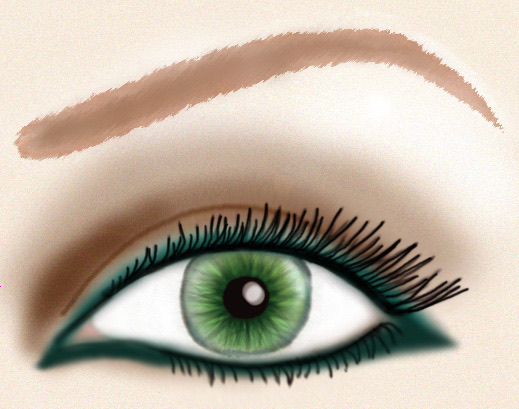
If your outer corners dip (negative tilt), the most consistent advice from Charlotte Tilbury and the Makeup.com artists is to keep the upper liner thin at the inner corner, thicken it over the outer third and flick it slightly up and out. Start the wing higher than the natural lash line, and judge it with your eyes open. Keep heavy dark liner off the outer lower lash line, or smudge it upward. For brows, L'Oréal Paris and HighBrow Beauty both suggest brushing and filling the tails upward so the tail never sits lower than the brow head.
Glasses, spacing and the rest of the eye area
We looked for optician guidance that matches frame shapes to canthal tilt and didn't find any with two independent sources, so we don't give one. Frame advice on FaceCheckup comes from your face shape instead. For close-set eyes, opticians suggest a clear, light or thin bridge, though that convention is only weakly sourced. The face shapes guide covers frames for each outline.
The same scan also measures eye spacing, eye openness and brow height. Brows frame the outer corner more than anything else, so if you want to change how your eyes read, the eyebrow shapes guide is the most useful next step. For overall left-right balance, the facial symmetry test shows whether a difference between your two eyes is larger than the normal small mismatch every face has.
How to read your FaceCheckup canthal tilt result
The result shows your canthal tilt averaged across both eyes, plus a separate 'tilt difference, left vs right', and the Eye tilt layer draws each eye's line. Each number carries a ± range. That range comes from measuring your photo and three re-framed copies of it. On one of our own test selfies, the four readings were 7.01°, 7.81°, 7.31° and 7.46°, so the result showed about ±0.4°. That is the smallest range the tool will ever show, because claiming more precision than that would be false.
There is a second limit worth knowing. Google reports that its landmarks land, on average, 2.06% to 3.85% of the distance between the eyes away from where human annotators place them. On an adult face that is roughly 1.3 to 2.4 mm. An eye is about 30 mm wide (Packiriswamy et al. measured 30.91 mm in men and 29.62 mm in women), so a corner placed 1 mm too high or low moves the angle by about 2°. Differences of a degree or two between your eyes, or between you and a friend, are within that error.
The scan's quality check runs first. If your head is turned more than 8° it warns you, beyond 15° it asks for a retake, and it also flags chin up or down, tilt, smiling, closed eyes, low resolution and poor light. A smile matters here more than for most measurements because it lifts the lower lids and moves the outer corners.
What to do this week
You don't need to do anything about your canthal tilt. If you want to use it, these are the steps with sources behind them.
- Re-measure properly: glasses off, phone propped at eye level about 1 to 1.5 m away, neutral face, window light. Compare two or three scans (research-supported and optician convention).
- If you wear liner, try one version that follows your tilt and one that balances it, photograph both from the same distance, and keep the one you like (makeup-artist convention).
- Brush the brow tails upward and fill them so they finish no lower than the brow head, which lifts the outer frame of the eye for any tilt (makeup-artist convention).
- For photos, keep your head level. Tipping the chin slightly down tends to read as more feminine and chin up as more masculine, so choose on purpose (research-supported).
- If one eye reads several degrees different from the other on repeated, well-taken photos, use the symmetry test to see it in context rather than worrying about a single scan.
Every guide in Canthal tilt
- Eyebrow shapes
Eyebrow shapes explained: soft arch, high arch, straight, rounded and S-curve, matched to your face in a free scan with no sign-up and a three-point map.
- Negative canthal tilt
Negative canthal tilt means the outer eye corner sits lower than the inner one. Check if yours is real or just the photo, and see makeup and brow options.
Questions people ask
- What is a good canthal tilt?
- There is no published 'good' value. The studies we read report group averages from about 4.7° to 8.8°, and quoted studies range from 1.2° to 9.64°, depending on population and sex. No peer-reviewed study we found sets an ideal angle in degrees.
- How do I measure my canthal tilt at home?
- Take a level, straight-on photo with a neutral face from about 1 to 1.5 m away, then measure the angle of the line from each inner eye corner to each outer corner against horizontal. The free FaceCheckup scan does this for both eyes and levels your head first.
- Why do different apps give me different canthal tilts?
- Most calculators measure against the edge of the photo, so any head roll is added to one eye and subtracted from the other. Chin position, camera distance and expression shift it too. In our model test, a 10° chin tip moved the reading by about 2.5°.
- Can my two eyes have different canthal tilts?
- Yes. Small left-right differences are normal in every face. FaceCheckup shows the difference separately. Differences of a degree or two are within landmark error, so judge them over several photos, not one.
- Is canthal tilt different for men and women?
- It depends on the study. Choi and Park found no significant sex difference in 996 Koreans (8.5° men, 8.8° women), while Packiriswamy et al. found women averaged higher (7.05°) than men (4.71°) in Malaysian South Indian adults.
- Does canthal tilt change with age?
- None of the studies on this page measured it across ages; they used young adults. We don't have a sourced answer, so we won't guess one.
- Is the canthal tilt scan medical?
- No. It measures the geometry of one photo using a landmark model Google built for augmented reality, not for clinical decisions. If you have a medical concern about your eyelids, see an eye doctor.
Sources & further reading
- Choi SS, Park DH (2002), J Korean Cleft Palate-Craniofac Assoc: Anthropometric Analysis of Slant of Palpebral Fissure in Koreans
- Packiriswamy V, Kumar P, Rao KG (2012), N Am J Med Sci: Photogrammetric analysis of palpebral fissure dimensions in Malaysian South Indian adults
- Vasanthakumar P, Kumar P, Rao M (2013), Oman Med J: Anthropometric analysis of palpebral fissure dimensions in South Indian adults
- Bashour M, Geist C (2007), Ophthalmic Plast Reconstr Surg: Is medial canthal tilt a powerful cue for facial attractiveness?
- Hönekopp J (2006), J Exp Psychol Hum Percept Perform: Once more: is beauty in the eye of the beholder?
- Bryan R, Perona P, Adolphs R (2012), PLoS One: Perspective distortion from interpersonal distance is an implicit visual cue for social judgments of faces
- Ward B, Ward M, Fried O, Paskhover B (2018), JAMA Facial Plast Surg: Nasal distortion in short-distance photographs: the selfie effect
- Google (2022): Model Card, MediaPipe Face Mesh V2
- Google: MediaPipe canonical face model (face_geometry data)
- Makeup.com by L'Oréal, quoting Sara Wren and Shreni Patel: Eyeliner technique for upturned eyes
- Makeup.com by L'Oréal, quoting Rommy Najor: Eyeliner for downturned eyes
- Makeup.com by L'Oréal: How to apply a cat eye for your eye shape
- Charlotte Tilbury: How to apply eyeliner for downturned eyes
- Clinique Skin School: Makeup for every eye shape
- L'Oréal Paris Beauty Magazine: Makeup tutorial for downturned eyes
- HighBrow Beauty: Eyebrow shapes to flatter your face
- NBC News (2016): New passport rule on glasses
- Reliant Medical Group, Dan Delisle (Registered Optician): How to choose eyeglasses that suit your face
- PsyPost (2020), reporting Marshall, Bartolacci and Burke, Evolutionary Psychology: head tilt and judgments of attractiveness
Read next
- Negative canthal tilt
Negative canthal tilt means the outer eye corner sits lower than the inner one. Check if yours is real or just the photo, and see makeup and brow options.
- Eyebrow shapes
Eyebrow shapes explained: soft arch, high arch, straight, rounded and S-curve, matched to your face in a free scan with no sign-up and a three-point map.
- Facial symmetry test
Facial symmetry test that mirrors 220 landmark pairs on your own photo, corrects head turn, and shows a ± range. Free, private, no sign-up.
- Face shapes
Face shapes explained: oval, round, square, oblong, heart, diamond and triangle, how stylists define each, and a free detector with no sign-up.
- Midface ratio
Midface ratio measured free on your photo, no sign-up: pupil distance ÷ pupils-to-lip height with a ± range, the three definitions and the research.
- Pretty scale
Pretty scale scores explained: how PrettyScale-style tests use dots and the golden ratio, what research found, plus a free scan with no sign-up.
Take the full free attractiveness test on the FaceCheckup home page.

Sukie · Founder and editor
Sukie built FaceCheckup because she always wanted a face tool that explains its numbers and tells you what to do with them, and nothing on the market did both. She checks every measurement on the site against published research and labels every tip for what it is: research, or stylist convention.
About this site · How pages are checked · Last updated October 23, 2026
FaceCheckup is for information and entertainment. It measures proportions in one photo; it is not a medical, psychological or cosmetic-surgery assessment, and it cannot tell you your worth.