Face shapes are a stylist's shorthand, not a medical category: a quick way to describe where your face is widest, how long it is compared with its width, and whether the jaw reads soft or angular. Hairdressers, barbers, opticians and makeup artists use the same seven names because the shape decides which way a haircut, a frame or a brow should pull the eye.
This guide defines each shape the way the people who use them professionally do, with the source for every definition. It shows three ways to work out your own shape, explains why apps and friends so often disagree, and ends with one practical move per shape. If you only want the answer, the free detector above measures your photo on your device and gives you the two closest shapes with a percentage for each.
The seven face shapes at a glance
Every face-shape system comes down to the same four checks. Which of the three horizontal widths is largest: forehead, cheekbones or jaw? How long is the face compared with its width? Is the jaw corner sharp or rounded? And does the chin come to a point or stay broad? The table below sums up how each shape answers those four questions. The diagram beside it draws all seven on the same base face so you can see that the differences are often small.
Notice that two pairs only differ in one trait. Round and square have the same length-to-width balance and differ only in the jaw corner. Oval and oblong share soft curves and differ mainly in length. Those two pairs produce most of the confusion you will meet online, and they are the reason a single label can be misleading.
| Shape | Widest part | Length vs width | Jaw | Chin |
|---|---|---|---|---|
| Oval | Cheekbones | Clearly longer than wide | Rounded, a little narrower than the forehead | Softly rounded |
| Round | Cheekbones | About equal | Soft, few angles | Rounded |
| Square | All three about equal | About equal | Angular, defined | Broad |
| Oblong (long, rectangle) | All three about equal | Noticeably longer than oval | Rounded (oblong) or square (rectangle) | Varies |
| Heart | Forehead | Moderate | Narrow | Narrow, often pointed |
| Diamond | Cheekbones; forehead and jaw both narrower | Often moderately long | Narrow | Narrow or pointed |
| Triangle (pear) | Jaw | Moderate | Wider than the forehead | Full |
How stylists and opticians define each shape
Oval. Celebrity hairstylist Paul Labrecque, quoted by TODAY, gives the only numeric definition we found: on an oval face “the length is equal to one and a half times the width.” The Art of Manliness, working with barber Thad Forrester, adds that the forehead is wider than the jawline. Optometrist Dr. Catherine Ong, writing for Zenni, describes “balanced proportions, slightly wider cheekbones, gentle narrowing at the forehead and jaw.” Read the full breakdown on our oval face shape page.
Round. Revlon Professional's guide for salon stylists says “the width and length of the face are equal” and that a round face “has few to no angles.” Optical trade journal Eyecare Business puts it as “full, as wide as it is long, with few angles.” The cheekbones are the widest point and the forehead and jaw are about the same width. Our round face guide covers it in depth.
Square. Matrix, L'Oréal's professional salon brand, says “the length and width of your face are equal,” the same as round. What separates the two is the jaw: Revlon Professional says the edges of a square face are “angular and defined,” and Zenni's optometrist describes forehead, cheekbones and jawline of similar width with a strong jaw.
Oblong. Also called long or rectangle. Matrix: “An oblong shape face is longer than it is wide.” All About Vision, reviewed by an ABOC-certified optician, adds “a long, straight cheek line.” The Art of Manliness sums it up neatly: long like an oval, but with forehead, cheekbones and jaw of similar size like a square. Our oblong face shape page explains where oval ends and oblong begins.
Heart. Labrecque: “Your face is widest at the forehead, narrower at the jawline.” L'Oréal Paris offers a quick test: “If your brows are noticeably wider than your jaw, you have a heart-shaped face.” Opticians sometimes call it a base-up triangle. See the heart-shaped face guide.
Diamond. Labrecque again: “You have wider cheeks with a narrow forehead and jawline.” Barber Matty Conrad, quoted in GQ Middle East, describes it as “widest at the cheekbones, and slightly more narrow at the forehead and chin.” The full diamond face shape guide explains how it differs from oval and heart.
Triangle (pear). Opticians at All About Vision describe a face that “has a narrow forehead and widens at the cheek and chin areas,” and Eyecare Business writes “narrow forehead and full jawline.” Be aware that the word triangle is used for opposite shapes: Matrix groups heart and triangle together as narrow at the chin, while optical guides use triangle for a wide jaw. On FaceCheckup, triangle always means the jaw is wider than the forehead.
How to find your face shape: three methods
You can work out your shape with a mirror, a soft tape measure or a photo. All three compare the same things; they just differ in how precise and repeatable the comparison is. Whichever you use, prepare the same way: hair pulled back off the forehead and away from the jaw, glasses off, a neutral expression with the mouth closed, and even light from the front or a window.
The preparation matters more than the method. Hair over the hairline or jaw hides the outline you are trying to compare, and a hard shadow under the cheekbones moves the apparent edge of the face. A smile widens the lower face and lifts the cheeks, which is why the same person can look round when laughing and oval in a passport photo.
- Mirror trace. Stand square to a mirror at arm's length, pull your hair back and trace the outline of your face on the glass with a washable marker or a lipstick, as the eyewear retailer Felix Gray suggests. Step back and look at the drawing: where is it widest, does the jaw turn a corner or curve, and is the outline much longer than it is wide? It is quick, but the line moves if you move.
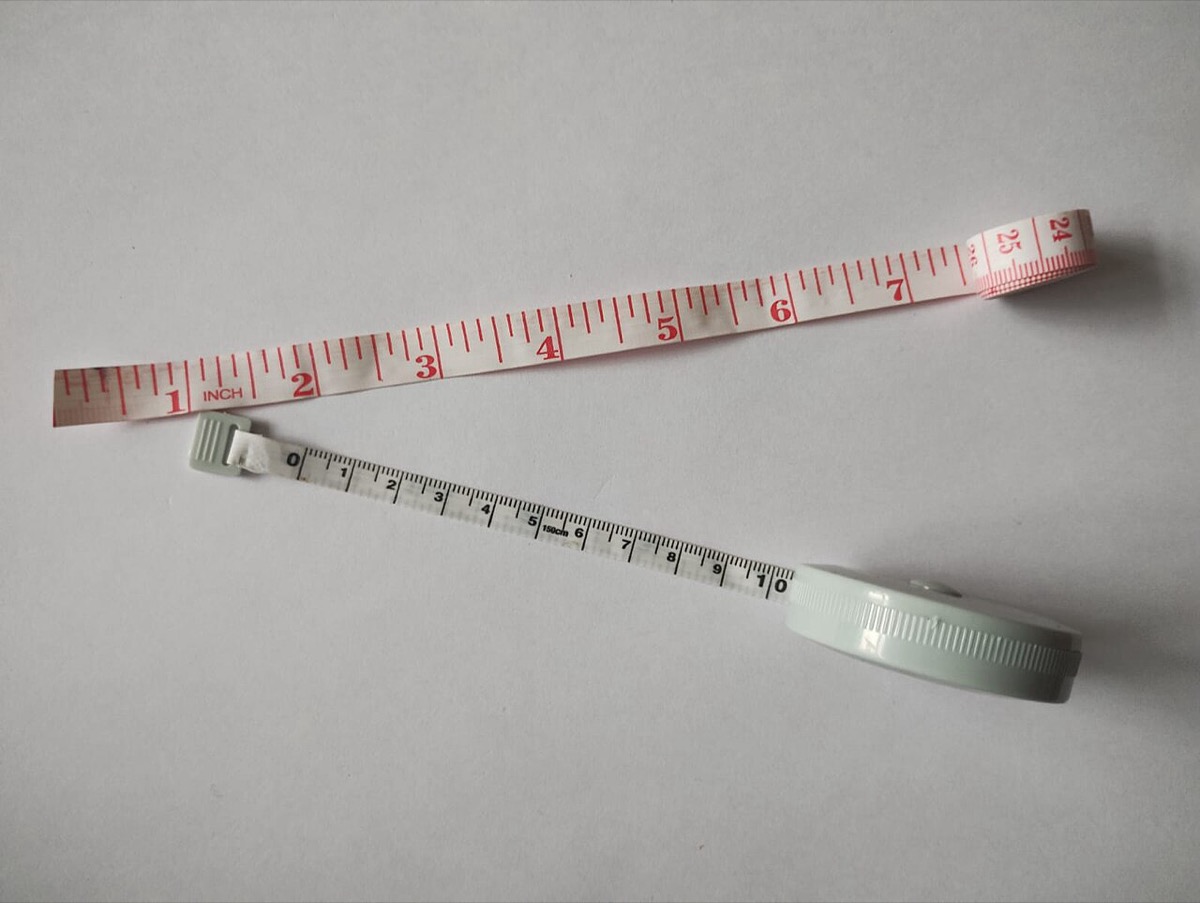
- Tape measure. Measure four things: forehead width across the widest part of the forehead, cheekbone width across the most prominent points of the cheekbones, jaw width from one jaw corner to the other, and face length from the middle of the hairline to the tip of the chin. Compare the three widths with each other, then compare the length with the cheekbone width. It gives real numbers but is hard to do on yourself, and the jaw corner is difficult to find by touch.
- Photo measurement. Take a straight-on photo with the phone propped about 1 to 1.5 m away at eye level, using the timer, and let a landmark model find the outline. Our free face shape detector does this in your browser and draws the forehead, cheekbone and jaw widths on your own photo so you can check what it measured. A photo is repeatable, which means you can take three and see whether the answer holds.
Why apps, friends and quizzes disagree about your face shape
If one app called you heart, another called you triangle and your friends say round, you are not alone: that exact complaint is one of the most-asked face-shape questions on Quora. There are four ordinary reasons for it, and none of them means your face is strange.
First, the shapes are conventions. Real faces are continuous, and many sit close to the line between two neighbouring shapes, so a tool that must pick one label will flip between them when the photo changes slightly. Second, sources define the shapes differently: the oval forehead is wider than the jaw for The Art of Manliness but “slightly narrower” for All About Vision, and triangle means opposite things in salon and optical guides. Third, the photo changes the measurement. Ward and colleagues (2018, JAMA Facial Plastic Surgery) modelled that a camera about 30 cm from the face makes the base of the nose look roughly 30% wider relative to face width than at 1.5 m, and the same perspective effect pulls on every width the shape depends on. A turned or tilted head shrinks one side of the face. Fourth, the landmark models themselves have error: Google's model card for MediaPipe Face Mesh V2 reports an average landmark error of 2.06% to 3.85% of the distance between the eyes depending on region and mode, against 2.56% disagreement between human annotators.
We saw the photo effect on our own test selfie, taken with the head turned about 10 degrees and smiling. Before correcting for the head turn, the left and right halves of the face matched in width by only 72%; after the 3D pose correction they matched by 95%. A shape tool that skips that correction is measuring the angle of your head, not the shape of your face.
What real faces measure: length versus width in 6,068 adults
Published face-shape guides rarely show how real faces vary, so we calculated it from the US Army's ANSUR II anthropometric survey, a public-domain data set of adults measured with calipers in 2010 to 2012. The measure is the facial index: face length from the top of the nose bridge (sellion) to the chin, divided by the width across the cheekbones, times 100. A higher number means a longer face.
Two things stand out. The average man and the average woman are close together, and the spread inside each group (a standard deviation of about 5 points) is larger than the gap between them. Face length relative to width varies far more from person to person than it does between the sexes, which is why the same seven shapes are used for men and women.
Note that this measure starts at the nose bridge, not the hairline, so the numbers are much lower than the stylists' “one and a half times” rule for oval, which measures from the hairline. Neither is wrong; they measure from different points. That is also why you should never compare a ratio from one tool with a threshold from another.
| Group | Men | Women |
|---|---|---|
| All | 86.1 ± 5.4 (n = 4,082) | 84.7 ± 5.1 (n = 1,986) |
| White | 86.3 ± 5.4 (n = 2,817) | 85.0 ± 5.1 (n = 975) |
| Black | 86.6 ± 5.5 (n = 642) | 84.6 ± 5.0 (n = 656) |
| Hispanic | 85.4 ± 5.1 (n = 440) | 85.1 ± 5.1 (n = 239) |
| Asian | 83.1 ± 4.9 (n = 117) | 80.3 ± 4.5 (n = 71) |
One move per shape: a quick style map
Once you know your shape, the advice follows one idea: add visual width or height where the face is narrow, and keep bulk away from where it is widest. The table gives the single most useful haircut and glasses rule for each shape from our sourced rulebook. Every haircut rule is a stylist convention and every frame rule is an optician convention, each backed by at least two professional sources. They are habits of the trade, not research findings, so treat them as starting points to try in front of a mirror.
For full lists, including brows, beards, makeup and photo lighting, open the guide for your shape or the hairstyle for face shape page, which compares every cut side by side.
| Shape | Haircut (stylist convention) | Glasses (optician convention) |
|---|---|---|
| Oval | Choose for hair texture and lifestyle; short, long, layered or one-length all suit | Frames about as wide as the widest part of the face; most shapes work |
| Round | Keep length at or below the jaw (a lob or long layers), not ending at the cheeks | Rectangular or geometric frames wider than they are deep |
| Square | Soft layers or waves that start below the jaw | Oval or round frames to soften the jawline |
| Oblong | Width at the sides; a fringe to about eyebrow level | Deeper lenses, such as taller squares or rounds |
| Heart | Volume at or just below the chin, such as a wavy bob or lob | Frames wider or heavier at the bottom, or aviators |
| Diamond | Chin-length bob or shoulder cut that adds fullness at the jaw | Oval or cat-eye frames, or a defined browline |
| Triangle (pear) | Volume at the crown and temples | Colour or detail on the top half, such as browline or cat-eye |
Face shapes for men and women: same shapes, different advice
The shapes are the same for everyone, but the advice for men and women sometimes points in opposite directions, and it helps to know where. The biggest split is the fringe. Barbers quoted by GQ Middle East and The Art of Manliness tell men with oval or square faces to avoid a heavy fringe because it shortens the face, while women's stylists at Matrix, TODAY and Huda Beauty recommend fringes for oval and oblong faces. Both are consistent with the same idea; they simply start from different typical lengths of hair.
Men also get a tool women's guides leave out: the beard. Barbers use it to add or remove width at the jaw. A man with a diamond face is told to grow fullness at the chin and lower jaw while keeping the cheeks lighter; a man with an oblong face is told to keep the beard from growing much past the chin so it doesn't add length. Where barbers disagree, as they do over whether a square jaw should be shown off with stubble or softened with a rounded beard, our rulebook lists both options rather than picking one.
On the measurement side, the ANSUR II figures above show men's and women's average length-to-width are close. Width itself differs more: the average cheekbone width in that survey was 142.6 mm for men and 133.8 mm for women. In a small study of 72 Kenyan adults, Virdi, Wertheim and Naini (2019) recorded jaw widths that work out to about 0.80 of cheekbone width in men and 0.74 in women. That is one small sample, so take it as a hint that men's jaws tend to look squarer, not as a rule. For a men-only walk-through, see male face shapes.
How to read your result on FaceCheckup
The detector at the top of this page runs Google's MediaPipe Face Landmarker in your browser and never uploads the photo. Before it measures anything, a quality check looks for a turned head (it warns past 8 degrees and asks for a retake past 15), a chin tipped up or down, a tilted head, too few pixels between the pupils (it needs at least 60), a close-up that distorts the face, a smile or open mouth, closed eyes, and dark or uneven light. A photo that fails badly (a head turned more than 15°, a chin tipped more than 18°, fewer than 35 pixels between the pupils, eyes closed, or a very dark photo) gets a retake request and no score; the other problems are flagged as warnings.
When the photo passes, switch on the Outline, Widths and Jaw layers. Outline traces the edge of your face, Widths draws the forehead, cheekbone and jaw lines the shape is built from, and Jaw marks the jaw corner and its angle. If a line sits on hair or shadow rather than skin, retake the photo with your hair back and the light in front of you. Then read the two shapes and their percentages. A result like 55% and 40% means you sit between two shapes; a result like 80% and 10% is a clear call. The face shape detector page explains the maths and the reference values in full.
Your next step
Do three things this week. Take three measurement photos in good light and see whether the top shape holds across all of them; if it flips, you sit between two shapes and should use both guides. Take a screenshot of the Widths layer to your next haircut or eye test so the stylist or optician can see the numbers, not just a label. And try one change from the style map above, such as moving your part, choosing deeper frames or adding a fringe, before committing to a bigger cut.
Then go deeper on your own shape: the guides for oval, oblong, diamond, round and heart-shaped faces each cover haircuts, glasses, brows and photos, with the reasons behind each rule. The FaceCheckup homepage scan also measures symmetry, facial thirds and your eyes if you want the full picture.
Every guide in Face shapes
- Diamond face shape
Diamond face shape: widest at the cheekbones with a narrower forehead and jaw. How to tell it from oval or heart, and the hairstyles and glasses that suit it.
- Face shape detector
Face shape detector that's free with no sign-up and runs on your device: it measures forehead, cheekbones, jaw and length, then gives your top two shapes.
- Haircut finder
Haircut depending on face shape: scan one photo free, no sign-up, to find your shape, then see sourced cuts to try and to avoid, for women and men.
- Heart shaped face
Heart shaped face: widest at the forehead, narrow at the jaw, often a pointed chin. Check yours from a photo, then get sourced cut, brow and glasses tips.
- Male face shapes
Male face shapes, explained: the 7 outlines barbers use, what research says differs in men's faces, and a sourced haircut, beard and frame plan per shape.
- Oblong face shape
Oblong face shape: clearly longer than wide, with forehead, cheekbones and jaw of similar width. How it differs from oval, plus haircuts, glasses and brows.
- Oval face shape
Oval face shape: longer than wide, widest at the cheekbones, softly rounded jaw. How to tell oval from oblong or round, and the cuts and frames that suit it.
- Round face
Round face: length close to width, widest at the cheeks, soft jaw with few angles. Learn how to tell it from square or oval, then get sourced styling tips.
Questions people ask
- What are the 7 face shapes?
- Oval, round, square, oblong (also called long or rectangle), heart, diamond and triangle (also called pear). Some guides add a rectangle as separate from oblong, which is an oblong face with a squarer jaw.
- What is the most common face shape?
- We could not find a published study that measures how common each face shape is in the population. Figures you see online come from unexplained app data, so we don't repeat them. What the research does show is that face length relative to width varies widely from person to person.
- How do I know my face shape without measuring?
- Pull your hair back, face a mirror and trace your outline on the glass. Then ask three questions: where is it widest, is the jaw angular or rounded, and is the face clearly longer than it is wide? If two answers fit two shapes, you are probably between them.
- Can your face shape change?
- The bone structure that sets the widths changes little in adult life, but weight, age and facial hair change the outline that people see, and so can the photo. A beard can square a jaw visually and fuller cheeks can make an oval read rounder. Re-measure if your weight or hairstyle changes a lot.
- Is the oval face shape the best?
- Stylists call oval the most versatile shape because most cuts and frames suit it, not because it is more attractive. FaceCheckup does not rank face shapes, and no shape is a flaw. Each one simply has different styling moves.
- Why do face shape apps give me different answers?
- Because many faces sit between two shapes, sources define the shapes differently, and the photo itself changes the measurement: distance, head turn, smiling and hair over the jaw all move the outline. Use a tool that shows the two closest shapes and draws what it measured.
Sources & further reading
- TODAY (NBC), Anna De Souza quoting hairstylist Paul Labrecque: Need a haircut? Here's how to get the best style for your face shape
- The Art of Manliness, with barber Thad Forrester: The Best Haircut for Your Face Shape
- Zenni Optical, Dr. Catherine Ong, OD: What Is My Face Shape?
- All About Vision, Erinn Morgan (reviewed by Chloe Tauaefa, ABOC): The Best Glasses for Your Face Shape and Skin Tone
- Revlon Professional: What Hairstyle Suits Me?
- Eyecare Business, Susan P. Tarrant (2001): The Last Word: All Shapes and Sizes
- Matrix, Jackie Summers: How To Choose The Best Hairstyle For Your Face Shape
- L'Oréal Paris USA: The Best Haircuts for Your Face Shape
- GQ Middle East, Adam Hurly quoting barber Matty Conrad: What's the best haircut for your face shape?
- Felix Gray, Noah Kain (2026): What Is My Face Shape for Glasses?
- Ward B, Ward M, Fried O, Paskhover B (2018), JAMA Facial Plastic Surgery: Nasal Distortion in Short-Distance Photographs: The Selfie Effect
- Rutgers University News (2018): Selfies Drive Self-Image and May Lead Many to Seek Plastic Surgery
- Yan G, Grishchenko I (2022), Google: Model Card, MediaPipe Face Mesh V2
- Gordon CC et al. (2015), US Army Natick: ANSUR II 2012 Anthropometric Survey public data (Penn State OPEN Design Lab)
- Virdi SS, Wertheim D, Naini FB (2019): Normative anthropometry and proportions of the Kenyan-African face
- Huda Beauty: How To Cut Your Bangs To Flatter Your Face Shape
- The Art of Manliness, quoting barber Thad Forrester: Your No-Nonsense Guide to Choosing the Right Beard Style
- Pall Mall Barbers: 2026 best beard styles for different shapes
Read next
- Face shape detector
Face shape detector that's free with no sign-up and runs on your device: it measures forehead, cheekbones, jaw and length, then gives your top two shapes.
- Oval face shape
Oval face shape: longer than wide, widest at the cheekbones, softly rounded jaw. How to tell oval from oblong or round, and the cuts and frames that suit it.
- Oblong face shape
Oblong face shape: clearly longer than wide, with forehead, cheekbones and jaw of similar width. How it differs from oval, plus haircuts, glasses and brows.
- Diamond face shape
Diamond face shape: widest at the cheekbones with a narrower forehead and jaw. How to tell it from oval or heart, and the hairstyles and glasses that suit it.
- Haircut finder
Haircut depending on face shape: scan one photo free, no sign-up, to find your shape, then see sourced cuts to try and to avoid, for women and men.
- Male face shapes
Male face shapes, explained: the 7 outlines barbers use, what research says differs in men's faces, and a sourced haircut, beard and frame plan per shape.
Take the full free attractiveness test on the FaceCheckup home page.
Sukie · Founder and editor
Sukie built FaceCheckup because she always wanted a face tool that explains its numbers and tells you what to do with them, and nothing on the market did both. She checks every measurement on the site against published research and labels every tip for what it is: research, or stylist convention.
About this site · How pages are checked · Last updated October 23, 2026
FaceCheckup is for information and entertainment. It measures proportions in one photo; it is not a medical, psychological or cosmetic-surgery assessment, and it cannot tell you your worth.