If you've ever looked at a photo and thought “do I have a big forehead?”, you're in very large company, and the internet's answers range from a four-finger rule to memes. Here's a calmer one: a measurement on your own photo, what measured faces actually look like, and what stylists, barbers and opticians suggest if you'd like your forehead to look smaller.
Two things to know up front. “Big” can mean tall or wide, and the scan measures each separately. And photos exaggerate foreheads more than most features, so the first job is making sure you're measuring your face, not your camera.
What does a “big forehead” actually mean?
When people say a forehead is big, they usually mean one of two things. Tall: the distance from the hairline down to the brows is long compared with the rest of the face. Wide: the forehead is broad at the temples compared with the cheekbones. A forehead can be one without the other, and they call for different styling.
Online, the most common test is the finger rule: lay your fingers flat between your brows and hairline and count. It's quick, but fingers vary in width from person to person, and it says nothing about how your forehead compares with the rest of your face, which is what people actually notice.
FaceCheckup measures proportions instead. Upper third is your hairline-to-brow-line distance as a percentage of hairline-to-chin length. Forehead width ÷ cheekbone width is the width across your temples as a percentage of the width at your cheekbones. Both come with a ± range from four slightly different framings of your photo.
So when you check for a big forehead on FaceCheckup, look at both numbers: a high upper-third share, a high forehead-to-cheekbone width, or both. That matters because the styling advice below differs for each.
How big are foreheads in measured adults?
Researchers who measure faces with calipers report the forehead as the distance from the hairline (trichion) to the nasal root (nasion). Their numbers make one thing clear: the upper third is normally one of the two longest parts of the face, and it varies more from person to person than any other third.
| Sample | Upper third | Middle third | Lower third | Upper as share of total |
|---|---|---|---|---|
| North American white men, n = 109 (Farkas, via Virdi et al. 2019) | 67.1 (7.5) | 54.8 (3.3) | 72.6 (4.5) | 34.5% |
| North American white women, n = 200 (Farkas, via Virdi et al. 2019) | 63.0 (6.0) | 50.6 (3.1) | 64.3 (4.0) | 35.4% |
| Saudi men, n = 75 (Al-Sebaei 2015) | 64.71 (7.51) | 54.12 (4.34) | 65.02 (5.16) | 35.2% |
| Saudi women, n = 93 (Al-Sebaei 2015) | 65.46 (6.90) | 53.19 (4.13) | 60.27 (4.62) | 36.6% |
Big forehead or high hairline?
Where your hair starts can change over the years, and that changes how big a forehead looks. The scan finds your hairline with a hair-segmentation model, walking up the centre of your face until it reaches hair. So it measures where hair starts in this photo, and it can't tell whether that hairline has always been there or has moved. A high reading can reflect hair rather than face.
Two other things move the reading. A widow's peak dips lower in the centre, and because the scan measures on the midline, it will read a shorter upper third than the corners of your hairline suggest. Bangs or a fringe will be found as the hairline itself, so pull them back for the measurement.
If you're worried about hair loss, that's a question for a doctor or dermatologist, not a face scan. This site doesn't give medical advice.
What the forehead measurement looks like on a real image
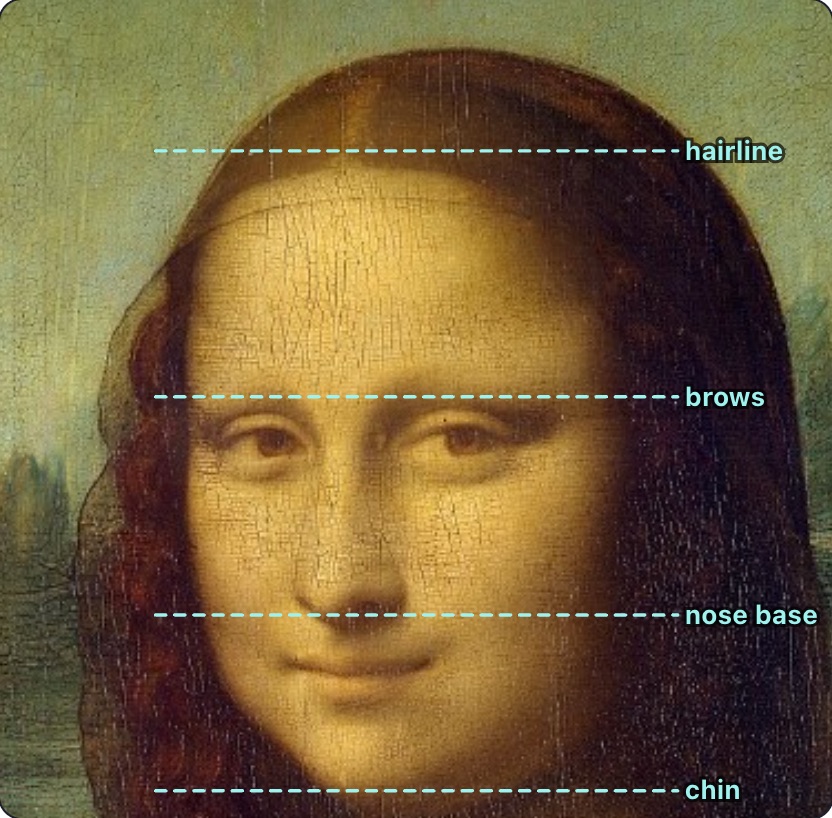
Here is the Thirds layer on a public-domain painting, Leonardo's Mona Lisa, so you can see exactly what the scan draws. It marks the hairline found by the hair-segmentation model, the brow line, the base of the nose and the chin.
On this image the scan put the upper third at 41% of face length, the middle third at 35% and the lower third at 24%. The photo check also flagged her head as turned 17° and her chin as down 19°, which is enough to request a retake. A lowered chin shortens the lower third on camera, so these numbers describe the painting's pose as much as the face. Treat your own result the same way: take a level, straight-on photo before reading anything into it.
How to run the big forehead test properly
Foreheads are where photos lie the most. A phone held close enlarges whatever is nearest the lens, so a high, close selfie puts your forehead nearest and makes it dominate. Ward and colleagues (2018) showed how strongly short distances distort the centre of the face, which is why our research-supported rule is to shoot from about 1 to 1.5 m away.
- Pull all your hair back off your forehead with a clip or headband, including bangs, so the hair-segmentation model can find your real hairline.
- Prop the phone at eye level about 1 to 1.5 m away, or use the rear camera's 2x lens and step back.
- Keep your chin level; the quality check warns if your chin is more than 10° up or down, because tilt changes the thirds directly.
- Use a relaxed face with lips together, and keep your eyebrows relaxed, since the brow line is one end of the measurement.
- In the results, turn on the Thirds layer to see the hairline and brow lines, and the Widths layer to see the forehead line across your temples next to the cheekbone line.
- Read Upper third and Forehead width ÷ cheekbone width with their ± ranges. If the scan says hairline not found, retake with hair fully back.
Haircuts, bangs and glasses for a big forehead
You never have to hide your forehead. Plenty of people wear theirs proudly with slicked-back hair. But if you'd like it to look smaller in photos and day to day, these are the suggestions in our sourced rulebook, each backed by at least two professional sources and labelled with the trade it comes from.
One honest note on fringes for men. Barbers quoted in our rulebook tell men with oval or square faces to skip heavy fringes because they shorten the face, while women's stylists recommend fringes more widely. If your face is also short or round, a full fringe may not be the right trade-off; a side-swept one usually is.
- Side-swept or curtain bangs, or simply bringing some hair forward onto the forehead. Hair across the upper forehead visually shortens and narrows it (stylist convention).
- Avoid a strict centre part and slicked-back styles that expose the whole forehead, if smaller is the goal. Stylists say both make it look larger (stylist convention).
- For a forehead that's wide rather than tall, a side part or deep side part puts hair across part of it and breaks up the width, and longer curtain bangs that are longer at the outer edges narrow it (stylist conventions for faces widest at the forehead).
- Glasses: prefer thin, light or bottom-weighted frames over heavy top bars, which add visual weight to an already prominent upper face (optician convention).
- Photos: hold the camera at eye level or slightly above, never below the chin, and face a window for soft light (photographer conventions).
- Run the full scan for your face shape. The style plan picks rules for your shape; the forehead rules above aren't added to it automatically yet, so combine them yourself and skip any that fight your shape's advice.
A kinder way to read your result
If you're here because someone joked about your big forehead, the jokes say more about how memorable foreheads are than about yours. Foreheads sit at the top of every photo and every video call, so they get noticed, and a high-angle selfie makes them look larger still. A measured number from a fair photo is a better guide than the worry.
Your upper third is the part of your face that varies most between people, partly because hairlines vary so much. That's why a number that looks high next to a friend's may be perfectly ordinary across a population. The scan shows it as a plain number for this reason: the published norms measure from a different point (the nasal root), so labelling your value normal or abnormal against them would be guesswork.
Forehead height also has a knock-on effect on one of the two ratios our Balance Score uses. Eyes-to-mouth ÷ face length (Pallett, Link and Lee's 36%) uses hairline-to-chin length, so a taller forehead lowers it by definition. Read that ratio as approximate if your hairline is high.
And remember what the research says about attractiveness as a whole: private taste counts about as much as shared taste (Hönekopp, 2006). Measuring your forehead tells you how to style it. It doesn't tell you what anyone else thinks of it. For the rest of your proportions, see our facial thirds page, and for haircuts by shape, the face shape detector.
Questions people ask
- What counts as a big forehead?
- There's no medical or scientific cut-off. In caliper studies, the hairline-to-nasal-root distance averaged about 63 to 67 mm, roughly a third or a little more of face height, with a wide spread. A forehead reads as big when its share of your face length is high compared with your own middle and lower thirds.
- Is a four-finger forehead big?
- The finger rule is a rough home test, not a measure. Finger width varies from person to person, and the count doesn't compare your forehead with the rest of your face. A proportion measured on a straight photo is more reliable.
- Why does my forehead look bigger in photos than in the mirror?
- Usually camera distance and angle. A phone held close enlarges whatever is nearest to it, and a high, close selfie puts the forehead nearest. Shooting from about 1 to 1.5 m at eye level removes most of that effect.
- Is a big forehead attractive?
- The research we use doesn't single out forehead size, and attractiveness depends heavily on the individual viewer: private taste counts about as much as shared taste. Many people choose to show a tall forehead with swept-back hair.
- What haircut hides a big forehead?
- Stylists suggest side-swept or curtain bangs, or bringing some hair forward onto the forehead, and avoiding a strict centre part or slicked-back styles. For a wide forehead, a side part and longer curtain bangs help. See the list above for the full set.
- Should guys with a big forehead get a fringe?
- It depends on face length. Barbers in our sources tell men with oval or square faces to avoid heavy fringes because they shorten the face, while forehead-specific advice favours bringing some hair forward. A side-swept fringe fits both sets of advice.
- Is my forehead big or is my hairline receding?
- A photo scan can't tell the difference: it measures where hair starts now. If your hairline has moved or you're worried about hair loss, a dermatologist can tell you; this site doesn't give medical advice.
- Why does the scan say hairline not found?
- The hair-segmentation model couldn't find a clear edge of hair above your forehead, usually because of bangs, a hat, hair the model can't separate from the background, or a crop that cuts off the top of the head. Pull hair back and include the top of your head in the frame.
- Can you make your forehead smaller without surgery?
- Styling changes how big it looks: bangs, partings and frames from the list above. Procedures that change a hairline exist, but this site gives no medical or surgical advice; speak to a licensed professional if you're considering one.
- Does a wide forehead mean I have a heart-shaped face?
- Not on its own. In the stylist definitions our face-shape detector uses, a heart shape is widest at the forehead and tapers to a narrow jaw and pointed chin. A wide forehead with an equally wide jaw points to other shapes. Run the face shape detector to see your forehead, cheekbone and jaw widths together.
- What is a “fivehead”?
- It's internet slang for a tall forehead, usually used as a joke. It isn't a measurement. If the word has been aimed at you, the measured version is your upper-third share on a fair photo, and as the published data above shows, a forehead longer than the middle third of the face is the usual pattern.
Sources & further reading
- Virdi SS, Wertheim D, Naini FB (2019), Maxillofacial Plastic and Reconstructive Surgery: Normative anthropometry of the Kenyan-African face (Tables 2–3 reproduce Farkas North American white norms)
- Al-Sebaei MO (2015), Head & Face Medicine: The validity of three neo-classical facial canons (includes Farkas prevalence data)
- Ward B et al. (2018), JAMA Facial Plastic Surgery: Nasal distortion in short-distance photographs: the selfie effect
- Pallett PM, Link S, Lee K (2010), Vision Research: New “golden” ratios for facial beauty
- Hönekopp J (2006), J Exp Psychol: Human Perception and Performance: Once more: is beauty in the eye of the beholder?
- Tkachenka A et al. (Google, 2019): Model Card, Hair Segmentation
- Jackie Summers, Matrix blog: How to choose the best hairstyle for your face shape
- Anna De Souza (quoting stylist Edmondo Blando), TODAY: The most flattering bangs for your face shape
- Nicole Catanese and Krista Carter, InStyle via AOL (2024): Celebrity hairstylists explain the best haircuts for every face shape
- Adam Hurly (quoting barber Matty Conrad), GQ Middle East: Best haircut for your face shape
- Erinn Morgan, All About Vision: Glasses shape and color analysis
- Amber Felton, WebMD: How to pick the right glasses for your face shape
- Lois Joy Johnson, quoting photographer Eric Wolfe, AARP (2024): Looking better in pictures
- Leonardo da Vinci, Mona Lisa (public domain), Wikimedia Commons file
Read next
- Facial thirds
Facial thirds measured free on your photo, no sign-up: hairline, brows, nose base and chin drawn for you, plus how rarely thirds are equal in studies.
- Face shape detector
Face shape detector that's free with no sign-up and runs on your device: it measures forehead, cheekbones, jaw and length, then gives your top two shapes.
- Eyebrow shapes
Eyebrow shapes explained: soft arch, high arch, straight, rounded and S-curve, matched to your face in a free scan with no sign-up and a three-point map.
- Facial symmetry test
Facial symmetry test that mirrors 220 landmark pairs on your own photo, corrects head turn, and shows a ± range. Free, private, no sign-up.
- Face shapes
Face shapes explained: oval, round, square, oblong, heart, diamond and triangle, how stylists define each, and a free detector with no sign-up.
Part of Facial symmetry test. Take the full free attractiveness test on the FaceCheckup home page.
Sukie · Founder and editor
Sukie built FaceCheckup because she always wanted a face tool that explains its numbers and tells you what to do with them, and nothing on the market did both. She checks every measurement on the site against published research and labels every tip for what it is: research, or stylist convention.
About this site · How pages are checked · Last updated October 23, 2026
FaceCheckup is for information and entertainment. It measures proportions in one photo; it is not a medical, psychological or cosmetic-surgery assessment, and it cannot tell you your worth.