A face shape detector should do more than print a word. Ours draws every line it measured on your own photo, tells you when the photo is too tilted or too close to trust, and admits when you sit between two shapes, because many people do. Below is exactly how it works, how to take a photo it can read well, what a borderline result means, how accurate it is, and what to do with the answer once you have it.
What the detector measures
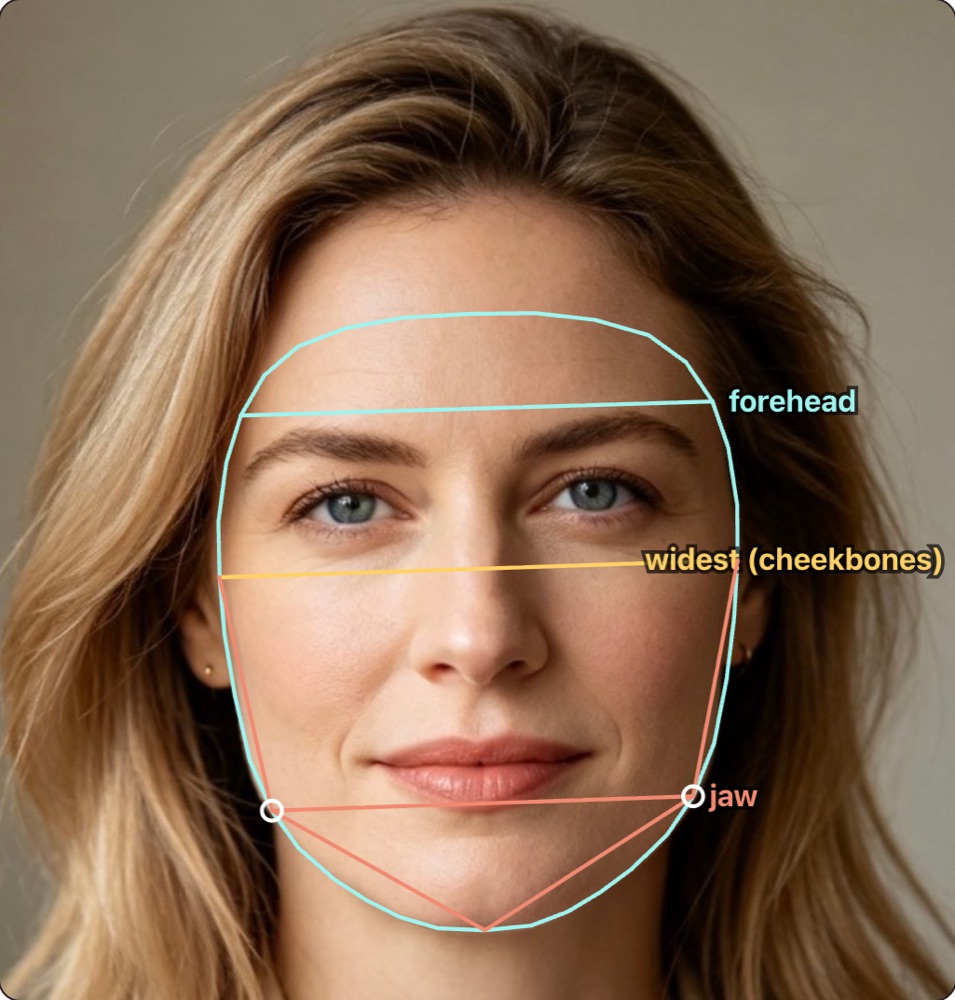
Google's MediaPipe Face Landmarker finds 478 points on your face. From the outline points, the detector takes four measurements, each one tied to a trait that stylists and opticians use to define the shapes. Before measuring, it rotates the 3D landmarks back to a straight-on view and levels the eyes, so a slightly turned or tilted head doesn't read as a narrower face.
Face width is the distance across the widest outline points at cheekbone level. Every other width is expressed as a share of it, which is why your photo's size or distance from the camera doesn't change the ratios much, as long as you are far enough away to avoid close-up distortion.
| Measurement | How it is taken | Which shapes it separates |
|---|---|---|
| Forehead ÷ cheekbone width | Outline width at temple level divided by the widest width at the cheekbones | Heart (wide forehead) from diamond and triangle (narrow forehead) |
| Jaw ÷ cheekbone width | Outline width at the jaw corners divided by cheekbone width | Square and triangle (wide jaw) from heart and diamond (narrow jaw) |
| Length ÷ width | Top of the face mesh on the upper forehead down to the chin, divided by cheekbone width | Round and square (short) from oval, then oblong (long) |
| Jaw angle | The angle at each jaw corner between the cheekbone point and the chin, averaged; smaller means a sharper corner | Square (angular) from round (soft) |
How the top two shapes and their percentages are calculated
None of the stylist or optician sources we read gives a numeric cut-off between shapes; the only figure in print is a hairstylist's rule of thumb that an oval face is about one and a half times as long as it is wide. So we built reference points ourselves. We measured Google's canonical face model, the average face MediaPipe is built around, and then moved each shape's reference in the direction its professional definition describes: wider forehead for heart, wider jaw for triangle, longer for oblong, sharper jaw corner for square, and so on.
Your four numbers are compared with all seven references at once. Each difference is put on a common scale, where 4 degrees of jaw angle counts the same as 0.03 of a width ratio or 0.06 of the length ratio, so no single measurement dominates. The closer your face is to a reference, the larger that shape's share. The shares add up to 100% across all seven, and the detector shows you the two largest.
Because the method is a comparison, not a yes-or-no test, it can't be fooled into false certainty by a face that sits on a boundary. If your face is halfway between the oval and oblong references, you will see two similar percentages, which is the honest answer.
| Shape | Forehead ÷ cheek | Jaw ÷ cheek | Length ÷ width | Jaw angle |
|---|---|---|---|---|
| Oval | 0.92 | 0.77 | 1.17 | 132° |
| Round | 0.92 | 0.81 | 1.05 | 138° |
| Square | 0.95 | 0.86 | 1.08 | 125° |
| Oblong | 0.92 | 0.80 | 1.31 | 130° |
| Heart | 0.97 | 0.72 | 1.15 | 134° |
| Diamond | 0.86 | 0.73 | 1.18 | 133° |
| Triangle | 0.86 | 0.85 | 1.12 | 128° |
How to take a photo the detector can read
Most wrong shape results come from the photo, not the face. The detector's quality check catches the worst problems and asks you to retake rather than guessing, but you will get a steadier answer if you set the photo up well in the first place. These steps come from our rulebook; each is labelled with where the convention comes from.
- Prop the phone about 1 to 1.5 m away at eye level and use the timer, instead of holding it at arm's length (research-supported: Ward and colleagues, 2018, modelled that a camera about 30 cm away makes the nose base look roughly 30% wider relative to face width than at 1.5 m).
- Look straight into the lens with a neutral face and your mouth closed, head level (optician convention, matching the US passport photo rule to face the camera directly with a neutral expression).
- Pull your hair back off your forehead and away from your jaw (stylist convention), so the outline the widths depend on is visible.
- Take your glasses off (optician convention): frames and glare hide the brow area and add shadows.
- Stand in even light facing a window, with no hard shadow across the cheeks or jaw (photographer convention). Overhead light throws shadows under the cheekbones and chin and moves the apparent edge of the face.
- Take three photos, not one, and compare the results. If all three agree, trust it; if they flip between two shapes, you sit between them.
Reading a borderline result
A result like Oval 52% and Oblong 39% is not a failure; it tells you your face sits near the line between those two shapes. The most common borderline pairs follow from the definitions: oval and oblong differ mainly in length, round and square differ mainly in the jaw corner, and diamond and heart both have a narrow jaw and differ in whether the forehead or the cheekbones are wider.
To see why the detector hesitated, open the result and switch on the Widths layer, then the Jaw layer. The shape card lists your forehead and jaw widths as a share of face width and your jaw angle, so you can see which measurement sits between the two references. If your length ratio is the deciding number, a hairstyle with volume on top or a fringe will push how your face reads one way or the other, so the borderline itself tells you where styling has the most effect.
The practical rule is simple. With a gap of 30 points or more between the first and second shape, follow the first shape's guide. With a smaller gap, read both guides and start with the advice they share. Stylists' rules for neighbouring shapes overlap a lot, so the shared advice is the safe bet.
How accurate is a face shape detector?
Honestly: accurate enough to be useful and repeatable, not precise enough to settle a boundary case by itself. Three limits apply to every photo-based detector, including ours.
First, the landmarks have error. Google's model card for MediaPipe Face Mesh V2 reports an average landmark error of 2.06% to 3.85% of the distance between the eyes, depending on face region and mode, compared with 2.56% disagreement between trained human annotators marking the same faces. So the model is about as consistent as a person with a ruler, and no better.
Second, the photo moves the numbers. On our own test selfie, taken with the head turned about 10 degrees and smiling, the left and right halves of the face matched in width by 72% before our 3D pose correction and 95% after it. Without that correction, a turned head simply looks like a narrower face. To show how much is left after correction, the detector measures your photo plus three re-framed copies of it and reports the spread as a ± range.
Third, the shapes themselves are conventions with no agreed boundaries, so there is no ground truth to be accurate against at the edges. That is why we show percentages instead of a verdict, and why we never claim an accuracy figure that nobody has measured.
Why other detectors gave you a different shape
If a different app said heart and ours says diamond, there are usually three explanations. Most detectors report one label, so a face near a boundary gets whichever side of the line that photo happened to land on. Detectors don't draw what they measured, so a jaw line taken from hair or shadow goes unnoticed. And detectors use different landmarks and different thresholds, none of them published, so the same face can cross one app's line and not another's.
Two practical checks settle most disagreements. Run several photos through the same detector, rather than one photo through several detectors, and look at which shapes keep appearing in the top two. Then look at the Widths layer and ask the plain question the shapes are built on: which of my three widths is largest? That answer, more than any label, is what a stylist or optician will work from.
One more check is worth doing if the disagreement is between round and oval or oblong: look at your photo's quality notes. A slight smile, a chin tipped down or a camera held below the face all shorten or widen the lower face, and they are exactly the conditions our quality check flags. Retake with a neutral face and the camera at eye level before deciding which detector was right.
What to do with your result
A shape is only useful if it changes what you ask for at the salon, the barber or the optician. These are the next steps we suggest, drawn from our sourced rulebook.
- Open the guide for your top shape, and your second shape if it scored within 30 points: oval face shape, oblong face shape, diamond face shape, heart-shaped face and round face each list haircuts, glasses, brows and photo tips with the reason for each.
- Compare cuts across shapes on the hairstyle for face shape page before you book, so you know which length and fringe to ask for.
- Screenshot the Widths layer and show it to your stylist or optician. A measured forehead, cheekbone and jaw comparison is more useful to them than a label.
- If your result mentions the jaw, the jawline rating tool measures jaw width and angle in more detail, and the high cheekbones page explains where your widest point sits.
- Men can use the male face shapes guide, which covers beard and barber advice by shape.
- Re-measure after a big change in hair length, beard or weight; the outline people see changes even when the bone structure doesn't.
Questions people ask
- Is this face shape detector free?
- Yes. The scan is free and unlimited, needs no sign-up, and runs on your device. An optional paid Full Face Report averages three to five photos and adds a complete style plan, but the shape result itself is always free.
- Do you upload or keep my photo?
- No. The landmark model runs in your browser, so the photo is measured on your phone or computer and never sent to our server. Closing the page discards it.
- Why does it show two face shapes?
- Because many faces sit between two of the seven conventional shapes, and a single label would flip between them from one photo to the next. Two shapes with percentages tell you how clear the call is.
- Can I use a smiling selfie?
- It will flag the smile and ask for a neutral face. A smile widens the lower face and lifts the cheeks, which changes the jaw and cheekbone widths the shape depends on. Use a neutral face with the mouth closed.
- What face shape do I have if the detector says oval and oblong?
- Your face is long with soft curves, sitting between the two references. Read both the oval and oblong guides; side volume and a fringe to eyebrow level are safe choices that suit both.
Sources & further reading
- Yan G, Grishchenko I (2022), Google: Model Card, MediaPipe Face Mesh V2
- Ward B, Ward M, Fried O, Paskhover B (2018), JAMA Facial Plastic Surgery: Nasal Distortion in Short-Distance Photographs: The Selfie Effect
- Rutgers University News (2018): Selfies Drive Self-Image and May Lead Many to Seek Plastic Surgery
- Bryan R, Perona P, Adolphs R (2012), PLOS ONE: Perspective Distortion from Interpersonal Distance Is an Implicit Visual Cue for Social Judgments of Faces
- U.S. Department of State: Passport photo requirements
- Felix Gray, Noah Kain (2026): What Is My Face Shape for Glasses?
- NBC News (2016): New Passport Rule: Glasses Off Before You Strike a Pose
- Adobe Express: How to take portrait photos with your phone
- TODAY (NBC), quoting hairstylist Paul Labrecque: Need a haircut? Here's how to get the best style for your face shape
Read next
- Face shapes
Face shapes explained: oval, round, square, oblong, heart, diamond and triangle, how stylists define each, and a free detector with no sign-up.
- Oval face shape
Oval face shape: longer than wide, widest at the cheekbones, softly rounded jaw. How to tell oval from oblong or round, and the cuts and frames that suit it.
- Oblong face shape
Oblong face shape: clearly longer than wide, with forehead, cheekbones and jaw of similar width. How it differs from oval, plus haircuts, glasses and brows.
- Diamond face shape
Diamond face shape: widest at the cheekbones with a narrower forehead and jaw. How to tell it from oval or heart, and the hairstyles and glasses that suit it.
- Jawline rating
Jawline rating from a front photo, free with no sign-up: jaw-to-cheekbone width and jaw angle drawn on your face, plus beard, hair and photo tips.
- Haircut finder
Haircut depending on face shape: scan one photo free, no sign-up, to find your shape, then see sourced cuts to try and to avoid, for women and men.
Part of Face shapes. Take the full free attractiveness test on the FaceCheckup home page.
Sukie · Founder and editor
Sukie built FaceCheckup because she always wanted a face tool that explains its numbers and tells you what to do with them, and nothing on the market did both. She checks every measurement on the site against published research and labels every tip for what it is: research, or stylist convention.
About this site · How pages are checked · Last updated October 24, 2026
FaceCheckup is for information and entertainment. It measures proportions in one photo; it is not a medical, psychological or cosmetic-surgery assessment, and it cannot tell you your worth.