If you have ever asked “what eye shape do I have?” and come away with three different answers from three quizzes, the problem is the question. Most eye-shape lists mix several unrelated features into one menu: the angle of the corners, the spacing between the eyes, how open the eye is, and what the lid does. You can be upturned, wide-set, almond and hooded all at once.
So instead of one label, this page splits eye shape into the parts that can be measured on a photo and the parts that can't. The free scan above handles the first group with numbers you can check. The second group gets a two-minute mirror test. At the end you'll have a description of your eyes that a makeup artist would recognise, and the reasons behind each part of it.
Eye shape is four questions, not one
Beauty brands use slightly different menus, but the same four questions sit underneath almost all of them. Clinique's eye-shape guide, for example, defines upturned, downturned, round, hooded, deep-set, close-set, wide-set and single-lid eyes, and each of those answers one of the questions below.
| Question | Names it produces | Can FaceCheckup measure it? |
|---|---|---|
| Which way do the corners slope? | Upturned, downturned, neutral | Yes: canthal tilt in degrees |
| How far apart are the eyes? | Close-set, wide-set | Yes: gap between inner corners ÷ eye width |
| How tall is the eye for its width? | Round, almond | Yes: eye openness (height ÷ width) |
| What does the lid do? | Hooded, single lid (monolid), deep-set | No: needs a mirror or a side view |
Question 1: upturned, downturned or neutral?
Look at the line from the inner corner of each eye to the outer corner. If the outer corner sits higher, the eye is upturned (a positive canthal tilt); if lower, downturned (negative); if level, neutral. Clinique's definitions put it the same way: upturned eyes have inner corners that dip and outer corners that lift, and downturned eyes the reverse.
This is the part of eye shape most easily faked by a photo. Tip your chin down and the outer corners rise in the picture; tip it up and they fall. FaceCheckup levels the line between your pupils and corrects slight head turns before measuring, then reports the angle with a ± range. Its style plan treats more than +2° as upturned and less than −2° as downturned, because smaller angles are within the landmark error.
For the record, upturned is the common case. Every published population average we found is positive, between about 1° and about 10°. The positive canthal tilt page charts all of them, and the canthal tilt guide shows how much head pose moves the number.
Question 2: close-set or wide-set?
The makeup definition is simple. Clinique calls eyes close-set when there is less than one eye length between them, and wide-set when there is more. That is exactly what the scan's eye-spacing number measures: the gap between your inner eye corners divided by the average width of one eye. Below 1.0 means a gap narrower than an eye, above 1.0 a gap wider than an eye.
Here is the part quizzes leave out. Whether a typical face counts as close-set or wide-set by that rule depends heavily on which population you look at. Caliper studies measured the gap and the eye width directly, and the results swing from one side of 1.0 to the other:
| Sample | Published finding | By the one-eye rule |
|---|---|---|
| Saudi young adults, n = 168 (Al-Sebaei 2015) | Eye wider than the gap in 55.9% of men and 74.7% of women; means 30.3 mm gap vs 32.9 / 32.4 mm eye (0.92* / 0.94*) | Most would read as close-set |
| Southern Chinese adults, n = 103 (Jayaratne et al. 2012) | Gap wider than the eye in 100% of people | Everyone would read as wide-set |
| North American white adults (Farkas, via Virdi et al. 2019) | Men 33.3 mm gap vs 31.3 mm eye (1.06*); women 31.8 vs 30.7 mm (1.04*); gap equal to the eye in 33% (Farkas, via Al-Sebaei) | Close to 1.0, slightly wide |
| African-American adults (Farkas, via Virdi et al. 2019 and Al-Sebaei 2015) | Men 35.8 vs 32.9 mm (1.09*); women 34.4 vs 32.2 mm (1.07*); gap wider than the eye in 73% | Mostly slightly wide |
| Malaysian South Indian adults, n = 300 (Packiriswamy et al. 2012) | Men 34.1 mm gap vs 30.91 mm eye (1.10*); women 32.77 vs 29.62 mm (1.11*) | Mostly wide |
Question 3: round or almond?
This is about how tall your eye opening is compared with how long it is. Clinique describes round eyes as having a rounder shape, sometimes with white showing between the waterline and the iris. PureWow's mirror test for almond eyes is the mirror image of that: if your iris touches both the top and bottom waterline and no white shows above or below it, you have almond eyes.
FaceCheckup's eye openness number is the visible height of each eye divided by its width, averaged across both eyes. A higher number means a rounder opening. We don't draw a line between round and almond on that number, because we couldn't find a published population value for it measured the way our landmarks measure it, and inventing a threshold would be guessing. Use the number to compare photos of yourself, and the iris test to name the shape.
Expression changes this more than anything else on the list. A smile pushes the lower lid up and makes any eye look narrower and more almond; raised eyebrows open it and make it rounder. Take the photo with a relaxed face and your mouth closed.
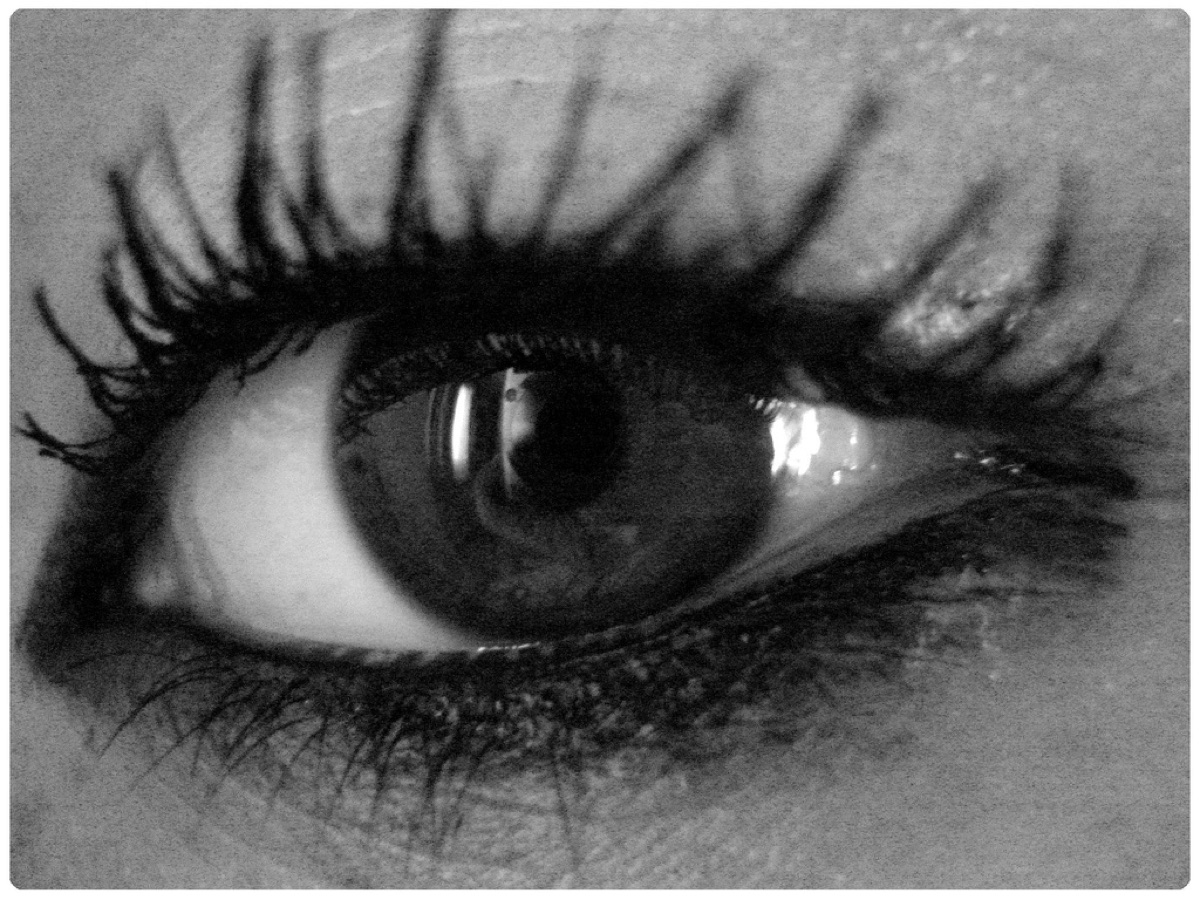
Question 4: what does your lid do? The mirror check
The lid is where landmark scans stop being useful. MediaPipe places points along the edge of the lid, where it meets the eye, not along the crease or fold above it, so it cannot tell a hooded lid from an open one. Do this check instead, in a mirror at eye level, in daylight, with your face relaxed:
- Look straight ahead without raising your eyebrows. If the skin under your brow folds down and hides most or all of the movable lid, your eyes are hooded. No7 defines it the same way: looking forwards, only a small amount of eyelid, or none, is visible.
- Look for a crease. If there is a slight crease close to the lash line or no crease at all, Clinique calls that a single lid (often called a monolid).
- Look at depth. If the eye sits set back under the brow and the crease stays clearly visible, the eye is usually called deep-set; Clinique's definition rests on that visible crease. A side view in a second mirror shows the depth best.
- Lift the outer brow gently with a fingertip. If the outer corner of the eye itself is unchanged but the eye suddenly looks less downturned, a hood was making it look lower than it is.
Putting your answers together
Your eye shape is the combination. “Upturned, slightly wide-set, almond, no hood” is a complete description, and it tells you more than a single label would. Most named shapes in quizzes are really one dominant feature: “hooded eyes” means the lid is the most noticeable thing, “downturned eyes” means the corners are, and so on.
Two combinations confuse people often enough to call out. Downturned plus hooded is common, and the hood can make a neutral eye look downturned; your scan's tilt number will tell you whether the corners actually slope. And close-set plus round can look very different from close-set plus almond, because a taller opening fills more of the space between the eyes. Neither combination needs fixing, but the makeup choices differ.
| Your scan shows | Eye-shape word | In your style plan? |
|---|---|---|
| Canthal tilt above +2° | Upturned | Yes: liner and brow rules for upturned eyes |
| Canthal tilt below −2° | Downturned | Yes: liner and brow rules for downturned eyes |
| Canthal tilt −2° to +2° | Neutral | No special rules; the corners are level within the error |
| Eye spacing below 1.0 | Close-set (one-eye rule) | Shown as a number; the close-set tips are listed below |
| Eye spacing above 1.0 | Wide-set (one-eye rule) | Shown as a number; the wide-set tips are listed below |
| Eye openness | Rounder or more almond | Shown as a number only; confirm with the iris test |
Makeup by eye shape, from the sources we trust
Every tip below comes from at least two independent professional sources in our rulebook (makeup brands' artist education, named makeup artists, established beauty press). These are conventions, not rules, and they are about emphasis, not correction.
- Upturned: tightline the upper lashes and follow the eye's own upward curve with a small wing; keep liner thin at the inner corner (Makeup.com by L'Oréal, quoting Sara Wren and Shreni Patel).
- Downturned: keep upper liner thin at the inner corner, thicken it over the outer third and flick it slightly up and out; start the wing above the natural lash line with your eyes open (Charlotte Tilbury; Makeup.com by L'Oréal, quoting Rommy Najor).
- Downturned: define just the outer third of the lower lash line with a deeper liner rather than the whole line (Clinique for downturned eyes; Mally Roncal, via Parade, lines the same outer third on hooded eyes).
- Close-set: start liner a little away from the inner corner and make it heavier on the outer half; put a light shade on the inner corner and the darker one outside (L'Oréal Paris, Gillian Fuller; Clinique).
- Wide-set: concentrate darker shadow and liner on the inner half of the eye, and fill the front of the brows slightly closer to the centre (Clinique; L'Oréal Paris; jane iredale).
- Hooded: work with your eyes open and looking straight ahead, and take colour above the fold so it shows (No7; Into The Gloss, quoting Katie Jane Hughes; Mally Roncal via Parade).
How accurate is a photo eye-shape test?
Better than a quiz for the measured parts, and blind to the rest. Google's model card for the face landmarker reports an average error of 2.06% to 3.85% of the distance between the eyes, roughly 1.3 to 2.4 mm on an adult face. On a 30 mm eye, that is enough to move the tilt by about 2° and the spacing ratio by a few hundredths. FaceCheckup measures your photo and three slightly re-framed copies and shows the spread as a ± range, so you can see how firm each number is.
Camera distance matters as well. Close selfies enlarge the middle of the face; Ward and colleagues (2018) modelled a nose about 30% wider relative to face width at 12 inches than at 5 feet. The inner eye corners sit close to that centre, so prop the phone 1 to 1.5 m away. And take your glasses off: frames hide the corners, which is the reason US passport photos dropped glasses in 2016.
If your result surprises you
Run it again on a different photo before believing it. The most common surprise is a downturned reading on someone who has always thought of their eyes as upturned, and the cause is nearly always a raised chin or a camera held low. The second most common is “neutral” for someone with hooded eyes, which usually means the corners are level and the hood is doing the work.
Eye shape also changes over the years, mostly in the lid. EyeWiki, the American Academy of Ophthalmology's reference, describes loose upper-lid skin as a common sign of ageing that produces classic hooding. If a lid ever starts to droop over your pupil or get in the way of your vision, that is a question for an eye doctor, not a face scan. This site doesn't give medical advice.
For the brow side of the picture, the eyebrow shapes guide explains how brow height and tail position change the look of the eye, and the facial symmetry test shows how much your two eyes differ.
Questions people ask
- What is the most common eye shape?
- No study we found counts eye shapes in the population. For tilt, every published group average is upturned (positive). For spacing, the answer flips by population: most measured Saudi adults would count as close-set by the one-eye rule, and every measured southern Chinese adult as wide-set.
- Can I have more than one eye shape?
- Yes, and almost everyone does. Tilt, spacing, openness and the lid are separate features, so “downturned and hooded” or “upturned, almond and wide-set” are normal descriptions.
- Why does an eye shape app say hooded when I'm not?
- Landmark-based apps can't see the lid fold, so any hooded label from a photo is a guess, often triggered by low eye openness. Use the mirror check: look straight ahead with a relaxed brow and see whether the movable lid is visible.
- Do my eyes have to match?
- No. Left and right eyes differ slightly in almost every face. FaceCheckup shows the tilt difference between your eyes separately, and a gap of a degree or two is within the landmark error.
Sources & further reading
- Clinique Skin School: Makeup for every eye shape (definitions of upturned, downturned, round, hooded, deep-set, close-set, wide-set and single-lid eyes)
- Carolyn Kuang-chen Stanley, PureWow (2019): A definitive guide to makeup for almond-shaped eyes
- No7 Beauty: Expert makeup tips for hooded eyes
- Al-Sebaei MO (2015), Head & Face Medicine: The validity of three neo-classical facial canons (includes Farkas prevalence data)
- Jayaratne YSN et al. (2012), PLoS One: neoclassical canons in southern Chinese adults
- Virdi SS, Wertheim D, Naini FB (2019), Maxillofacial Plastic and Reconstructive Surgery (Tables 2–3 reproduce Farkas norms)
- Packiriswamy V, Kumar P, Rao M (2012), N Am J Med Sci: palpebral fissure inclination and eye distances
- Google: Model Card, MediaPipe Face Mesh V2 (landmark accuracy)
- Ward B et al. (2018), JAMA Facial Plastic Surgery: Nasal distortion in short-distance photographs: the selfie effect
- Safia Samee Ali, NBC News (2016): New passport rule: glasses off before you strike a pose
- EyeWiki (American Academy of Ophthalmology): Dermatochalasis, reviewed July 2026
- Jordan Julian (quoting Sara Wren and Shreni Patel), Makeup.com by L'Oréal: Pro makeup tips for upturned eyes
- Jessica Harrington (quoting Rommy Najor), Makeup.com by L'Oréal: Eyeliner for downturned eyes
- Charlotte Tilbury: How to apply eyeliner for downturned eyes
- Gillian Fuller, L'Oréal Paris Beauty Magazine: Makeup tutorial for close-set eyes
- Lauren Paige Richeson, L'Oréal Paris Beauty Magazine: Makeup tutorial for wide-set eyes
- Chelsea Simmons, jane iredale: How to shape and define your eyebrows like a pro
- Ali Oshinsky, Into The Gloss: Katie Jane Hughes' hooded-eye tips
- Sheila Baylis, Parade via AOL (2025): The best makeup trick for hooded eyelids, according to Mally Roncal
- Camila Zanon, Wikimedia Commons: Eye make-up (mascara) (CC BY 2.0)
Read next
- Positive canthal tilt
Positive canthal tilt means your outer eye corners sit higher than the inner ones. Check yours free, no sign-up, and see how common it really is.
- Canthal tilt
Canthal tilt is the angle from your inner to outer eye corner. Measure each eye free, no sign-up, with head-roll correction and published averages.
- Eyebrow shapes
Eyebrow shapes explained: soft arch, high arch, straight, rounded and S-curve, matched to your face in a free scan with no sign-up and a three-point map.
- Negative canthal tilt
Negative canthal tilt means the outer eye corner sits lower than the inner one. Check if yours is real or just the photo, and see makeup and brow options.
Part of Canthal tilt. Take the full free attractiveness test on the FaceCheckup home page.

Sukie · Founder and editor
Sukie built FaceCheckup because she always wanted a face tool that explains its numbers and tells you what to do with them, and nothing on the market did both. She checks every measurement on the site against published research and labels every tip for what it is: research, or stylist convention.
About this site · How pages are checked · Last updated October 26, 2026
FaceCheckup is for information and entertainment. It measures proportions in one photo; it is not a medical, psychological or cosmetic-surgery assessment, and it cannot tell you your worth.